


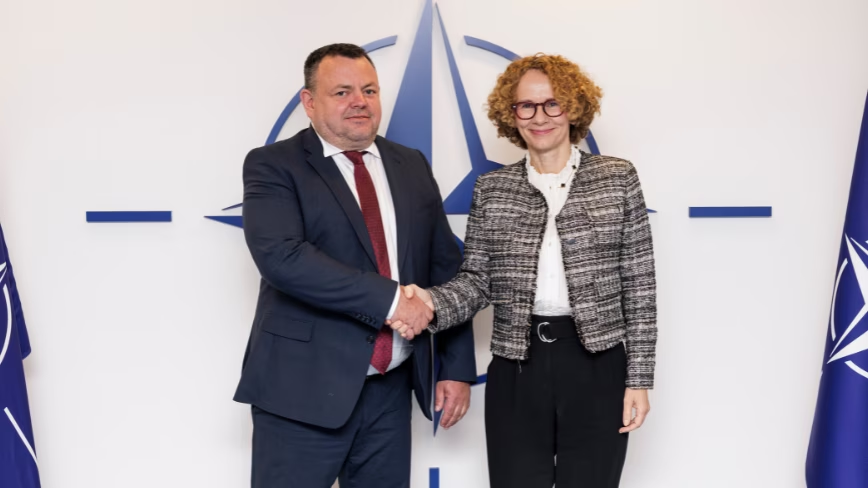
NATO has formalized strategic cybersecurity collaborations with technology firms Microsoft, Palo Alto Networks, and ESET. These partnerships, characterized as non-commercial agreements, aim to bolster collective cyber defense and resilience among member states. The announcement was made on May 27 during the International Conference on Cyber Conflict (CyCon) held in Tallinn, Estonia, an event hosted annually by NATO’s Cooperative Cyber Defence Centre of Excellence.
As organizations integrate generative AI into everyday workflows, security teams face unprecedented threats that traditional systems can't detect. From AI-driven process automation to code creation and document review, these AI tools are becoming essential operational platforms. This evolution brings new security concerns that demand more advanced monitoring solutions.
Talkdesk has developed proactive AI agents aimed specifically at retail and financial sectors. These agents enable the company to shift from just handling inbound customer inquiries to autonomously initiating outbound contact. Integrated in Talkdesk's Customer Experience Automation (CXA) platform, the agents can be set up, tested, and deployed through predefined multi-agent workflows.
Cognition AI has successfully raised more than $1 billion in funding, bringing its valuation to $26 billion—more than doubling its worth since the previous $10.2 billion valuation in September. This financing round was led by Lux Capital, General Catalyst, and 8VC, with significant contributions from Ribbit Capital, Atreides Management, and Founders Fund, backed by Peter Thiel. The company highlights that 90% of its own software code is produced by its AI, showcasing its innovative approach to technology development.

A recent report by Alexandre Dewez of venture firm 20VC highlights a shift in the French tech ecosystem, where growth is increasingly reliant on a small group of AI companies. Meanwhile, the broader startup community is struggling, with French startups securing €6.7 billion across 411 funding rounds in 2025—a 5% drop from previous levels.

Quantinuum, the quantum computing firm majority-owned by Honeywell, has set its initial public offering (IPO) valuation target at $12.7 billion. This figure is significantly lower than the previously rumored valuation of over $20 billion that was mentioned when the company filed its S-1 document in early May. The adjusted valuation suggests a roughly 27% increase over the company's prior $10 billion pre-money valuation.

Felipe Sinisterra and Dave Wang, former investment bankers, are in high demand, booked solid for two months teaching financial institutions how to effectively utilize their existing AI tools. Their expertise commands up to $25,000 a day as they help senior staff get the most out of their AI investments.

The European Commission is set to announce a proposal to allocate two-thirds of the EU's 2 GHz mobile-satellite spectrum exclusively for European operators. This move restricts Starlink, Amazon’s Project Kuiper, and other non-European firms to competing for only the remaining one-third of the spectrum. The proposal aims to prioritize European companies in the future mobile-satellite services market.

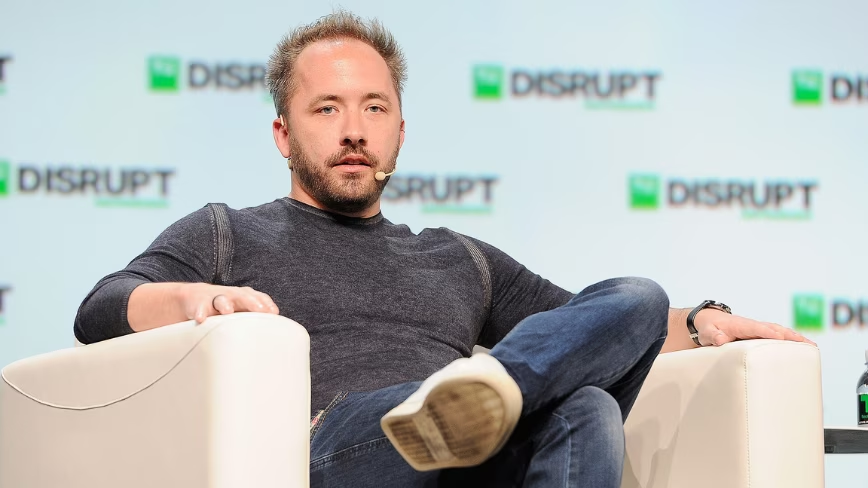
Drew Houston, who co-founded Dropbox and grew it from a small Y Combinator project to a platform with over 700 million users, is stepping down as CEO. Ashraf Alkarmi, currently Dropbox’s head of product, will assume the role of co-CEO immediately. Houston will transition to executive chairman, with Alkarmi taking the lead after a handover period.
The Dutch government has fully prohibited Kyndryl, a US-based IT infrastructure company spun out of IBM in 2021, from acquiring Solvinity, a prominent Dutch cloud provider. The acquisition, valued at around €100 million, would have transferred control of the platform operating DigiD, the Netherlands’ national digital identity system, to a company headquartered in the United States. This move underscores the government's priority to maintain domestic oversight over critical digital infrastructure.
