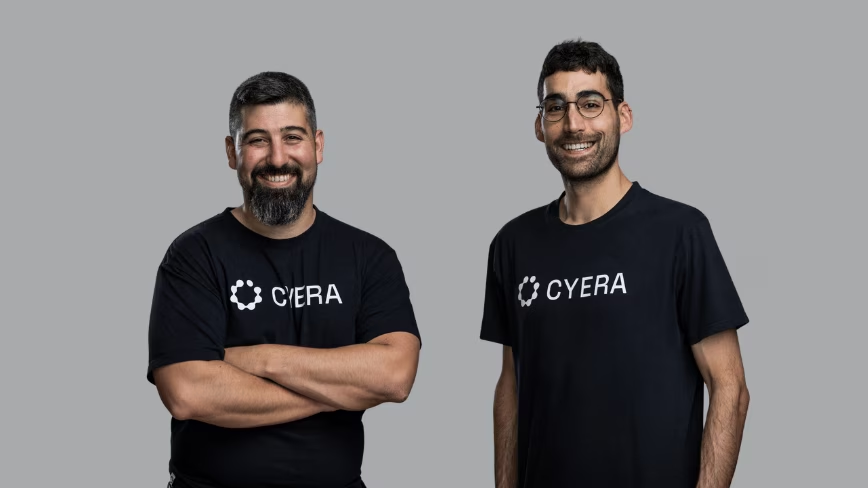
Cyera's CEO, Yotam Segev, highlighted the company's focus on building trust in AI agents' capabilities as a crucial step before scaling their use. On Tuesday, Cyera announced a $400 million investment from Growth Equity at Goldman Sachs Alternatives, part of their Series G funding round. This recent infusion brings Cyera's total funding to $1.4 billion over the year, reinforcing their commitment to improving AI security and monitoring for enterprise clients, particularly among the Global 2000 companies.
Amazon took decisive action against AI shopping agents on Monday by blocking Muse, Meta's new AI assistant, from accessing Amazon.com. Additionally, Amazon filed an amended legal complaint against Perplexity, alleging the company misled a federal appeals court. The block on Muse was implemented first, and users trying to use Muse for shopping on Amazon started encountering pop-ups over the weekend.

American advertisers today face an unprecedented media environment filled with more channels, extensive data, and advanced technology. The primary challenge for marketers has shifted away from merely finding new advertising spaces to deeply understanding how each advertising investment impacts the overall business performance. This nuanced approach is essential in today's dynamic market, as highlighted by insights from Rob DeSalvo.

Harvey experienced a dramatic swing in its gross margin, dropping from around 50% at the beginning of the year to negative 50% by June due to a surge in customer use of its AI agents. The margin only rebounded after Harvey launched its own AI model built on Moonshot’s Kimi K3. Other startups like Abridge, Decagon, Ramp, and Rogo are adopting similar strategies, while investors such as Sequoia are closely watching these developments.

OpenAI has urged the United States to take a lead role in establishing international standards for advanced artificial intelligence. The focus would start with defining mandatory incident reporting rules and could be coordinated through national AI safety organizations, such as the US Center for AI Standards and Innovation. This effort aims to create a unified approach to AI safety and governance on a global scale.
A survey by the OECD covering 6,047 companies across six countries revealed a striking disparity in the use of software to discipline employees. In the US, 67% of firms implement software-based sanctions for underperformance, compared to just 4% in multiple European countries. Additionally, 55% of American companies monitor the tone and content of workplace conversations, whereas only 6% of European firms do so. This significant gap is attributed primarily to differences in regulatory frameworks between the US and Europe.

Anthropic has appointed Accenture as the first embedded evaluator of its advanced AI models, with both companies committing to invest around $1 billion over the next five years. Although Anthropic is currently financing the evaluations directly, it emphasizes in its announcement that such funding ideally should come from pooled resources or government entities—structures that are not yet in place. Accenture is already working closely with Anthropic to assess these frontier AI technologies.

According to a July presentation linked to a computing partnership, The Financial Times revealed that OpenAI anticipates a negative free cash flow of $278 billion from 2026 to 2030. This forecast marks an improvement compared to an earlier projection of about $305 billion made in May. However, the expected spending on compute and infrastructure has increased significantly to roughly $856 billion from initial estimates of $600 billion shared with investors in February.

Nik Storonsky, the founder of Revolut, shared with Les Echos that the company is planning to list on both the London Stock Exchange and Nasdaq. Speaking during his visit to Paris, this marks the first time Storonsky has openly confirmed the strategy of a dual listing. The interview was conducted by Gabriel Nédélec and Ingrid Feuerstein and published in the French newspaper. This move reflects Revolut's ambition to expand its presence across major financial markets.

A federal court has ruled against a group of anonymous programmers who accused GitHub, Microsoft, and OpenAI of copyright infringement related to the AI coding tools Copilot and Codex. Judge Eric Miller, writing for the unanimous Ninth Circuit panel, dismissed the attempt to categorize the lawsuit as a DMCA claim, keeping it within the bounds of standard copyright infringement. The case, Doe v GitHub (24-7700), highlights ongoing legal challenges surrounding AI-generated code and the open-source community's concerns.