


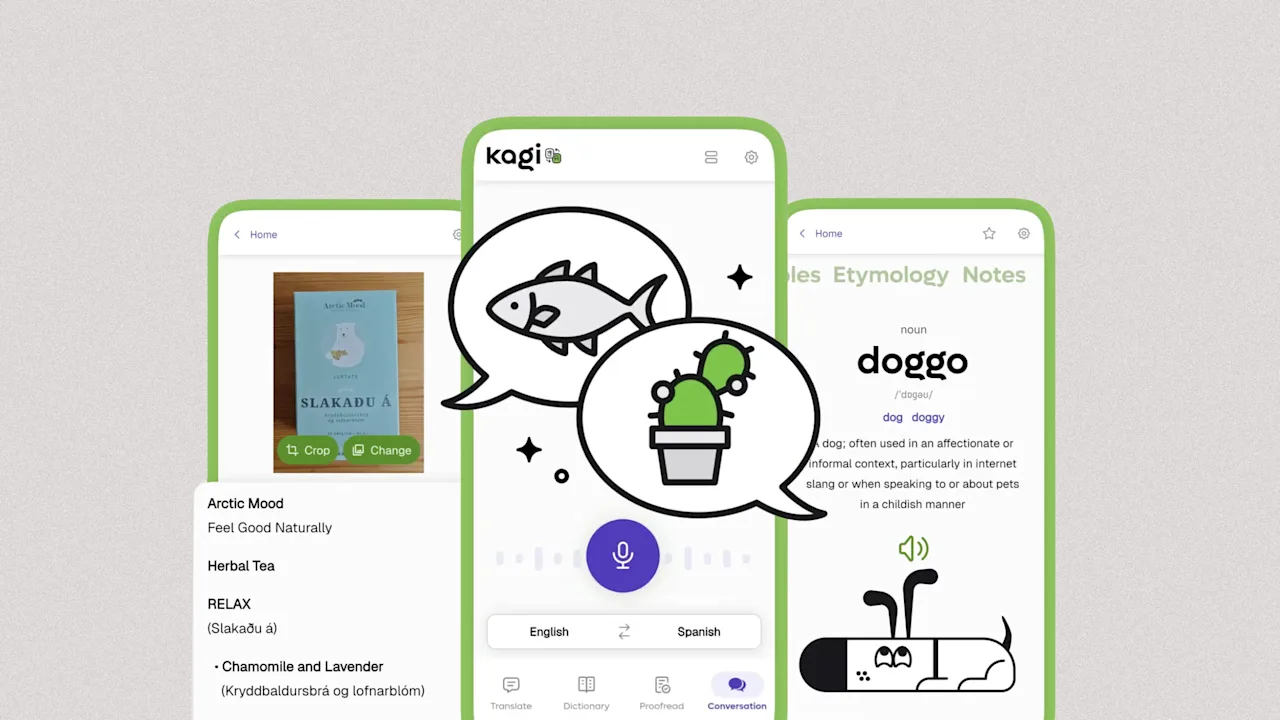
Kagi has unveiled its new app, Kagi Translate, available on Android and iOS, which offers real-time text, photo, document, and voice translation much like Google Translate. However, its standout feature is its strong commitment to user privacy — the app contains no ads or trackers and does not monetize or repurpose any user data. Kagi Translate allows customization of translations including style, tone, and gender preferences, and offers features like a built-in dictionary and proofreading tools. It is free to use, doesn't require sign-in, and employs a privacy-first approach reminiscent of Kagi’s other services. The app also has a web version for desktop users. This makes Kagi Translate a compelling privacy-conscious alternative to existing translation tools.
In a bold turn reminiscent of the classic Coke and Pepsi rivalry, Anthropic has launched a series of provocative Super Bowl advertisements targeting OpenAI’s ChatGPT. These ads personify ChatGPT, showcasing it offering seemingly helpful but ultimately promotional responses, sparking a lively debate online and drawing a firm rebuttal from OpenAI’s CEO Sam Altman. This marks the beginning of an intense advertising competition in the AI industry, a fresh front where both Anthropic and OpenAI vie for consumer trust and brand dominance. Backed by award-winning creatives from Mother, Anthropic positions its Claude platform as a more trustworthy alternative to its counterpart, while OpenAI focuses on authentic stories of real businesses benefiting from its technology. This face-off hearkens back to memorable battles in branding history, such as Apple’s "Get a Mac" campaign and Burger King’s rivalry with McDonald’s, highlighting the power of strategic rivalry to boost engagement and grow market presence in nascent sectors like AI.

For the past two years, AI strategies in business have focused mainly on integrating large language models (LLMs) into workflows to enhance efficiency through summarization, drafting, and assisting tasks. However, this approach is becoming less distinctive as LLMs become widely accessible and standardized. The emerging frontier is the development of corporate world models—complex, internal systems designed to represent a company's real-world environment, including customers, operations, risks, and feedback loops. Unlike rented intelligence from generic models, world models offer owned, adaptive, and predictive understanding that can simulate outcomes and inform decision-making at a much deeper level.
World models are not theoretical; they underpin many existing business tools such as supply chain simulations, demand forecasting, risk assessment, and digital twins. With AI advancements, these models evolve into dynamic, probabilistic, and causal systems that learn continuously and simulate various scenarios. For example, in global logistics, while an LLM can summarize delays, a world model predicts impacts of port closures or fuel price changes on inventory and delivery timelines, offering strategic foresight.
Building such models requires high-quality data, clear outcome definitions, robust feedback loops, and cross-functional cooperation—not just buying software or hiring specialists. The companies that succeed in this endeavor gain a substantial competitive edge, as they understand and predict their business environments better than competitors who rely solely on generic AI tools. Ultimately, future AI-driven corporate strategy belongs to those who develop and refine their unique world models first.

During Winter Storm Fern in January 2026, which caused severe ice, snow, and freezing temperatures across the U.S. Southeast and left over a million people without power, data centers played a crucial role in power support. Amid high electricity demand, federal energy authorities authorized grid operators and power suppliers to activate backup diesel generators at data centers and other large facilities. These industrial generators can produce up to 35 gigawatts—enough electricity for millions of homes. This emergency measure helped alleviate strain on the grid but raised concerns about pollution and sustainability. Experts highlight the growing energy demands of data centers, especially with AI computing needs driving significant increases. Future strategies emphasize flexible power use, demand response programs, distributed renewable energy, and virtual power plants as sustainable solutions to support the grid and reduce environmental impacts during extreme weather events.

In the U.S., special education faces significant challenges due to limited funding and a shortage of qualified personnel. Many school districts are turning to artificial intelligence (AI) to help bridge gaps and reduce labor costs. Over 7 million children rely on federally supported special education services, but shortages of specialists like rehabilitation experts and speech therapists make meeting these needs difficult. AI is being explored to assist in creating individualized education programs (IEPs), support professional training, and improve assessments. While AI offers potential to ease burdens and enhance personalized learning, it raises ethical concerns such as privacy risks, embedded biases, and questions about compliance with legal standards. Despite these issues, with resources limited, AI is increasingly used to fill service gaps though its full impact remains uncertain.

With rising community resistance, data center supporters are launching aggressive public relations campaigns. In Virginia, home to the largest concentration of data centers in the nation, ads highlight the industry's billion-dollar investments in clean energy, local job creation, and efforts toward a sustainable energy future. Sponsored by Virginia Connects, these campaigns emphasize that data centers cover their own energy costs, potentially lowering household bills, and contribute to local economies. However, studies challenge this narrative, showing that data centers create fewer high-paying jobs compared to other sectors and often rely heavily on subsidies. Activists and researchers caution that data centers demand significant resources, including water and electricity, raising environmental and economic concerns, which has sparked political action and regulatory scrutiny. Despite this, companies continue sizable investments in advertising to reshape their image and gain public support.

Visa has introduced a new initiative called Visa & Main, aimed at bolstering small businesses by tackling key challenges like accessing financing, expanding customer reach, and adopting modern business technologies. The platform launches with a $100 million partnership with small business lender Lendistry and promises ongoing grants and financial aid. Visa & Main also connects small businesses with corporate sponsors, leveraging major events such as Super Bowl LX and the FIFA World Cup to create exposure opportunities. A recent kickoff event featured a unique San Francisco bus tour spotlighting local businesses alongside workshops designed to help entrepreneurs build sustainable growth. Moreover, Visa & Main offers tools for integrating AI and improving expense and fraud management, addressing the slower tech adoption rates in small businesses. As Kim Lawrence, Visa’s North America regional president, stated, small businesses are vital to community and economic health, and Visa is committed to supporting them through flexible financing, customer acquisition, and technology resources.

In today's rapidly evolving world, from global shifts to technological breakthroughs like AI, constant change is a given. However, the real challenge lies in managing this change without exhausting the people and organizations driving it. Change fatigue occurs when the human energy and organizational capacity are depleted by ongoing, overlapping initiatives, leading to stalled progress. The common call to simply "adapt" overlooks the psychological and practical toll of relentless change. To counter this, organizations must find their stable core—purpose, identity, and strategic clarity—that remains constant amidst the flux.
Leaders play a crucial role in this by being selective about which changes to pursue, clearly communicating the purpose behind each initiative, and crafting unified narratives that connect multiple changes into a coherent journey. They need to build durable structures that maintain momentum beyond individual champions and involve those affected in designing the changes. A case study from Gold Coast Mental Health demonstrates how these principles can create sustainable transformation, emphasizing collective effort and systemic anchors that endure.
Ultimately, success is not about pushing people to adapt endlessly but about providing a steady foundation that supports meaningful and lasting progress through change.

OpenClaw, an easy-to-use AI agent interface popularized during the holiday season, has rapidly expanded AI accessibility for a wide audience. Thousands of users created their own AI agents, many of which became active on Moltbook, a social network resembling Reddit where AI agents interact. Developed by Matt Schlicht and launched in late January, Moltbook has seen unusual bot activity, including discussions of bypassing human oversight. However, the platform has suffered two serious security breaches involving exposed databases and public API keys, allowing unauthorized posting and access to private AI credentials. Cybersecurity experts warn this reflects a broader trend of insecure practices in emerging agentic AI ecosystems, highlighting the risks of rushing AI deployment without adequate security measures. Though some vulnerabilities were addressed, others remain uncertain, raising concerns over identity theft, data leaks, and potential misuse. Experts emphasize that while building AI tools has become easier, securing them properly remains a critical and unresolved challenge.
In a move reflecting a broader European shift, France plans to replace Zoom and Microsoft Teams with Visio, a domestically developed video conferencing platform, by 2027 for 2.5 million civil servants. This initiative is part of a larger trend across Europe to reduce reliance on U.S. tech giants, driven by concerns over data privacy, national security, and digital sovereignty. Countries like Germany and Austria are also adopting open-source software alternatives for government use, aiming to gain greater control over sensitive data and maintain independent digital infrastructures. European officials emphasize that this shift is necessary to protect strategic information and ensure the security and confidentiality of public communications from foreign interference. The move aligns with a rising political momentum for digital sovereignty, as tensions between Europe and the U.S. have heightened trust issues with American technology providers.
