


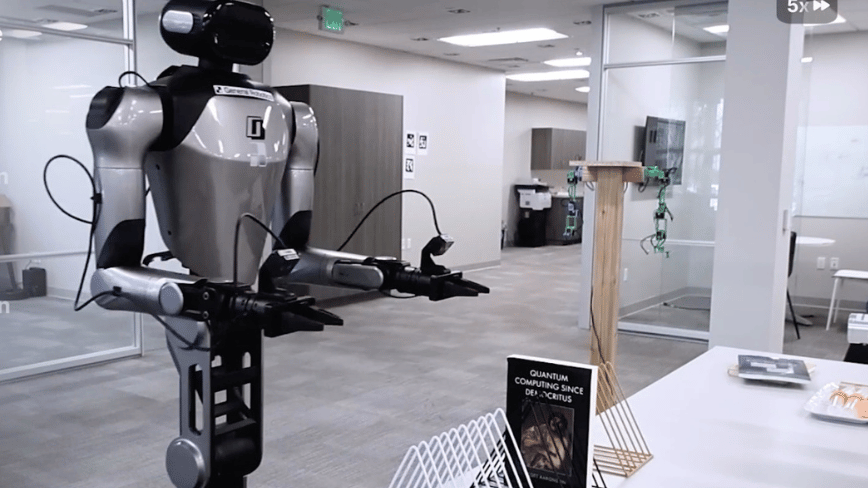
Accenture Ventures has made a strategic investment in General Robotics, whose GRID platform offers a unified AI layer that works across more than 40 robots from diverse manufacturers such as FANUC, Flexiv, and Ghost Robotics. This move extends Accenture’s physical AI approach, complementing its NVIDIA-powered Physical AI Orchestrator and previous partnerships with Sanctuary AI and Schaeffler in humanoid robotics.
Athena Technology Solutions, headquartered in Fremont with a team of about 120 employees, has introduced FabOrchestrator, a cutting-edge AI platform designed to streamline manufacturing operations. This new system automates numerous processes such as reporting, support ticket management, system modeling, and code generation specifically for semiconductor and electronics manufacturing facilities. Developed in collaboration with Bangalore's LLM at Scale.AI, FabOrchestrator integrates advanced LLM technologies atop the Siemens Opcenter framework to enhance manufacturing efficiency and precision.

Accel has successfully raised $5 billion through its $4 billion Leaders Fund V and a $650 million sidecar fund. This capital injection is aimed at making 20 to 25 late-stage AI investments, each with an average commitment of $200 million. The fundraise is driven by impressive returns from prior investments like Anthropic, which grew from a $183 billion valuation to nearly $800 billion, and Cursor. This move highlights the expanding scale of venture capital targeting AI infrastructure and innovation.


Venture capitalists are eager to invest further in Anthropic at valuations on par with or exceeding those of OpenAI, but the company is currently holding off on accepting these offers.

Objection, a startup backed by Peter Thiel, plans to use AI to assess journalism by allowing users to pay to contest news stories. While innovative, this approach has raised concerns among critics who fear it might discourage whistleblowers and alter the landscape of media accountability.

OpenAI has upgraded its Agents SDK, providing enterprises with improved tools to build safer and more capable AI agents. This update comes as interest in agentic AI continues to rise, supporting organizations in deploying advanced, reliable AI solutions with enhanced safety features.


By Louis Blankemeier
In October 2024, my co-founders and I embarked on a mission to translate our Ph.D. research into tangible healthcare solutions. We developed AI models capable of interpreting medical images such as X-rays and CT scans across thousands of potential diagnoses, creating comprehensive radiology reports that mirror radiologists’ clinical reasoning. This represented a major leap at a time when AI in radiology only flagged a few specific conditions.
Less than a year later, we faced a critical decision: continue raising venture capital and advance independently or accept an acquisition from Radiology Partners, the largest radiology practice worldwide. Contrary to the tech norm emphasizing independence, we chose collaboration to significantly boost our chances of transforming healthcare access.
Clinical AI faces complex regulatory hurdles, long sales cycles, and challenging market dynamics that favor well-established players. Joining forces with a major industry player offered resources, extensive data, and clinical integration required to develop reliable, scalable models. Research-scale successes do not guarantee clinical readiness; real-world radiology demands massive, diverse datasets and continuous performance monitoring to handle complex, high-stakes cases.
Moreover, sustainable success in healthcare AI hinges on rigorous evidence from large-scale implementation across diverse populations and environments, not small pilots. Partnering with Radiology Partners provided the infrastructure and credibility essential for trust and adoption, accelerating our mission to expand access to high-quality healthcare worldwide.
Louis Blankemeier is CEO and co-founder of Cognita, part of Radiology Partners. His work bridges AI research and clinical application, driven to improve healthcare accessibility through technology.


Florence Nightingale is often remembered as a compassionate nurse, yet her pioneering work transformed healthcare through innovation. Her strategies—powerful data communication, clear public guidance, and formalized training—reshaped nursing and hospital sanitation practices, leaving lessons relevant for today’s leaders.
Born in 1812 in Italy, Nightingale defied societal norms to pursue nursing. During the Crimean War, she and her team improved hospital conditions amidst dire circumstances, using data-driven visuals, like her famous 1858 polar area chart, to advocate for sanitation reforms. She also authored Notes on Nursing, providing accessible, practical advice for caregivers, and led the establishment of the first formal nursing school, professionalizing training and broadening healthcare access.
Nightingale’s impact extended beyond immediate reforms; her work influenced public health policies that increased life expectancy in the UK by nearly 40% over five decades. Her legacy underscores the power of doing things differently, using simple tools effectively, and nurturing disruptive innovation through curiosity, collaboration, and persistence.


The path from a lab hypothesis to a commercial medicine is long and costly, often taking 10 to 15 years and massive investment. This journey is complicated by fragmented workflows that force scientists to juggle multiple databases, software, and experimental setups manually. OpenAI's new AI model, GPT-Rosalind, aims to revolutionize this process by serving as a specialized assistant for life sciences research. Named after Rosalind Franklin, a trailblazing chemist in DNA discovery, GPT-Rosalind is designed to accelerate hypothesis synthesis, experiment planning, and data integration, optimized for genomics, protein engineering, and chemistry.
Unlike previous general-purpose AI, GPT-Rosalind offers deep domain expertise, demonstrated by its top-tier performance on bioinformatics and molecular cloning tasks. Its sequence-to-function prediction skills even ranked in the 95th percentile among human experts. To streamline research, OpenAI also released a Life Sciences research plugin for Codex on GitHub, connecting researchers to over 50 multi-omics databases, enabling automated, complex workflows in biochemistry and genetics with greater efficiency.
Access to GPT-Rosalind is limited to qualified US enterprise customers under strict governance and security controls, ensuring the technology is used responsibly for public benefit. Early industry feedback from leaders at Amgen, NVIDIA, Moderna, and the Allen Institute highlights the model's potential to compress research timelines and enhance reproducibility. Building on successes like a 40% cost reduction in protein production via AI collaboration, OpenAI envisions GPT-Rosalind as a key partner advancing biological and chemical discovery.

Salesforce has introduced Headless 360, a groundbreaking transformation that converts its entire platform into API-driven infrastructure accessible by AI agents without a traditional interface. This initiative, announced at its TDX developer conference, includes over 100 new tools enabling developers to build, deploy, and manage Salesforce applications via AI coding agents using any coding environment. Headless 360 focuses on three pillars: flexible development with extensive MCP tools and SDK support, deployment across diverse user interfaces including Slack and mobile apps, and robust lifecycle management tools for scalable agent operations. This restructuring signals Salesforce's pivot from conventional CRM interfaces to agent-centric automation, emphasizing openness by integrating multiple major AI models and tools. By abandoning per-seat licensing in favor of consumption-based pricing for Agentforce, Salesforce aligns its business model with AI-driven workflows. The company is betting that its deep enterprise data and workflows will sustain its relevance as AI agents increasingly automate workflow and system construction.
