


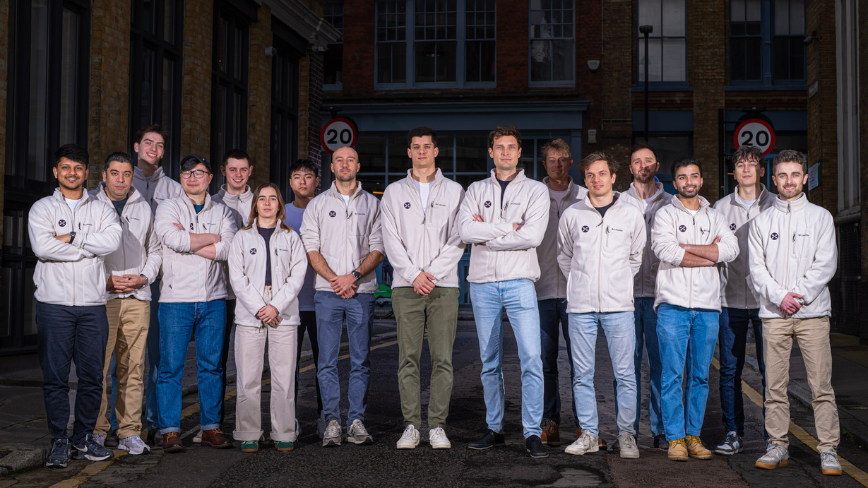
Helical, a pharmaceutical AI startup founded by three childhood friends from Luxembourg and based in London, has successfully raised $10 million in a seed funding round. The company is actively collaborating with several top-20 global pharmaceutical firms, including a public partnership with Pfizer. The funding round was led by redalpine, with notable angel investors including the CEOs of Cohere and HuggingFace. Helical aims to transform bio foundation models into practical systems for the pharma industry.
Hexagon, a leading measurement and sensor technology group based in Stockholm, is set to acquire Waygate Technologies from Baker Hughes for $1.45 billion. Waygate, generating around $630 million annually and employing about 1,500 people across 25 sites, offers cutting-edge computed tomography, radiography, and remote visual inspection technologies. This acquisition strengthens Hexagon’s Manufacturing Intelligence division, combining over 130 years of experience in the field.

Bremen-based startup Synera has raised $40 million in Series B funding, led by Revaia with Capgemini participating via its ISAI Cap Venture fund. The agentic AI platform enhances industrial engineering by deploying autonomous AI agent teams that perform complex engineering tasks across over 75 tools without replacing existing systems. This innovative approach is currently used by industry leaders including NASA, BMW, Airbus, and Hyundai. All previous Series A investors also returned for this round, signaling strong confidence in Synera’s technology and growth potential.
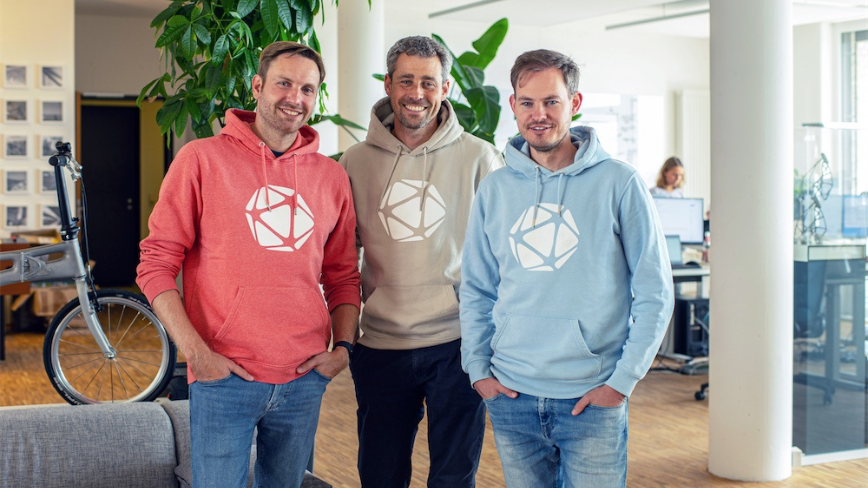

Pillar aims to provide advanced, institutional-level financial tools tailored for small and medium-sized enterprises. The company envisions making hedging as commonplace and accessible as everyday payments or accounting software, according to their leadership.
Fluidstack, an AI-focused datacenter startup, is reportedly in discussions for a $1 billion funding round at a valuation of $18 billion. This comes just months after reaching a $7.5 billion valuation. The company has recently secured a $50 billion contract to develop data centers for Anthropic, fueling investor interest and fundraising efforts.


European venture capital funding hit $17.6 billion in Q1 2026, marking a nearly 30% increase year over year and the second consecutive quarter of growth, according to Crunchbase data. The surge was predominantly fueled by AI companies, which for the first time accounted for over half of all venture funding in Europe that quarter. Despite this growth in capital, the number of deals fell sharply by 40%, with notable decreases in seed and early-stage funding rounds. The UK and France saw year-over-year funding growth, raising $7.4 billion and $2.9 billion respectively, while Germany's funding remained flat. Late-stage funding nearly doubled compared to the previous year, highlighting investor confidence in more mature startups across diverse sectors such as AI hardware, fintech, and energy. The largest rounds included billion-dollar investments in AI pioneers like Advanced Machine Intelligence and Nscale, underscoring Europe’s expanding leadership in AI frontier technologies.


The evolution of AI from simple chatbots to comprehensive workforce tools is now a reality, reflected in Anthropic's latest major update. On April 14, 2026, Anthropic released a complete redesign of the Claude Code desktop app for Mac and Windows alongside a research preview of a new feature called "Routines." These changes highlight a fundamental shift in the developer’s role from individual coder to orchestrator of multiple, parallel workflows. Unlike traditional single-threaded copilots, the new Claude Code app lets developers manage several tasks across various repositories simultaneously through a unified 'Mission Control' sidebar.
Routines introduce automation running on Anthropic’s cloud infrastructure, enabling tasks like nightly bug triage to run independently of the user’s device. There are three types of Routines tailored for enterprise needs: Scheduled (time-based tasks), API-driven (triggered by HTTP requests from monitoring tools), and Webhooks (responding to GitHub events). Usage limits depend on the user's subscription tier, with options to purchase additional capacity.
A key advantage of the redesigned desktop app is its high-concurrency visibility, allowing developers to arrange terminal, preview, diff, and chat windows to suit their workflow, enhancing productivity. Features like ‘Side Chat’ provide context without cluttering main conversation history. However, the CLI remains important for fast and lightweight workflows and supports most plugins, though some inconsistencies were noted. The desktop version emphasizes management and review, featuring an integrated file editor and efficient diff viewer, making it ideal for overseeing complex refactors and finalizing code.
While the desktop app offers a cohesive environment optimized for Anthropic’s models, its restriction to this ecosystem may limit users who prefer leveraging multiple AI services. The CLI remains preferable for users needing a flexible, diverse AI stack.
In summary, the Claude Code desktop app and Routines set a new direction for AI in enterprise development, positioning developers more as orchestrators and less as single-task operators. This reflects a broader industry trend towards cloud-based automated work with centralized monitoring and control, potentially redefining how coding and AI-assisted workflows operate in professional settings.

Developing self-improving AI systems is crucial for deploying agents in unpredictable, dynamic environments, especially within enterprise settings where tasks vary greatly. Existing systems rely on static, handcrafted mechanisms, limiting their effectiveness beyond coding tasks. To address these challenges, Meta researchers and university collaborators have developed "hyperagents," a novel AI framework that autonomously rewrites and optimizes its problem-solving methods and underlying code, extending self-improvement to non-coding domains such as robotics and document analysis. Unlike previous approaches, hyperagents integrate the task-solving and meta-level self-improvement functions into a single, self-reflective program that can evolve its own improvement strategies without human intervention. This allows continuous enhancement and accumulation of capabilities, reducing dependency on manual tuning or domain-specific adjustments. In tests, hyperagents matched or outperformed specialized models across coding, paper review, robotics, and even transfer learning to unseen challenges like Olympiad-level math grading. Moreover, they demonstrated autonomous innovations such as creating memory tools, performance tracking, and adaptive planning based on computational budgets. While promising, hyperagents require careful safety controls to prevent unchecked modification and ensure reliability. Researchers advocate for isolating experimental phases within sandboxes and implementing strict validation before deploying changes. This paradigm shift also suggests future AI engineers will transition from hand-crafting improvements to overseeing system robustness and aligning objectives toward meaningful goals.

AI agents are increasingly integrated into enterprise workflows but still fail about one in three attempts on benchmark tests, highlighting a crucial reliability challenge for IT leaders in 2026, according to Stanford HAI's latest report. While frontier models have made significant progress in areas like complex reasoning, cybersecurity, and video generation, basic tasks—even telling time—remain problematic. Hallucinations and difficulties with multi-step reasoning persist despite advances. Additionally, transparency is declining, as leading AI labs conceal key details about their models, and benchmarks are becoming less reliable due to contamination and saturation. The report underscores a widening gap between AI's showcased capabilities and its consistent performance in real-world applications, with responsible AI development lagging behind rapid technological progress.


Duolingo initially included AI usage as part of its employee performance reviews, sparking some pushback from staff who questioned the value of using AI just for its own sake. CEO Luis von Ahn confirmed the company has since stepped back from this approach, emphasizing that job performance will now be judged on overall results rather than AI use alone. While Duolingo embraced an "AI-first" strategy last year, even suggesting less new hiring if roles could be automated, this too met resistance and was reconsidered. Von Ahn noted AI tools have accelerated productivity and enabled many new language courses, but also highlighted limitations, such as AI’s struggles with consistent narrative generation and coding accuracy. Despite these challenges, Von Ahn affirmed that no layoffs have occurred, as employee productivity has grown with AI assistance. Duolingo's recent financial outlook shows steady growth but falls short of some expectations.
