


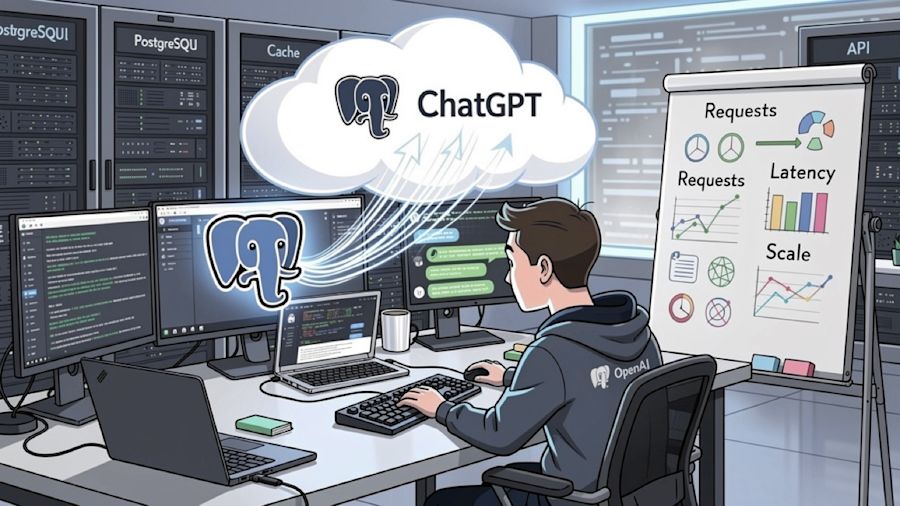
OpenAI has revealed how it manages to serve 800 million users using a single-primary PostgreSQL instance for ChatGPT and its API platform, challenging traditional scaling methods. Instead of sharding or moving to a distributed SQL database, OpenAI relies on one Azure PostgreSQL Flexible Server for writes and nearly 50 read replicas for reads, processing millions of queries per second with minimal latency and high availability. This approach is supported by targeted optimizations such as connection pooling and cache locking to prevent overloads. OpenAI’s strategy emphasizes optimizing existing database technology based on workload patterns rather than premature re-architecture, offering valuable insights for enterprises. They apply strict operational discipline, monitor ORM-generated SQL queries, and separate workloads to maintain performance as the system scales.
LinkedIn, a pioneer in AI recommender systems for over 15 years, recently faced the challenge of upgrading its recommendation technology to better serve future job seekers. The company realized that traditional prompting methods wouldn’t meet their goals for accuracy, speed, and efficiency. Instead, LinkedIn developed a novel approach involving multi-teacher distillation, starting with a massive 7-billion-parameter model fine-tuned using a detailed product policy document. This document, created in collaboration between product managers and engineers, scored thousands of job description and profile pairs to align the model with LinkedIn’s product standards.
The process involved training two specialized teacher models: one focused on product policy adherence and another on click prediction and personalization. These informed the development of a streamlined 1.7 billion parameter student model that balances quality and performance. This approach not only improved recommendation outcomes but also modularized training methods, allowing independent iteration on different model objectives.
Berger, LinkedIn’s VP of product engineering, emphasizes the importance of integrating product expertise with machine learning development, marking a shift in how teams collaborate on AI projects. The multi-teacher distillation technique has become a core methodology at LinkedIn, driving significant improvements in recommendation quality and serving as a blueprint for future AI products. The company also highlights the value of flexible pipelines and traditional engineering debugging to accelerate R&D.
For a more in-depth discussion, listeners can access the full podcast on platforms like YouTube, Spotify, and Apple Podcasts.

Researchers from Shanghai Jiao Tong University and collaborators have introduced MemRL, a novel framework for large language model (LLM) agents that enables learning new skills without costly fine-tuning. MemRL equips agents with episodic memory, allowing them to retrieve and leverage past experiences to tackle previously unseen challenges, continuously refining strategies using environmental feedback. This approach contrasts with traditional fine-tuning, which risks catastrophic forgetting, and non-adaptive retrieval methods like RAG. Instead, MemRL freezes the LLM's parameters and relies on an external, evolving memory organized as "intent-experience-utility" triplets, which include a Q-value score that reflects the success of past experiences. Agents use a two-phase retrieval, first selecting relevant memories semantically, then re-ranking by utility to prioritize effective solutions. Reinforcement learning is integrated, updating memory scores based on outcomes without adding significant computational load. Tested on industry benchmarks, MemRL consistently outperformed RAG and other models, especially in complex environments requiring exploration, highlighting its superior adaptability and generalization. Importantly, MemRL integrates easily into existing tech stacks and offers transparency and reversibility in its learning process. This technology represents a significant step toward self-evolving AI agents that can adjust dynamically in real-world applications without the need for repeated full model retraining.

ServiceNow has announced a strategic multi-year partnership with OpenAI to integrate GPT-5.2 into its AI Control Tower and Xanadu platform. This collaboration highlights ServiceNow’s focus on managing enterprise AI workflows, governance, and orchestration, rather than developing the foundational AI models themselves. For enterprise clients, it signals a shift: while base AI models become commoditized, the platforms orchestrating their use—including deployment, monitoring, and security—are where real value lies. ServiceNow allows enterprises to create AI-driven agents and applications, embed them into workflows, and oversee their operation through a unified management console. The partnership also offers enhanced capabilities such as voice-first AI agents, improved enterprise knowledge access with grounded Q&A, and operational automation including incident summarization and resolution. ServiceNow will continue to support a flexible, multi-model AI environment, enabling customers to choose or integrate various AI models alongside their own specialized large language models for enterprise tasks. This approach underlines a broader trend in enterprise AI adoption—focusing on governance and orchestration to scale AI solutions safely and efficiently.

Elon Musk's social platform X, previously Twitter, has made a significant move by releasing the architecture and some code of its new AI-based social recommendation algorithm under an open-source Apache 2.0 license on GitHub. This revolutionary 'Transformer'-powered algorithm, developed alongside xAI's Grok AI language model, dictates which posts and accounts users see, providing brand managers crucial insights on post visibility and engagement mechanics.
Unlike its 2023 predecessor, the updated system discards outdated heuristics for a swift, AI-mediated evaluation process where post engagement velocity in the first 30 minutes is critical. It penalizes frequent posting to ensure content diversity and discourages low-quality reply spamming. Verified accounts with X Premium status gain a considerable reach advantage, making verification an essential strategic investment. Negative feedback such as reports and blocks heavily curtail content exposure, emphasizing the importance of brand safety and thoughtful engagement.
To maximize impact on X's platform, businesses must coordinate messaging with precision, focus on high-quality interactions, and continuously monitor both the algorithm updates and official communications from X’s leaders. This hybrid approach is vital due to the absence of exact weighting parameters in the open-source data. Adapting to X’s new AI-driven landscape with a keen eye on velocity and content quality offers brands a pathway to sustained visibility and growth.

MIT CSAIL researchers have introduced Recursive Language Models (RLMs), an innovative approach that lets large language models (LLMs) handle extremely long texts by treating prompts as an external environment. Instead of loading entire long prompts into the model’s limited context window, RLMs let the LLM programmatically explore, break down, and recursively analyze smaller text snippets through Python code. This method overcomes traditional context length limits and context degradation, enabling reliable processing of millions of tokens without retraining.
The framework treats lengthy context handling as a systems engineering challenge rather than simply expanding context windows or summarizing prior information. A "root" LLM oversees the process by generating code to extract relevant text chunks, while a "worker" LLM analyzes those snippets. This design allows enterprises to tackle complex, long-horizon tasks such as large-scale code analysis, extensive legal review, and multi-step reasoning that current models struggle with.
Tests on benchmarks involving millions of tokens demonstrated impressive improvements: the RLM approach powered by GPT-5 outperformed other agents significantly, maintaining performance even as input lengths grew beyond typical limits and reducing costs compared to summarization methods. While some challenges remain, such as occasional expensive compute bursts, this framework promises a practical tool for large-scale text processing in enterprise applications. The RLM codebase is openly available for experimentation on GitHub.

The question isn’t if we are in an "AI bubble," but rather which of the multiple AI bubbles we are currently experiencing, each with its own expiration timeline. The AI landscape consists of three layers: wrapper companies, foundation model developers, and infrastructure providers, each facing unique risks and opportunities.
Wrapper companies, those repackaging AI tools with user-friendly interfaces, are most vulnerable to being absorbed or commoditized by bigger platforms. Many will fail between 2025 and 2026 as competition intensifies and margins shrink.
The middle layer encompasses foundation model creators like OpenAI and Anthropic, which have solid technological moats but face consolidation pressures. Efficiency in engineering and inference optimization will dictate the survivors by 2028.
Finally, infrastructure companies, including chip manufacturers and cloud providers, offer foundational support essential for all AI applications. This layer is least likely to face a bubble burst and is expected to retain long-term value despite potential short-term overbuilding.
This staggered collapse across layers will reshape the AI market. Builders should strive to move beyond wrapper roles to own workflows and user experiences, embedding defensibility and switching costs.
Summary:
AI is not a single bubble but multiple distinct ones across different AI ecosystem layers: fragile wrapper apps, consolidating model creators, and stable infrastructure builders. Wrappers will struggle soon, foundation models will consolidate, and infrastructure will endure, guiding strategic focus for startups and investors alike.

Alfred Wahlforss, CEO of Listen Labs, faced a daunting challenge: hiring over 100 engineers amid fierce competition with tech giants offering $100 million+ packages. He invested $5,000 in a creative San Francisco billboard featuring coded AI tokens leading to a complex coding challenge. Thousands tried the puzzle; a select few were hired, with the winner rewarded with an all-expense-paid trip to Berlin.
This bold approach helped Listen Labs attract $69 million in Series B funding, valuing the company at $500 million and boosting total investment to $100 million. Listen Labs has rapidly grown, achieving 15x revenue growth in nine months and executing over a million AI-driven customer interviews.
The company’s platform innovates market research by combining AI-driven recruitment, open-ended video interviews, and automated insights, addressing limitations of traditional surveys and human interviews. Their system detects and eliminates fraudulent participants, enhancing data integrity—a feature highly valued by clients like Emeritus and Microsoft.
Listen Labs' technology accelerates insight delivery from weeks to hours, proving vital for large companies and startups alike. Their AI platform isn’t just replacing traditional market research—it’s expanding demand by making customer understanding affordable and scalable. The team behind Listen boasts elite technical talent, including programming champions and Olympiad medalists.
Future plans include simulating synthetic customers and automating responses to research findings, while maintaining strict ethical standards. This vision could redefine product development through continuous, automated user feedback loops, inspired by Y Combinator’s ethos.
Listen Labs is positioning itself to disrupt the $140 billion market research industry by delivering fast, honest, and scalable customer insights that empower smarter business decisions and product innovations.

As AI technology advances from experimental stages to real-world applications, a significant infrastructure challenge has emerged: managing memory efficiently. The constraint isn’t about processing power or model capabilities, but the limited GPU memory available to store Key-Value (KV) caches crucial for long-running AI agents to maintain context. GPUs today can’t hold the extensive context needed by these agents, leading to wasted work and increased cloud costs. This problem, known as the memory wall, forces AI systems to discard important data prematurely, hindering the ability to maintain ongoing, stateful conversations.
Shimon Ben-David, CTO of WEKA, explained that the major bottleneck is GPU memory, not processing cycles. Transformer models use KV caches to track every token in a conversation, and the longer the context, the more memory is consumed—often exceeding the 288GB limit of top-end GPUs once the model itself is factored in. This scarcity forces systems to repeatedly recalculate and reload cached context, causing wasted energy, delays, and higher costs.
To address this, WEKA proposes a new paradigm called token warehousing through augmented memory. Their approach moves KV cache storage from limited GPU memory to an extended, fast shared storage grid using NeuralMesh architecture, effectively scaling memory resources without increasing latency. This solution can dramatically improve efficiency, allowing more tokens to be processed per GPU and significantly reducing operational expenses for large-scale AI inference workloads.
With AI inference demand expected to grow exponentially, overcoming the memory wall is becoming critical for enterprises deploying stateful AI agents. Organizations that prioritize smarter memory management stand to gain significant competitive advantages both in cost savings and performance.

Anthropic's Model Context Protocol (MCP), an open-source standard launched in late 2024, enables AI models and their agents to interface seamlessly with external tools through a structured format. This protocol powers Claude Code, Anthropic's AI programming harness, offering functionalities like web browsing and document creation instantly upon request. However, Claude Code faced a significant efficiency hurdle as it had to preload all tool documentation, regardless of immediate need, consuming a large portion of the available context window. Recently, the team introduced the MCP Tool Search, a feature that implements 'lazy loading'—loading tool definitions on demand rather than all at once. This innovation drastically reduces token consumption from over 130,000 to about 5,000 in tests, greatly improving resource use and agent responsiveness. This shift not only preserves context window capacity but also enhances the AI's reasoning and accuracy by minimizing noise from irrelevant information. The update is a milestone in evolving AI infrastructure from brute-force approaches to sophisticated, software engineering best practices, allowing developers to expand toolsets without penalizing performance.
