In today's enterprises, the crucial question has shifted from whether AI agents can work for a company to whether these agents communicate effectively with one another. This underscores the importance of orchestration across multiple AI agents and platforms as a vital factor for success. Tim Sanders, chief innovation officer at G2, highlights that without proper orchestration, agents may misunderstand each other, leading to errors, security risks, or data leaks.
While orchestration traditionally focused on data, it now centers on coordinating actions across agents, robotic process automation (RPA), and data systems using what are described as "conductor-like solutions." Early orchestration tools from companies like Salesforce MuleSoft, UiPath Maestro, and IBM Watsonx Orchestrate provide visibility into agent activities across enterprises.
Beyond coordination, these platforms are evolving into risk management tools that monitor agent reliability, detect hallucinations, and help enforce policies. Enterprises often distrust vendor claims about agent dependability, prompting the rise of third-party platforms that automate approval workflows and reduce human intervention in managing agent decisions.
A notable shift is moving from "human-in-the-loop" to "human-on-the-loop" (designers overseeing automation), facilitated by no-code platforms that enable more people to create and manage AI agents using natural language. This democratizes AI and emphasizes goals such as context-setting and anticipating pitfalls.
Enterprise leaders are encouraged to actively integrate AI agents into repetitive workflows, initially with human oversight, to unlock significant gains in efficiency and quality. An essential first step is for IT leaders to understand their entire automation stack, ensuring smooth orchestration without technology clashes, especially in customer-facing areas.
Summary: Effective orchestration of AI agents is becoming essential in enterprises to enhance collaboration, reduce risk, and optimize workflows. Moving towards human-on-the-loop management and leveraging no-code platforms democratizes AI, enabling organizations to accelerate automation with improved reliability and security.

In 2026, AI advancement continues with the rise of proprietary models like Google's Gemini 3 family, including Nano Banana Pro, known for fast and accurate image generation, and the open-source challenger GLM-Image by Chinese startup Z.ai. GLM-Image redefines the approach by combining an auto-regressive language model with diffusion techniques to excel in generating text-heavy images like infographics and technical diagrams — an area where it surpasses Nano Banana Pro on the CVTG-2k benchmark with a Word Accuracy score of 0.9116 versus 0.7788 for Google's model. However, in practical use, GLM-Image struggles with instruction precision and detailed text rendering compared to Nano Banana Pro, which benefits from integrated web knowledge. While GLM-Image offers enterprises an open-source alternative with permissive licensing that supports commercial use and customization, it demands significant computational resources, taking over four minutes to generate a high-resolution image on an H100 GPU. Despite slower performance and slightly lower visual appeal, GLM-Image represents a major step forward for open-source AI image generation, merging reasoning and painting stages to enhance semantic control, ideal for organizations needing precise and customizable image creation without vendor lock-in.

Salesforce has launched a completely reengineered version of its Slackbot workplace assistant, transforming it from a simple notification tool into an AI-powered agent capable of searching enterprise datasets, drafting documents, and executing tasks autonomously. The new Slackbot is now available for Business+ and Enterprise+ customers and represents Salesforce's strategic push to embed agentic AI at the core of workplace collaboration. Powered by Anthropic's Claude large language model, Slackbot integrates with Salesforce records, Google Drive, calendars, and Slack communications to deliver contextual insights and support complex workflows without requiring user configuration.
The fresh Slackbot has been rigorously tested internally by Salesforce's 80,000-strong workforce, with high adoption and satisfaction rates as employees report saving significant time weekly. Pilot deployments at companies like Beast Industries highlight frictionless integration and substantial productivity gains. Slackbot aims to outshine competing tools like Microsoft's Copilot and Google's Gemini by deeply embedding context and convenience directly within Slack.
Looking ahead, Salesforce envisions Slackbot evolving into a 'super agent' that coordinates multiple AI assistants across enterprises. Though some features are in development, the platform is positioned as a free add-on for eligible Slack customers, though potential data access fees from Salesforce may impact some organizations. The launch signals Salesforce's belief that conversational AI through familiar chat interfaces will define the future of work, turning everyday communication platforms into powerful centers of intelligence.

Enterprises using large language models (LLMs) frequently waste costly GPU resources to retrieve static information like product names or contract clauses, leading to inflated infrastructure expenses. DeepSeek's new research introduces "conditional memory" via the Engram module, which separates static pattern retrieval from dynamic reasoning. This reduces redundant GPU computation by handling static data through efficient hash lookups filtered by contextual gating.
DeepSeek found the optimal mix to be around 75% model capacity dedicated to dynamic reasoning and 25% for static data retrieval. This approach boosts performance on complex reasoning tests from 70% to 74% accuracy and knowledge retrieval from 57% to 61%.
Unlike agentic memory systems focused on episodic recall, conditional memory enhances internal model efficiency by providing native knowledge lookup capability, avoiding prolonged computations for basics like named entities. Its deterministic lookup mechanism allows embedding tables exceeding 100 billion parameters to be offloaded to CPU memory, dramatically easing GPU memory demands without significant slowdowns.
For enterprises, this suggests AI infrastructure can be rethought towards hybrid architectures balancing computation and memory, potentially shifting investment from expensive GPU scaling to memory-rich setups. The breakthrough indicates future AI models will achieve better reasoning performance with lower operational costs.
DeepSeek’s work charts a promising route for AI developers facing the dual challenge of escalating GPU costs and demand for smarter, more efficient LLMs.

In optimizing Large Language Models (LLMs), engineers have created complex prompting strategies like "Chain of Thought" and elaborate emotional cues to improve accuracy. Yet, new research from Google Research reveals a surprisingly straightforward method: repeating the input prompt twice. This simple repetition notably enhances performance across leading models such as Gemini, GPT-4o, Claude, and DeepSeek on tasks that don't require complex reasoning. The underlying reason is that modern LLMs are "causal" and process text left-to-right, causing them to miss context ahead. Prompt repetition allows the model to "look back" at the repeated prompt, effectively simulating bidirectional attention, which improves understanding and precision. Evaluations showed that prompt repetition won 47 out of 70 tests and dramatically increased accuracy in retrieval tasks—e.g., boosting Gemini 2.0 Flash-Lite's accuracy from 21.33% to 97.33% on a name retrieval test. Surprisingly, this technique adds minimal delay because the increased input size affects only the highly parallelizable prefill stage, not the slower generation phase. However, it is mainly effective for direct answer tasks and less so when step-by-step reasoning is required. For enterprises, prompt repetition offers a "free" way to improve accuracy without extra costs or latency, especially for lightweight models, and can be integrated into middleware pipelines conditionally to optimize performance. Security teams should consider implications for prompt injection attacks and potentially use repetition to reinforce safety prompts. This research underscores how current LLM architectures are limited by their unidirectional nature and suggests that prompt repetition could become a standard practice or even be internally adopted in future model designs.

Egnyte, a $1.5 billion cloud content governance company, has integrated AI coding tools across its global development team of more than 350 engineers. Instead of cutting jobs, Egnyte uses AI to accelerate the onboarding of junior engineers, enhance their understanding of the codebase, and shorten their path to becoming senior contributors. This approach counters predictions that automation will replace developers, highlighting how AI can expand engineering capacity while keeping humans central to the process.
Egnyte employs tools like Claude Code, Cursor, Augment, and Gemini CLI for tasks such as data retrieval, code comprehension, and smart searches. AI assists developers in navigating large, complex codebases and automates pull request summaries. However, all code changes are human-made and pass through rigorous review and security checks to maintain quality and safety.
Junior engineers gain hands-on experience through all development phases, supported by senior engineers who provide company-specific knowledge and architectural guidance. AI speeds up the learning curve by helping juniors overcome traditional obstacles quickly, allowing them to deliver value faster. Senior engineers play a crucial role in guiding adoption and ensuring thoughtful integration of AI tools.
Egnyte’s hiring will continue to balance scaling with nurturing future senior engineers and fostering fresh perspectives. The core message is that AI does not eliminate engineering roles but reshapes talent development. Treating AI as a tool rather than a replacement helps maintain creativity, judgment, and accountability in software development teams.

Anthropic has implemented new technical measures to block unauthorized third-party tools from mimicking its official Claude Code client, aiming to restrict access to its powerful Claude AI models under more favorable pricing and usage limits. This move has disrupted services like the open source coding agent OpenCode. Concurrently, Anthropic has limited rival firms, including Elon Musk’s xAI through its Cursor IDE, from using its AI models for competitive development. These measures are driven by technical and economic reasons: unauthorized wrappers cause system instability and allow users to bypass rate limits and pricing structures meant to control cost. While the community has expressed frustration over these restrictions, Anthropic emphasizes maintaining system integrity and sustainable business models. The crackdown follows a broader pattern, including recent actions against OpenAI and other tools. The rising popularity of Claude Code, especially with the "Ralph Wiggum" brute-force coding plugin, has fueled demand that Anthropic now channels through official, controlled avenues like its commercial API and Claude Code environment. For enterprises, these changes require a shift from flat-rate subscriptions with unauthorized tools to official per-token billing and sanctioned clients, prioritizing reliability and compliance over cost savings.

We faced a rapid 30% monthly growth in our LLM API bill that didn’t match traffic increases. Upon examining query logs, we realized that users were asking the same questions differently, like “What’s your return policy?” and “Can I get a refund?”, each triggering costly API calls. Exact-match caching barely helped, covering only 18% of duplicates because it relied on identical wording.
We switched to semantic caching, which looks at the meaning behind queries rather than their exact text. This change boosted our cache hit rate to 67%, slashing API costs by 73%. Our approach embedded queries into vectors and used similarity thresholds to find closely related cached queries.
An adaptive threshold approach tailored to query types (FAQ, searches, support) prevented incorrect cached answers. To maintain accuracy, we combined time-based TTLs, event-driven invalidation, and periodic freshness checks. Though semantic caching adds about 20ms latency, it’s minimal compared to the 850ms saved per cached LLM call.
After three months, our system achieved a 65% latency reduction, a 67% cache hit rate, and only a 0.8% false-positive rate, all while causing minimal customer complaints. Key tips include avoiding a one-size-fits-all threshold, implementing robust invalidation, and excluding certain sensitive queries from being cached.

Researchers Alexander and Jacob Roman have developed Orchestral, a new Python framework that challenges the complexity of popular AI tools by offering a straightforward, synchronous, and reproducible way to manage large language models (LLMs). Unlike other frameworks like LangChain or AutoGPT, Orchestral emphasizes deterministic execution to ensure predictable and debuggable workflows, which is essential for scientific research reproducibility. The framework is provider-agnostic, compatible with OpenAI, Anthropic, Google Gemini, Mistral, and local models via Ollama, allowing easy switching between LLM providers. Orchestral also introduces "LLM-UX," which streamlines the development process by generating JSON schemas from Python type annotations, enhancing model-to-code communication reliability. Designed initially for demanding scientific environments, it supports LaTeX exports for academic documentation and includes cost tracking to manage token expenses across providers. Safety features like "read-before-edit" guardrails protect against inadvertent file overwrites. Although freely installable via pip, Orchestral’s proprietary license restricts use and distribution beyond viewing the source, signaling a potential enterprise focus. It requires modern Python 3.13+, reflecting its cutting-edge design. Orchestral's goal is to reduce the engineering overhead in AI research, letting users focus on actual experimentation rather than infrastructure complexities.

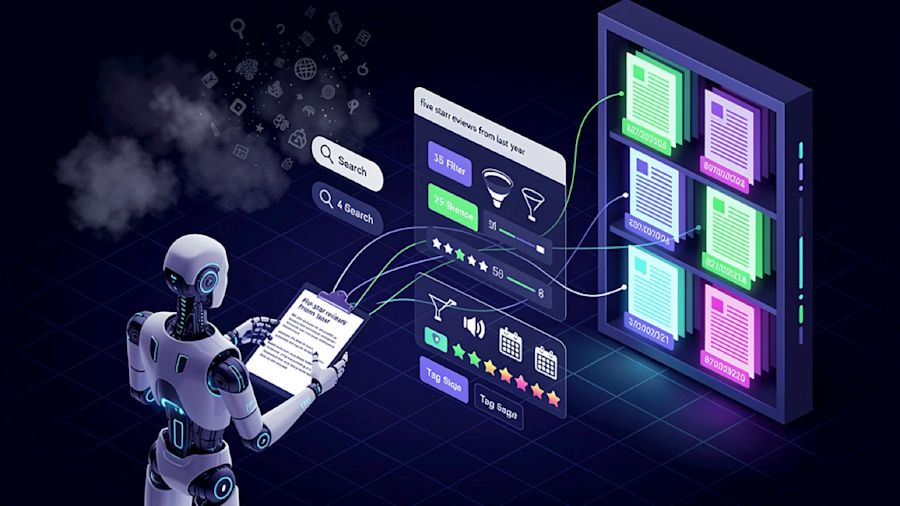
In modern AI-driven data retrieval, traditional retrieval systems like RAG pipelines often fall short when handling complex enterprise data, especially where rich metadata is involved. Databricks has introduced the Instructed Retriever, a novel architecture that improves retrieval accuracy by up to 70% on intricate, instruction-heavy enterprise tasks by effectively leveraging metadata. Unlike traditional systems, which treat queries mainly as text-matching exercises, this new approach interprets system-level specifications, decomposes queries, and applies metadata reasoning to produce highly relevant search results. This method addresses the limitations of conventional retrieval methods in environments with multifaceted data such as finance, healthcare, and e-commerce. The Instructed Retriever is currently integrated into Databricks' Knowledge Assistant product, helping enterprises seamlessly harness complex datasets without extensive data management. The evolution signals a shift toward retrieval architectures that are capable of robust instruction-following and metadata understanding, essential for the next generation of AI-powered enterprise applications.