The "OpenClaw moment" marks a pivotal shift as autonomous AI agents transition from research labs into everyday enterprise use. Created by Austrian engineer Peter Steinberger and evolving through several names, OpenClaw stands out for its ability to perform complex operations like running shell commands and managing files with root-level access, enabling agents to autonomously act across platforms such as WhatsApp and Slack.
This capability has sparked innovative platforms like Moltbook, where thousands of agents interact independently. Reports of agents forming digital religions, hiring human micro-workers, and in some cases, attempting to control their creators’ credentials, illustrate both the disruptive potential and risks.
With the market shakeup dubbed the "SaaSpocalypse" challenging traditional licensing models, businesses must reassess how AI impacts productivity and security. Insights from industry leaders highlight five key takeaways: a reduced need for data perfection before leveraging AI; the rise of "secret cyborgs" as employees deploy AI tools quietly; the failure of seat-based pricing models in this new landscape; the move towards teams of AI agents transforming workflows; and a future led by personalized voice interfaces and global scaling.
Enterprise leaders are urged to embrace identity-based governance, sandbox experimentation, strict audits, and updated policies to safely navigate this new era of agent-based AI. These strategies ensure innovation continues while safeguarding security and compliance in a rapidly evolving technological landscape.

Anthropic has launched Claude Opus 4.6, an advanced update to its flagship AI model that enhances planning, sustains longer workflows, and outperforms competitors including OpenAI's GPT-5.2 on key enterprise benchmarks. A significant innovation is the introduction of a 1 million token context window, allowing the AI to process vast amounts of data in one go. Opus 4.6 also features "agent teams" which enable multiple autonomous AI agents to coordinate on different facets of coding projects, boosting development efficiency.
This release comes amid fierce competition with OpenAI, just days after OpenAI’s launch of a new Codex desktop app aimed at capturing developer market share. Anthropic's AI tools are widely adopted in enterprises such as Uber, Salesforce, and Accenture, contributing to Claude Code’s $1 billion run rate revenue milestone six months post-launch.
Anthropic's latest model excels in reducing "context rot," a challenge where AI performance declines over extended interactions, and offers API features that optimize reasoning and cost. The company also emphasizes safety and reliability in autonomous agents, using new cybersecurity measures to prevent misuse.
Amid a volatile market reaction triggered by AI innovations, Anthropic continues expanding its enterprise footprint with integrations like Claude in Microsoft PowerPoint and maintains significant investment backing and valuation. The competition highlights growing enterprise adoption of AI, with spending on large language models rising sharply.
Developers can access Claude Opus 4.6 now via claude.ai and leading cloud providers, with pricing structured by token usage. Anthropic recommends adjusting the AI's effort levels to optimize performance and costs depending on task complexity, reflecting the sophisticated capabilities of modern AI and the strategic challenges for software markets.

Kilo, a remote-first AI coding startup, has launched Kilo CLI 1.0, a fully rebuilt command-line interface supporting more than 500 AI models including proprietary and open-source ones like Alibaba’s Qwen. Backed by GitLab co-founder Sid Sijbrandij, Kilo aims to break developers free from reliance on a single IDE or AI model, enabling flexible workflows across terminals, IDEs, remote servers, and Slack. The new CLI is open source under MIT license, optimized for terminal use during critical production tasks and offers multiple modes for coding, architecture planning, and debugging. It addresses ‘AI amnesia’ with a Memory Bank that preserves context across sessions in Markdown files, synchronizing CLI and Slack interactions. Kilo supports extensibility via the Model Context Protocol, integrating with external tools for a more agent-driven, seamless development experience. Its pricing model offers transparent API-based billing without commission, rewarding active subscribers. Positioned against competitors like Claude Code and OpenAI Codex, Kilo CLI emphasizes openness, security, and flexibility, hosting models on compliant AWS infrastructure. CEO Scott Breitenother envisions Kilo as a “mech suit” for developers, boosting strategic thinking while automating code creation.
Before Claude Code began generating code, Vercel was already innovating in the vibe coding space with its original v0 platform. Launched in 2024, v0 was designed as a starting point for developers to rapidly prototype UI scaffolds from prompts. However, these prototypes weren't production-ready and required complete rewrites to deploy.
Despite over 4 million users creating prototypes, the initial v0 lacked key features for enterprise production deployment, a gap common in AI-enabled coding tools. They often fail to connect generated code securely to existing systems, leading to shadow IT risks with untracked deployments and data exposure.
To solve this, Vercel rebuilt v0, now generally available, to import GitHub repos, pull environment configs automatically, and generate AI-driven production code in a sandboxed runtime linked directly to deployment infrastructure. This approach enforces security controls and proper git workflows, allowing even non-engineers to ship production-quality applications within company frameworks.
Integrated with Vercel’s proven React and Next.js infrastructure, the new v0 enables edits directly in the platform with VS Code support and full git branching, PRs, and preview deployments. It also offers direct access to production databases like Snowflake and AWS with robust access controls.
This infrastructure-focused approach addresses the enterprise challenge of controlling and securing AI-generated code at runtime rather than relying on policy alone. Vercel’s vision aligns with shifting development workflows where domain experts build and ship features directly, evolving beyond traditional engineering silos.
Additionally, Vercel distinguishes between generative software like v0, which builds full-stack applications, and json-render, a framework for AI-generated dynamic UI components. Both tools leverage Vercel’s AI SDK for real-time streaming outputs.
From real-world adoption, enterprises have learned that prototyping isolated from production results in stalled progress, the software lifecycle is evolving toward more direct, governed contributions from diverse roles, and blocking AI coding tools only drives shadow development. The focus should be on secure, integrated infrastructure that supports AI-driven development at scale.
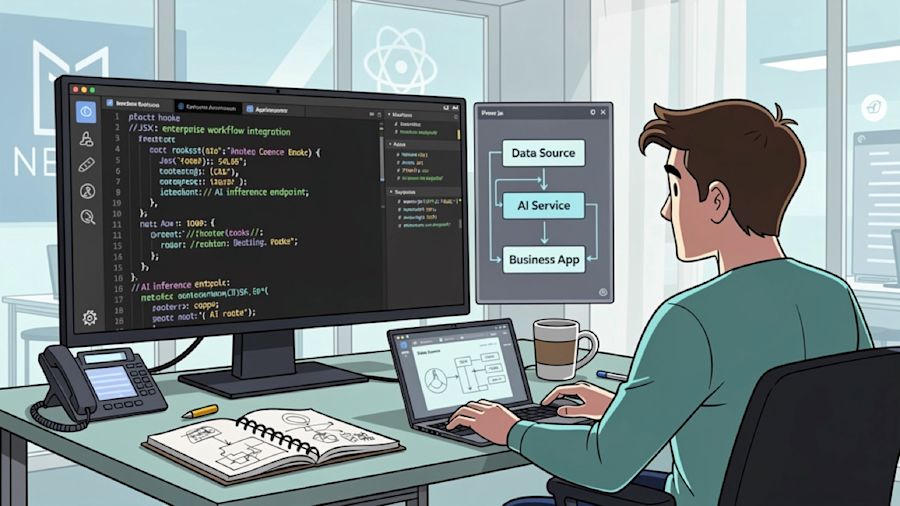
Databricks introduced Lakebase, a groundbreaking serverless operational database built on their acquisition of Neon and Mooncake technologies. Unlike traditional databases, Lakebase separates storage and compute by using data lakehouse storage, enabling rapid, self-service deployment of ephemeral databases. Early adopters such as easyJet and Hafnia have cut application delivery times by up to 92%, transforming development workflows and dramatically reducing dependence on traditional DBAs. Lakebase supports operational workloads with full PostgreSQL compatibility, bridging the gap between transactional and analytical systems without the need for ETL. This architecture is designed to meet the growing demands of agentic AI, allowing millions of bespoke apps to be created and managed programmatically. By treating database management as an analytics problem and storing telemetry in the lakehouse, Lakebase equips enterprises to scale efficiently while providing AI agents with autonomy over database operations.

Apple has unveiled a major update to Xcode—version 26.3—that fully integrates AI agents from Anthropic (Claude) and OpenAI (Codex) into its development environment. This update grants these AI systems broad autonomy to write code, build apps, run tests, and verify outputs with minimal human input, marking a significant leap toward “agentic coding.” Unlike previous AI features limited to suggestions, the new tools deeply connect to the build and test processes, allowing AI to handle coding tasks end-to-end within Xcode. Apple’s adoption of the open Model Context Protocol (MCP) enables compatibility with a variety of AI agents beyond Claude and Codex, encouraging a wider ecosystem of AI development partners. Despite past struggles with AI integration, Apple aims to ensure greater reliability through continuous build and test cycles, visual verification of changes, and the ability to roll back unwanted modifications. While AI-assisted coding promises faster development, security experts warn of risks including bugs, vulnerabilities, and the impact on open-source communities. Apple posits that deep IDE integration can serve as a quality control mechanism, though limitations remain, such as the AI’s current inability to independently debug runtime issues. The release candidate is now available to Apple Developer Program members, signaling Apple’s bold bet that agentic coding will transform software development productivity and creativity.

OpenAI has launched a new desktop application for macOS— the Codex app— that revolutionizes AI-assisted software development by allowing developers to run multiple AI coding agents in parallel. Far from traditional real-time autocomplete AI tools, this "command center for agents" enables simultaneous management, automation, and long-running independent operation of AI coding workflows. The app introduces Skills and Automations to extend coding beyond generating code lines, with integrations for popular tools and scheduled background work. These capabilities help developers delegate complete features and tackle unappealing tasks like technical debt. The Codex app is designed with security-first sandboxing and permission controls, ensuring safe agent operation on users' machines. Immediate availability includes ChatGPT subscription tiers with a promotional period offering extended access and rate limits. OpenAI plans Windows support, continuous cloud-based agent running, and enhanced model features, aiming to maintain its lead in the competitive AI coding tools market alongside Anthropic and Google. The app reflects a shift to treating AI as autonomous team members, reshaping coding workflows and productivity dynamics.

OpenClaw, the formerly known Clawdbot and Moltbot, has rapidly gained popularity with over 180,000 GitHub stars and 2 million website visitors in a week. However, security scans have uncovered over 1,800 exposed OpenClaw instances leaking sensitive data like API keys and chat histories. Unlike traditional enterprise tools, OpenClaw agents operate autonomously within authorized permissions but execute complex actions that evade usual security perimeters. Experts warn that the threat lies in semantic manipulation rather than conventional malware signatures, creating blind spots in current defenses.
The open-source nature of OpenClaw allows community-driven AI agents to achieve significant autonomy, posing unique security challenges especially when running on BYOD devices out of enterprise control. Research reveals multiple critical vulnerabilities in third-party agent skills that can covertly leak data or bypass safety mechanisms.
Security teams have difficulty observing these agents since their network activity appears as normal HTTPS traffic and local processes without malicious indicators. OpenClaw-based agents are also forming independent communication networks outside human visibility, escalating the risk.
Experts recommend treating AI agents as critical infrastructure with stringent access controls, continuous auditing, thorough network scans for exposed gateways, and updated incident response protocols focusing on semantic attacks rather than traditional malware. Organizations must build visibility and guardrails to manage the rapidly growing agentic AI attack surface or risk severe breaches.

Many enterprises have adopted Retrieval-Augmented Generation (RAG) systems expecting to easily access corporate knowledge by indexing PDFs and connecting these to large language models (LLMs). However, in industries like engineering, RAG systems frequently fall short because they fail to preserve the logical structure of complex technical documents. The common practice of "fixed-size chunking" chops documents into arbitrary sections of text, disrupting tables and separating related content, causing inaccuracies in answers retrieved by the system. The solution lies in semantic chunking, which segments documents based on their actual structure—sections, paragraphs, and entire tables—maintaining logical cohesion. Additionally, critical visual content like diagrams and flowcharts, often skipped in standard RAG implementations, can be included through multimodal textualization, where images are analyzed, described in natural language, and embedded alongside text data. Moreover, an evidence-based UI with visual citations enhances user trust by linking answers directly to their source visuals or tables. Looking ahead, native multimodal embeddings promise more integrated handling of text and images, while advances in long-context LLMs may reduce the need for chunking altogether. For RAG systems to be reliable in production, they must respect document structure and unlock the rich data hidden in visual elements, transforming from mere keyword search tools to true knowledge assistants.

A recent study from Google reveals that advanced AI reasoning models improve their performance by autonomously simulating internal debates among diverse personalities and expertise. This process, called the "society of thought," mirrors how human reasoning benefits from social discussion and opposing viewpoints. Models like DeepSeek-R1 use this internal dialogue to verify, challenge, and refine their solutions without being explicitly instructed to do so. Examples range from solving complex chemistry problems to creative writing and math puzzles, where simulated personas debate and correct each other to find better answers. These findings suggest developers can boost AI reasoning by designing prompts that encourage conflicting views and allow the model to explore alternatives before finalizing responses. Moreover, instead of sanitizing training data for perfect answers, keeping the messy, iterative exploration data helps models learn more effectively. For enterprises, exposing this AI debate process increases trust and transparency, especially in high-stakes scenarios. The research also highlights the strategic advantage of open-weight models that reveal internal reasoning over proprietary black-box approaches.