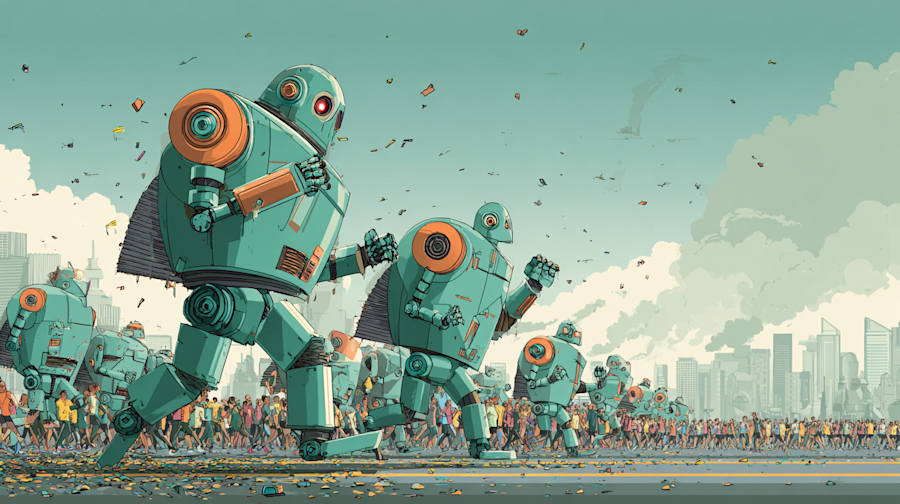
Enterprises have quickly adopted autonomous AI agents for tasks ranging from customer support to code management, but the proliferation of different platforms has led to fragmentation and poor interoperability. BAND, a startup emerging from stealth with $17 million in Seed funding, aims to solve this by creating a "universal orchestrator" that enables AI agents built on diverse frameworks to discover, communicate, and collaborate efficiently. BAND's platform introduces an "agentic mesh," supporting multi-peer collaboration with deterministic routing and enterprise-grade governance to ensure secure and reliable message exchange. It operates independently of specific AI model ecosystems, avoiding vendor lock-in and offering flexible deployment options including SaaS, private cloud, and edge environments. Early traction comes from tech-forward sectors, combining AI agents to improve workflows like coding, customer support, and operations. BAND’s tiered pricing caters to individual enthusiasts up to large enterprises, promising scalable, auditable, and secure multi-agent systems poised to become the backbone of the future "agentic economy."

OpenAI Launches GPT-5.5, Narrowly Edging Out Anthropic's Claude Mythos Preview on Terminal-Bench 2.0
OpenAI has officially introduced GPT-5.5, its most advanced large language model to date, succeeding previous rumors and internal codenames. This new iteration remarkably outperforms rival models including Anthropic’s Claude Opus 4.7 and narrowly surpasses Claude Mythos Preview on the Terminal-Bench 2.0 benchmark, which evaluates a model’s ability to operate in a terminal environment. The model enhances autonomous task handling, coding, scientific research, and professional computing tasks with significant efficiency improvements thanks to a hardware-software co-design. GPT-5.5 comes in two versions: a standard model and a Pro variant, the latter aimed at highly demanding tasks such as legal, data science, and business analytics. Although API access is not yet available, the model is accessible to users subscribed to various ChatGPT paid tiers. Pricing has increased compared to prior versions, reflecting the model's advanced capabilities. OpenAI has also introduced a "cyber-permissive" license for verified security professionals, balancing AI's defensive benefits with potential risks. Reception from early users highlights substantial advances in code conceptual clarity and workflow autonomy. OpenAI’s team underscores ongoing potential for further model improvements beyond this release.

In recent weeks, developers and AI enthusiasts reported that Anthropic's Claude models seemed to be underperforming, showing reduced reasoning capabilities, increased hallucinations, and token inefficiencies. Critics observed a shift from a "research-first" to an "edit-first" approach, sparking concerns about the model's reliability for complex tasks. After initial denials, Anthropic published a detailed post explaining that three changes in the model's operational harness caused the downgrade: lowering the default reasoning effort from high to medium to ease UI latency, a caching bug clearing short-term memory repeatedly, and stricter system prompt verbosity limits restricting responses. These changes impacted Claude Code and associated tools but spared the Claude API. To restore trust, Anthropic reverted these changes, implemented new testing and auditing protocols, increased internal testing with public builds, and reset usage limits to compensate subscribers. The company plans to maintain transparency via social channels and GitHub.

Traditional enterprise data stacks were designed for humans running scheduled queries, but with AI agents acting autonomously 24/7, this model is becoming obsolete. At Cloud Next, Google introduced the Agentic Data Cloud, a groundbreaking architecture with three key elements: the Knowledge Catalog, which automates metadata curation without manual intervention; the cross-cloud lakehouse, enabling BigQuery to query Iceberg tables across AWS S3 via private network with zero egress fees; and the Data Agent Kit, which allows data engineers to focus on desired outcomes instead of writing pipelines. This shift supports a move from reactive intelligence to proactive, agent-driven action, unlocking full enterprise data activation with AI while maintaining trust through enhanced semantic understanding. Google's open, federated approach integrates with third-party catalogs and emphasizes cross-cloud openness, addressing the growing need for scalable, cost-effective, and outcome-focused data infrastructure.

Cirrascale Cloud Services has expanded its partnership with Google Cloud to deliver the Gemini AI model in a fully private, on-premises appliance using Google Distributed Cloud. This innovative solution offers enterprises and government agencies the ability to run Gemini on dedicated hardware equipped with eight Nvidia GPUs, disconnected from the internet and Google's cloud. The Gemini model resides entirely in volatile memory, ensuring it vanishes when powered off and cannot be tampered with, providing unparalleled data security. With flexible licensing and deployment options, the product targets regulated sectors like finance, healthcare, and public sector research, addressing data sovereignty and security concerns. This move marks a significant shift from traditional cloud AI, bringing powerful frontier models into customers' own infrastructure and signaling the rise of private AI deployments.

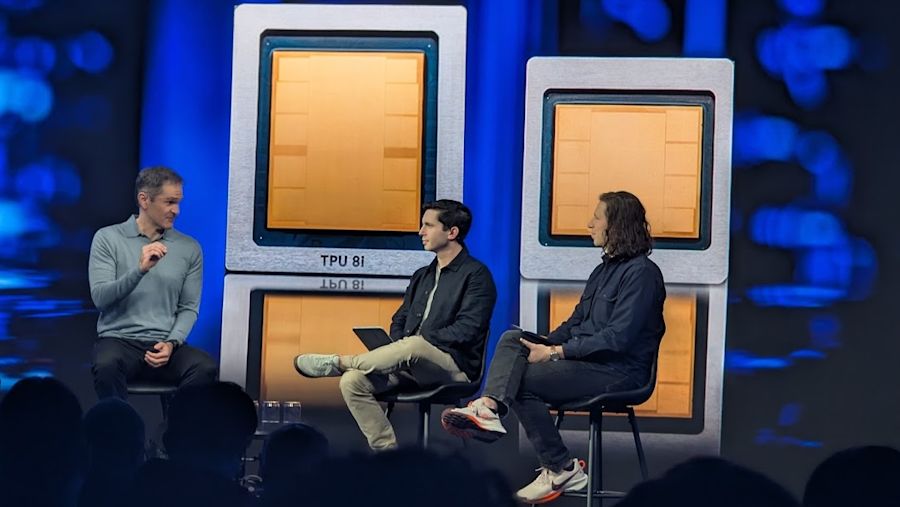
Leading AI labs are currently constrained by electricity and compute costs, often paying high margins to Nvidia for model training hardware. Google bucks this trend with its upcoming eighth-generation Tensor Processing Units (TPU 8t and TPU 8i), each designed for distinct AI tasks: TPU 8t optimizes training for frontier models, while TPU 8i focuses on inference for agentic applications and real-time processing. Google's SVP Amin Vahdat emphasized their fully integrated AI stack, allowing them to cut costs per token more effectively than competitors reliant on Nvidia chips. TPU 8t offers massive scalability, supporting over a million chips in a single job with enhancements like TPU Direct Storage to speed data access. TPU 8i, developed in partnership with DeepMind, features a redesigned network topology for drastically lower latency, improving performance for real-time language model sampling and reinforcement learning. This vertical integration helps Google avoid the high "Nvidia tax," representing a significant cost advantage for enterprise buyers. These advances suggest a shift in cloud AI evaluations, emphasizing tailored hardware capabilities alongside raw performance metrics.
OpenAI has introduced Privacy Filter, an open-source, 1.5-billion-parameter model designed to detect and remove personally identifiable information (PII) directly on user devices, preventing sensitive data from ever being uploaded to the cloud. Released under the permissive Apache 2.0 license on Hugging Face, Privacy Filter is built for local-first data sanitization workflows and can run on standard laptops or within web browsers using transformers.js with WebGPU. Unlike typical autoregressive language models, Privacy Filter employs a bidirectional token classification approach and a Sparse Mixture-of-Experts architecture, allowing it to scan large documents efficiently while maintaining high accuracy. It supports redaction of key PII categories such as private names, contact details, digital identifiers, and secrets, enabling enterprises to comply with regulations like GDPR and HIPAA with enhanced privacy-by-design capabilities. OpenAI’s choice of an Apache 2.0 license facilitates commercial use, customization, and integration without the obligations found in copyleft licenses, positioning Privacy Filter as a foundational tool for secure data handling. While the model is celebrated for its technical innovations and throughput, OpenAI cautions it should be used as a redaction aid rather than a sole solution in high-risk scenarios. This release marks a return to OpenAI’s open-source roots, fostering safer, more compliant AI deployments for businesses.

Enterprise teams developing multi-agent AI systems may be incurring higher computational costs without achieving superior results compared to single-agent systems. Stanford University research reveals that when given equal "thinking token" budgets, single-agent AI models frequently match or outperform multi-agent architectures on complex reasoning challenges. Multi-agent systems require additional computation due to their longer reasoning paths and multiple agent interactions, which can inflate performance metrics. The study introduces a fair comparison method by limiting reasoning tokens and shows that a single-agent system with an optimized prompt—allotted adequate thinking time—can deliver more efficient, reliable, and cost-effective multi-hop reasoning. While multi-agent setups excel in handling degraded or corrupted contexts, single-agent models remain the best default choice for many tasks due to lower overhead and better information retention. Developers and enterprises should carefully evaluate whether the complexity of multi-agent orchestration is necessary or simply adding a costly 'swarm tax.'
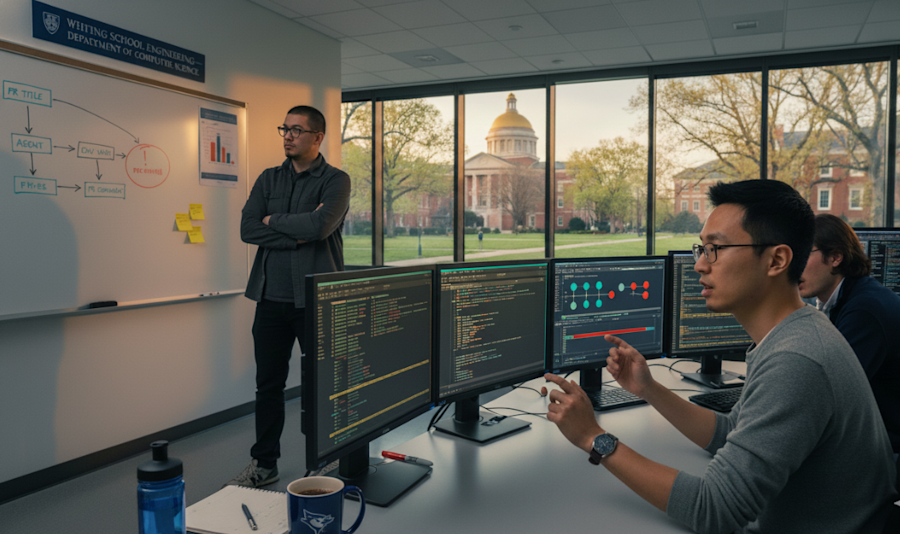
A security researcher from Johns Hopkins University revealed a significant vulnerability in AI coding agents through a malicious pull request title on GitHub. This exploit, impacting Anthropic’s Claude Code Security Review action, as well as Google’s Gemini CLI Action and GitHub’s Copilot Agent, allowed the leakage of secret API keys without involving external infrastructure. The attack, dubbed "Comment and Control," exploits prompt injection weaknesses in agent runtimes, specifically where workflows need secret access via GitHub’s pull_request_target trigger. Anthropic, Google, and GitHub addressed the issue quietly with bounties but no CVEs.
Anthropic’s extensive system card documents injection resistance and explicitly notes the vulnerability in Claude Code Security Review, while OpenAI and Google provide less runtime transparency. The research highlights critical risks: secrets exposed to AI agents due to broad permissions, lack of safeguards on agent runtime operations, and no standard CVE tracking for such AI vulnerabilities. Organizations are urged to audit secrets and permissions tightly, adopt short-lived OIDC tokens, and demand clear, quantified injection resistance metrics from vendors before renewal. The incident underscores how AI agent design and CI/CD integration pose systemic security challenges beyond individual vendor protections.
Most existing orchestration frameworks were originally developed for agents that operate over short durations—seconds to minutes. But now, newer agents are capable of running for hours and even days continuously, pushing these frameworks to their limits. Model providers like Anthropic with Claude Code and OpenAI with Codex have started to support longer-running agents via multi-session tasks and background execution, though these solutions still assume limited runtime contexts.
Moonshot AI introduces Kimi K2.6, a model designed specifically for continuous, long-duration execution. It has demonstrated agents running autonomously for several hours and up to five days, managing complex tasks like monitoring and incident response. However, the growing use of such agents uncovers significant orchestration gaps since most frameworks were not built to maintain persistent state or handle changing environments effectively.
Kimi K2.6 uses an advanced Agent Swarms approach, managing hundreds of sub-agents across thousands of coordinated steps, relying on the model itself rather than predefined roles for orchestration. The model is now accessible via Hugging Face, API, Kimi Code, and the Kimi app. Practitioners warn that orchestration fragility goes beyond just improving prompts, highlighting the complexity of maintaining agent state and adapting to evolving conditions.
Industry leaders point out critical challenges including governance risks due to rapid autonomous code generation and the architectural shift towards persistent agents requiring new infrastructural components. Moonshot’s K2.6 also showcases impressive feats like autonomously building a compiler and optimizing extensive codebases over prolonged periods, illustrating the vast potential and demands of long-running AI agents.