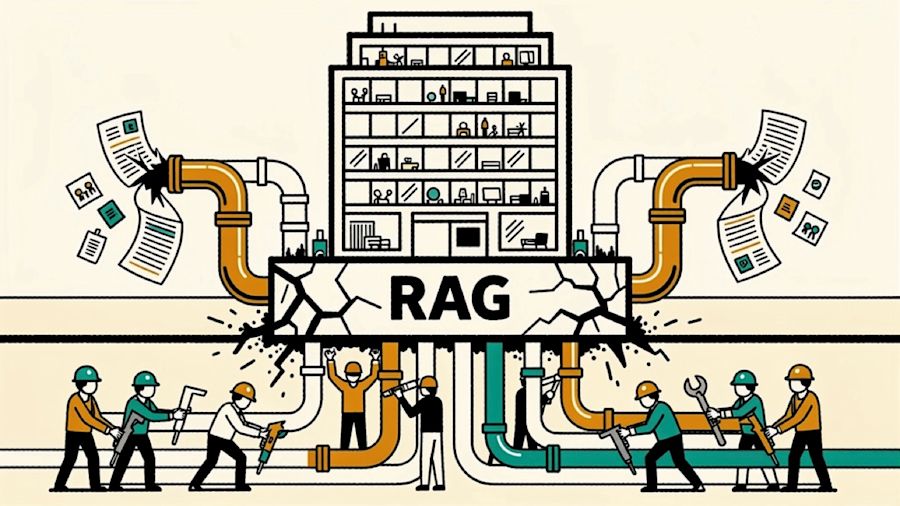
In early 2026, enterprise Retrieval-Augmented Generation (RAG) systems saw a notable shift. Instead of adding new retrieval layers, organizations concentrated on improving existing ones — a trend dubbed the retrieval rebuild. Data from VB Pulse across Q1 reveals a tripling in enterprise intent to adopt hybrid retrieval systems, which combine dense embeddings and keyword search for greater accuracy and control. This shift emerged as many enterprises found their initial RAG architectures failed to scale effectively. Hybrid methods have become the preferred approach, overshadowing standalone vector databases, which faced declines in adoption despite remaining reliable in production. Moreover, the criteria for evaluating retrieval quality evolved, with relevance and accuracy becoming as critical as correctness. While some sectors paused RAG initiatives, overall the market is moving beyond early RAG frameworks towards more sophisticated and scalable models. The message is clear: the original RAG setup is being replaced, not the concept itself.
Amazon Web Services (AWS) has launched a major AI initiative by integrating OpenAI's leading models, including GPT-5.4 and GPT-5.5, into its Bedrock platform. This move follows the recent restructuring of OpenAI's exclusive cloud deal with Microsoft, enabling AWS to offer OpenAI’s powerful AI models widely. The offerings include Amazon Bedrock Managed Agents, a platform merging OpenAI technology with AWS’s proprietary "harness" for agentic AI, which uses reinforcement learning for better performance. AWS also introduced Amazon Quick Desktop, a proactive AI assistant for knowledge workers, and expanded Amazon Connect from a single contact-center product into four AI-driven solutions targeting supply chain, hiring, healthcare, and customer experience. AWS CEO Matt Garman emphasized the security advantages, highlighting zero human access to inference machines and the use of custom silicon chips. This launches a new era in enterprise AI, shifting focus from exclusive model access to comprehensive, secure platforms capable of agentic actions across business workflows.

Mistral AI, a Paris-based artificial intelligence firm valued at €11.7 billion, has introduced Workflows, a Temporal-powered orchestration platform that is now publicly available in preview. This production-grade system is designed to transition AI applications from experimental stages into revenue-generating business operations. Integrated within Mistral's Studio platform, Workflows focuses on providing the critical infrastructure needed for reliable, scalable AI deployment across enterprise environments, addressing challenges like data privacy and complex process orchestration. It supports developers with a Python SDK for building workflows and features a unique design that separates orchestration control from execution, enabling execution near customer data to maintain privacy. Customers across logistics, finance, and banking are already leveraging Workflows for large-scale automation, processing millions of executions daily. Workflows complements Mistral's broader strategic AI platform, including Forge for model customization and Vibe for user interaction, positioning Mistral as a comprehensive enterprise AI provider. With strong financial backing and rapid growth, Mistral aims to drive enterprise AI adoption through robust, flexible orchestration tailored to the needs of regulated industries and critical applications.

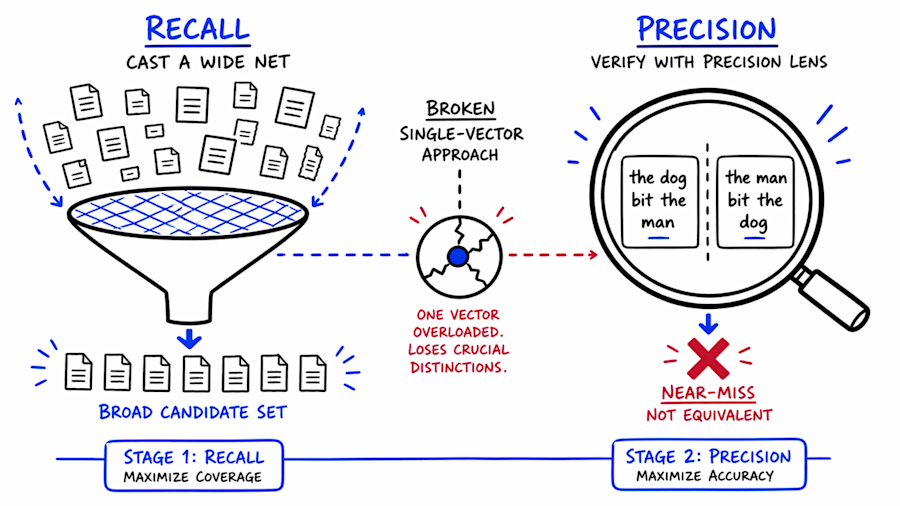
New research from Redis reveals that enterprise teams fine-tuning RAG embedding models for improved precision might inadvertently harm the retrieval quality critical to their AI pipelines. The study, titled "Training for Compositional Sensitivity Reduces Dense Retrieval Generalization," shows that training models to differentiate sentences with nearly identical words but opposite meanings (like negation flips) can significantly degrade overall retrieval performance—by 8-9% on smaller models and up to 40% on mid-sized models commonly used in production.
This degradation poses serious risks for agentic AI setups where retrieval quality directly impacts the reasoning and decisions made by AI agents. The research challenges the assumption that high semantic similarity equates to correct intent, highlighting that structural misinterpretations are common.
The study also explored common remedial approaches such as hybrid search, MaxSim reranking, cross-encoders, and contextual memory, all of which fell short in addressing these structural errors effectively. Instead, the researchers propose a two-stage retrieval architecture: first, a dense retrieval step for broad recall; second, a verification step using a Transformer model to check for structural mismatches at the token level. While this improves precision, it introduces latency costs.
For enterprise teams, the key takeaway is to acknowledge this tradeoff, question reliance on fine-tuned embedding models alone, and consider adopting the two-stage architecture where precision sensitivity matters, such as legal or financial domains. RAG remains a viable architecture but not without caveats for precision-critical applications.
Researchers at SII-GAIR have developed a groundbreaking AI framework, ASI-EVOLVE, that fully automates the optimization of training data, model architectures, and learning algorithms. This framework cycles through continuous learning, designing, experimenting, and analyzing phases to improve AI systems without human intervention. By leveraging prior knowledge and complex experimental feedback, ASI-EVOLVE surpasses human-engineered benchmarks, significantly boosting performance—for example, raising benchmark scores by over 18 points on challenging language understanding tasks. The system autonomously creates innovative neural architectures and efficient reinforcement learning algorithms, reducing the manual engineering effort typically needed for AI research and development. Designed for enterprise AI, it enables teams to integrate proprietary knowledge and reduce optimization costs, accelerating AI innovation at scale. The framework and its code are openly available for adoption by developers and researchers.

Xiaomi has introduced its MiMo-V2.5 and MiMo-V2.5-Pro, advanced open source AI large language models notable for their efficiency in agentic 'claw' tasks. Released under the permissive MIT License, these models are accessible for commercial use and modification, available on Hugging Face for direct download and deployment. Benchmarks show MiMo models excel in performing tasks such as autonomous content creation and scheduling with fewer tokens, reducing operational costs compared to competitors like Anthropic, Google, and OpenAI. The Pro version, featuring a massive 1.02 trillion-parameter architecture with 42 billion active parameters, demonstrates exceptional long-horizon task coherence and complex software engineering abilities, including building a compiler from scratch and advanced video editing. Xiaomi's pricing strategy is competitive, with scaled costs based on token usage and context window length, targeting both domestic and global markets. By leveraging Mixture-of-Experts architecture and reinforcement learning, the models optimize token consumption and memory management for superior task performance. Xiaomi also supports the ecosystem with powerful inference engines and offers extensive token grants to foster development. This launch stresses Xiaomi's commitment to open-source AI advancements, challenging proprietary models and encouraging innovation with transparent, cost-effective solutions.

In many enterprise AI deployments, the most costly failures don't trigger alerts or errors—they occur silently when systems confidently deliver incorrect outputs. This reliability gap emerges not at the model level but within the supporting infrastructure—data pipelines, orchestration layers, retrieval systems, and workflows—that traditional monitoring tools often fail to effectively track. While operational metrics like uptime and error rate appear normal, AI systems silently suffer from issues such as stale data context, orchestration drift, partial failures, and cascading errors through complex workflows. To close this gap, organizations must extend observability with behavioral telemetry that measures response grounding and confidence, simulate semantic faults during testing, establish clear halt conditions for AI workflows under uncertainty, and ensure shared ownership across teams. As AI adoption matures, the differentiator will shift from model capability to reliable system integration under real-world conditions, emphasizing disciplined infrastructure design and proactive failure detection.

A recent Cisco survey highlights a significant gap: while 85% of enterprises are piloting AI agents, just 5% have deployed these agents into full production, largely due to trust concerns. Cisco's President Jeetu Patel identifies trust as the crucial factor distinguishing market leaders from those at risk of failure. AI agents resemble intelligent yet inexperienced teenagers needing strict oversight to prevent costly mistakes. At RSA Conference 2026, Cisco announced new security tools like AI Defense Explorer Edition and Defense Claw, addressing three key areas: protecting agents, safeguarding the environment from agents, and detecting threats rapidly. Nvidia's OpenShell integration accelerates secure deployment by automating security policies at launch. Patel also revealed a bold plan to have 70% of Cisco's products built entirely by AI by the end of 2027, signaling a cultural shift in engineering. Five strategic “moats” such as sustained speed and trusted delegation guide enterprises toward safer, more efficient AI adoption. Experts warn that distinguishing agent-initiated actions from human ones remains a challenge, urging enterprises to enhance telemetry alongside identity controls to close security gaps. To move forward, security teams should audit trust barriers, red-team AI workflows, map delegation, establish behavior baselines, and improve logging capabilities to ensure safe AI agent operation.
Chinese AI startup DeepSeek, originated from High-Flyer Capital Management, has launched DeepSeek-V4, a groundbreaking 1.6-trillion-parameter Mixture-of-Experts (MoE) AI model. Offered under an open-source MIT License, it delivers near state-of-the-art intelligence comparable to top-tier closed-source models like OpenAI's GPT-5.5 and Anthropic's Claude Opus 4.7 but at roughly one-sixth the cost. DeepSeek-V4 offers vast improvements in efficiency, long-context handling with a 1 million token window, and stability through novel architectural innovations like Manifold-Constrained Hyper-Connections (mHC) and a Hybrid Attention Architecture. The model is priced competitively via API, potentially transforming the economics of AI deployment for enterprises by making advanced AI capabilities more accessible and affordable. It supports multiple reasoning modes and is compatible with NVIDIA GPUs and Huawei’s Ascend NPUs, promoting sovereignty in AI technology infrastructure. Community and industry responses highlight the model’s disruptive potential, placing pressure on established AI providers to justify their pricier offerings while broader access promises significant benefits for AI integration worldwide.

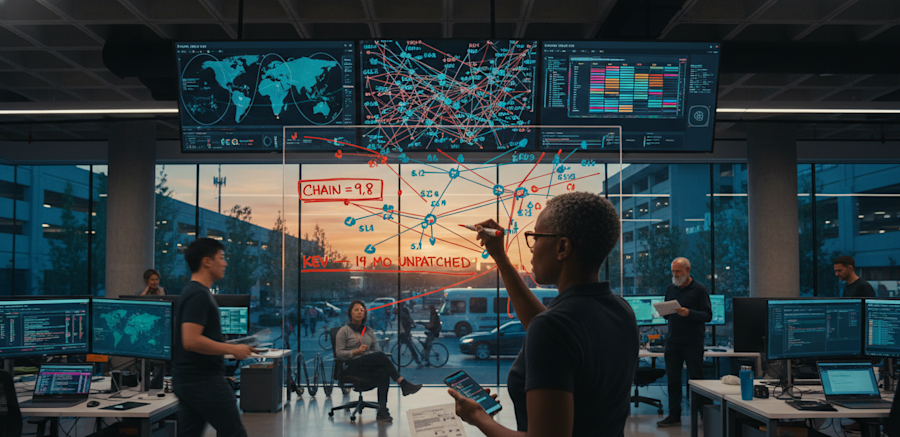
In a recent security breach dubbed "Operation Lunar Peek," attackers exploited two Palo Alto Networks vulnerabilities, CVE-2024-0012 and CVE-2024-9474, affecting over 13,000 devices by chaining a seemingly manageable authentication bypass with a privilege escalation flaw. Despite individual CVSS scores that suggested remediation challenges—one vulnerability scored below common patching thresholds—combined they granted root access to numerous systems. Experts emphasize the failure of scoring systems to account for compound risks and real-world attack strategies, urging a shift beyond traditional CVSS-based prioritization to encompass chained vulnerabilities, rapid exploitation timelines, identity verification gaps, and the growing volume of discovered vulnerabilities due to AI technologies. Key measures include tightening patch deadlines, auditing chains of vulnerabilities, integrating identity-focused controls, and preparing for increased vulnerability discovery rates to prevent overwhelming existing security pipelines.