


American Express (AMEX) is developing an innovative system enabling AI agents to shop and make payments on behalf of customers, uniquely leveraging its own closed payment network. Their Agentic Commerce Experiences (ACE) developer kit addresses a major gap in agent-driven commerce by offering full control at the payment layer — a feature uncommon among current protocols.
Unlike other financial networks, AMEX acts as both card issuer and payment network, allowing seamless validation of agent-led transactions within its system. While the kit builds trust through agent identity verification and intent contracts, some aspects of its validation process remain a black box, raising concerns around transparency.
The ACE kit features agent registration, account enablement, intent intelligence including creation of Intent IDs and Proof of Intent Tokens, and usage of single-use payment tokens bound to spending constraints. This structure ensures that AI agents execute transactions strictly within user-defined parameters, enhancing security and accountability.
This approach highlights the critical balance of innovation and risk management in agentic commerce, underlining the importance of trusted systems to support AI-driven financial interactions and safeguard consumers, merchants, and institutions alike.

xAI has introduced Grok 4.3, an enhanced language model designed for complex reasoning with a massive 1 million-token context window, alongside a new, fast voice cloning suite. Despite challenges like founding team departures and stiff competition, Grok 4.3 delivers improved performance on legal and financial tasks and offers a distinctly lower price point with API access costing $1.25 per million input tokens and $2.50 per million output tokens. The model is designed for "always-on reasoning," making it creative but sometimes cautious in autonomous actions. xAI’s voice cloning API allows quick, high-fidelity voice replication from short audio samples, restricted to the US for privacy reasons. While Grok 4.3 shines in specialized applications, it faces critiques on generalist and coding capabilities. Its aggressive pricing and agentic workflow optimization make it an appealing choice for enterprises prioritizing cost efficiency and domain-specific power.

The layer of AI development tools that once helped programmers build applications integrating large language models (LLMs)—such as indexing systems, query engines, and agent workflows—is becoming obsolete. Jerry Liu, co-founder and CEO of LlamaIndex, explains that this shift marks progress, not a setback. He describes how modern AI models are increasingly capable of handling vast amounts of unstructured data autonomously, reducing the need for complex, handcrafted frameworks. With advancements like the Modern Context Protocol and Claude Agent Skills plug-ins, models can now use tools dynamically without custom integration for each task.
Liu also highlights that the traditional coding barrier is breaking down, as AI assists programmers by generating the majority of the code, allowing natural language to become the primary programming interface. The real competitive edge moving forward is the ability to provide detailed context—accurately extracting and parsing information from diverse file formats, a strength of LlamaIndex’s technology leveraging optical character recognition.
Furthermore, Liu stresses the importance of maintaining modular and flexible AI stacks to avoid being locked into specific platforms or tools, encouraging builders to stay adaptable to rapidly evolving models. He advises enterprises to keep their architectures debt-free and ready to integrate new capabilities as the AI landscape continues to change.

Enterprise AI teams often struggle not because of AI's reasoning capabilities, but due to underlying workflows ill-suited for AI agents. Tasks frequently fail and handoffs break down as AI agents are integrated deeper into back-office systems. Salesforce aims to solve this with Agentforce Operations, a new platform that converts complex enterprise workflows into manageable tasks for AI agents. Users can upload existing processes or use Salesforce's Blueprints, enabling the system to break them down for agents to handle efficiently.
Sanjna Parulekar, Salesforce's Senior VP of Product, explains that many enterprise workflows are flawed from the start, often written in product requirements documents in ways that don't translate well when automated. Agentforce Operations encourages companies to rethink these workflows, making steps explicit and deterministic, so agents know exactly what to do. This approach contrasts with traditional automation by enforcing a strict control plane that determines task execution, avoiding vague or probabilistic decision-making.
However, codifying broken workflows amplifies problems across an organization. Therefore, governance becomes essential—defining who owns the process, oversees task success, and adapts workflows as conditions evolve. Brandon Metcalf of Asymbl emphasizes that shared goals and clear management, whether human or agent, are crucial to workflow success. Ultimately, the challenge shifts from agent intelligence to creating coherent, executable workflows for AI and humans alike.

Netomi, a San Francisco-based startup specializing in AI for enterprise customer service, announced a $110 million funding round led by Accenture Ventures and Adobe Ventures, among others. This investment signifies not just a financial boost but a strategic alliance integrating Netomi's AI solutions deeply into enterprise ecosystems. Accenture is preparing to train hundreds of its consultants on the Netomi platform to offer it to Fortune 100 clients globally, while Adobe plans to incorporate Netomi into its Brand Concierge platform, enhancing digital experience management for large brands. Unlike conventional chatbots that wait for customer issues to arise, Netomi's AI proactively anticipates and prevents problems, reshaping digital interactions fundamentally. Drawing from its founder Puneet Mehta's Wall Street experience with low-latency trading systems, Netomi aims to deliver a contextually aware, multi-signal AI that governs customer experiences responsibly and efficiently, even during high traffic events. Key clients like DraftKings and Coach illustrate the platform’s robust deployment capabilities. The overarching vision is to move beyond reactive customer support towards an ambient intelligence that seamlessly integrates into customer interactions, potentially reducing the need for traditional service tickets. This investment reflects confidence in Netomi’s approach to trusted, scalable, and strategically embedded AI in enterprise customer service.

Writer, supported by Salesforce Ventures, Adobe Ventures, and Insight Partners, launched new event-driven triggers for its Writer Agent platform, allowing AI agents to autonomously detect key business activities across tools like Gmail, Gong, Google Calendar, Google Drive, Microsoft SharePoint, and Slack. This innovation enables complex workflows to execute without human initiation, marking a move from reactive to proactive AI in enterprise software. Writer's approach thoughtfully addresses the human bottleneck in triggering automations by having AI directly respond to real-world events, streamlining workflows especially for marketing teams. Unlike traditional automation tools like Zapier, Writer's AI reasoning engine uses natural language understanding and dynamic execution decisions, removing the need for rigid manual setup. Writer introduces enhanced governance controls including encryption options, connector profiles, and detailed observability features to ensure trust and safety in autonomous AI operations within regulated companies. Positioned against offerings from AWS, Salesforce, and Microsoft, Writer emphasizes accessibility for non-technical users and business-focused automation. Future connector expansions aim to integrate deeper enterprise systems such as Salesforce CRM, SAP, and Workday. While enterprises still often maintain human approval checkpoints, Writer’s platform is evolving toward more autonomous, context-aware agents that align with broader organizational objectives. This release embodies Writer’s vision that enterprise AI success hinges not just on model power but on widespread usability, with agents now acting proactively rather than waiting for prompts.

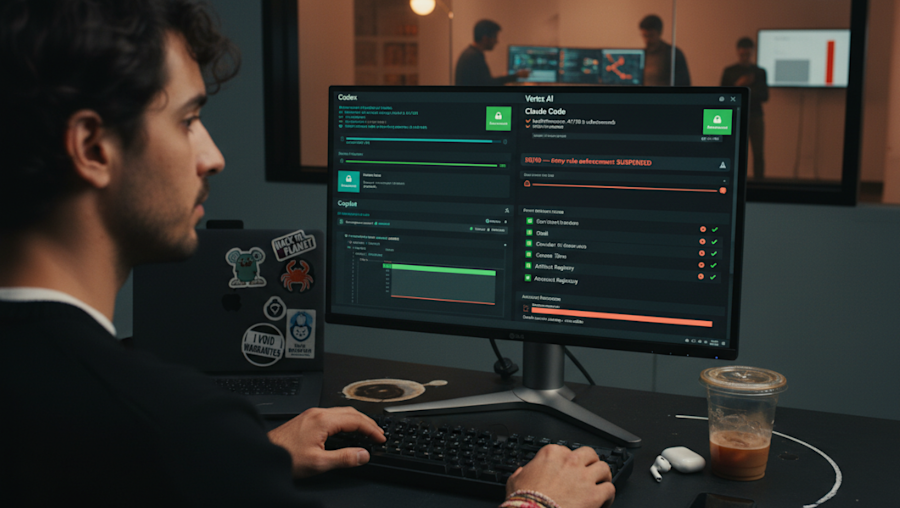
On March 30, BeyondTrust revealed a critical vulnerability where a crafted branch name in GitHub could expose OpenAI Codex's OAuth token in plaintext, classified as Critical P1 by OpenAI. Shortly after, Anthropic's Claude Code source leaked on the public npm registry, with subsequent discoveries showing it ignored deny rules beyond 50 subcommands, posing serious sandbox bypass risks. Over nine months, multiple teams uncovered that exploits in Codex, Claude Code, Copilot, and Vertex AI all targeted credential theft rather than the AI models themselves. For example, Microsoft's Copilot could be manipulated via pull request descriptions and GitHub issues to grant unauthorized root access, while Vertex AI's default permissions allowed excessive reading of Google Cloud resources. Experts highlight that these breaches arise from inadequate identity governance and insufficient security controls around AI agent credentials, rather than flaws in AI output generation. The recommended defense is rigorous inventory and management of AI agent credentials, strict auditing of OAuth scopes, treating all user inputs as untrusted, and enforcing human session validation before AI agents access sensitive systems.
Enterprises face a paradox where fear of losing scarce GPU resources leads them to overcommit and underuse these expensive assets, with fleets operating at just around 5% utilization. This waste is driven by a combination of procurement locking teams into multi-year commitments amidst shortages and the inefficiencies inherent in running AI workloads that involve both CPU and GPU stages in tightly coupled containers. Market data reveals a split in cloud compute pricing: commodity GPUs are becoming cheaper, while cutting-edge models like NVIDIA's H200 face acute shortages and price hikes due to high demand and limited supply chain capacity. Experts suggest that improving GPU utilization dramatically—targeting 30% to 40%—is possible through strategies such as sharing GPUs across regions and time zones, continuous resource rightsizing, and employing disaggregated inference frameworks. The industry's challenge is breaking the loop of overcommitment and inefficient architecture, encouraging enterprises to question whether they truly need the latest, most expensive GPUs and to optimize how workloads are distributed across available hardware.

Enterprise AI teams utilizing centralized orchestration tools now face a new dynamic with the introduction of AWS Quick, which has expanded into a desktop-native agent that creates a continuously updated personal knowledge graph from local files, calendar, email, and SaaS apps. Unlike conventional chat-based assistants that reset every session, Quick proactively triggers actions based on this rich context, extending its reach beyond what most orchestration control planes can monitor.
Launched by AWS in October last year, Quick has evolved from an AI assistant into a proactive workflow agent that integrates deeply with Google Workspace, Microsoft 365, Zoom, Salesforce, Slack, and local files. This enables it to gather user-specific context and perform autonomous actions within enterprise security and permission boundaries.
While enterprises rely on orchestration layers to manage agents and workflows, Quick's personalized knowledge graph introduces a potential blind spot in governance. The system’s implicit, context-driven triggers may generate ‘shadow orchestration’—decisions and actions that lack full transparency and auditability. AWS maintains that Quick operates within a governed environment offering flexibility to users while ensuring IT retains control over data and system connections.
This development points to a broader shift in enterprise AI tools from rigid orchestration toward context-driven, stateful agent management, raising important questions about accountability and oversight in AI-autonomous workflows.

IBM has launched Bob, an AI-driven software development platform designed to enhance security and reliability in enterprise coding environments. Bob integrates multi-model routing with human checkpoints throughout the software development lifecycle, ensuring greater control and auditability as AI agents write and test code. The platform supports various AI models including IBM's Granite series and Anthropic’s Claude, and is already utilized by over 80,000 IBM employees. Bob aims to balance automation with human oversight, reducing risks associated with autonomous AI workflows. It features a structured process where humans approve agent tasks, saving teams up to 70% of time on selected tasks. Pricing includes multiple subscription tiers based on "Bobcoins," IBM's internal metric for platform usage, with options ranging from a free trial to enterprise plans offering centralized management and additional support.
