


Uber is investing in Atoms, Travis Kalanick's robotics company, which promotes the use of industrial AI to revolutionize global industries.


Nigel Morris reflects on four decades in financial services and why AI marks a revolutionary shift unlike previous innovations such as branchless banking, blockchain, or the rise of Big Tech. Past waves transformed banking by digitizing services, leveraging data, and reducing costs, but AI is poised to be the fundamental operating system of global finance. From wealth management to risk compliance, AI is reshaping every element of the financial ecosystem, making processes faster, cheaper, and more personalized. Morris emphasizes that incumbents must embrace transformation and AI-driven reinvention or risk losing ground to agile fintech startups. He underscores AI’s ability to reduce marginal costs to near zero and create products tailored to individual behaviors and needs. The future financial landscape will be radically different, shaped by those willing to adapt aggressively to AI’s potential.


Erik Brynjolfsson challenges the common question about AI's impact by urging us to focus on how we use AI rather than what AI will do to us. In a conversation on "Me, Myself, and AI," Brynjolfsson, a leading economist at Stanford, discusses the critical role human choices, institutions, and organizations play in shaping AI's economic and social impact. He reflects on his earlier predictions about AI progress, the complexities behind AI adoption, and the importance of investment in complementary assets like new skills and business models. Brynjolfsson highlights recent research showing that AI's impact on jobs varies significantly by age and occupation, emphasizing the need to think beyond job automation to the creation of new opportunities. He advocates for mindful optimism, stressing human agency and values in directing AI's development toward economic growth and shared prosperity. The conversation covers the challenges of measuring AI's benefits, the J-curve effect in productivity adoption, and the balance between academic and industry roles in AI innovation. Brynjolfsson calls for active engagement from all stakeholders to navigate AI's transformative potential responsibly.


Presented by Atlassian
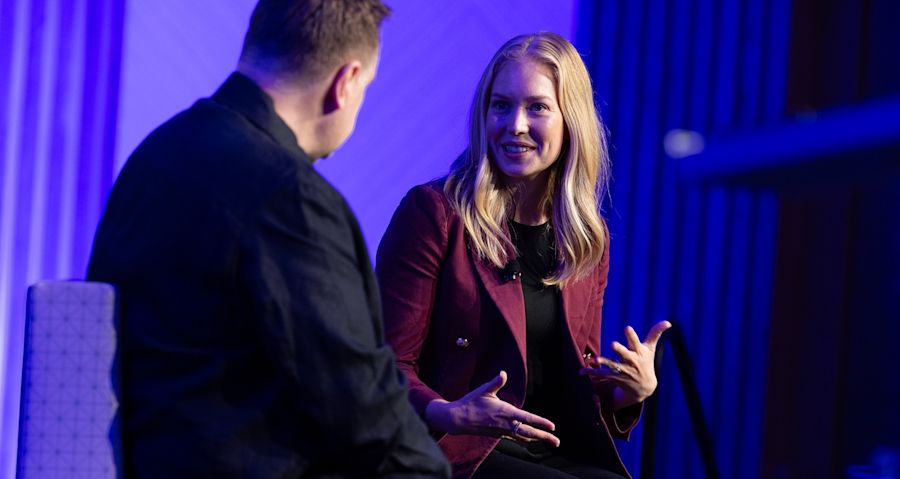
Many companies are approaching AI adoption incorrectly by focusing on individual use rather than how teams collaborate, explains Dr. Molly Sands, head of Atlassian's Teamwork Lab, in a discussion at VB Transform 2026. Sands' team of behavioral scientists studies how AI reshapes teamwork and assists organizations in redesigning their workflows.
Atlassian’s State of Teams Report, surveying 12,000 knowledge workers and Fortune 1000 executives, reveals a gap between AI activity and tangible value. While 89% of executives noted increased individual AI use, only 6% could identify clear ROI. In contrast, 14% of teams successfully turned AI usage into real value by focusing on context, workflows, and culture.
Successful teams create a "context graph" capturing shared goals and decisions, redesign entire workflows rather than speeding isolated tasks, and foster a culture of experimentation and learning. Sands encourages leaders to implement AI working agreements to align team AI use and avoid fragmented knowledge. Ultimately, AI exposes longstanding teamwork challenges, emphasizing the need for shared context and explicit workflows.

With Andy Burnham stepping into his role as the UK's prime minister, the spotlight is on his groundbreaking cabinet formation, featuring AI as a dedicated cabinet member for the very first time.

Samsung is launching a new robotics division, spearheaded by Dongkun Lee, former lead at Boston Dynamics. The company aims to create robotics research centers in the US, China, and Japan, unifying these efforts under Lee's leadership to advance innovation in robotics technology.


Nvidia's Vera Rubin platform integrates CPUs and GPUs into one system, showcasing the company's expanding goal to support all levels of AI infrastructure.


Humanoid, a London-based robotics startup, has successfully raised $152 million in a Series A funding round, driven by Prime Movers Lab, known for backing tech firms like Figure AI. This investment elevates Humanoid's valuation above the $1 billion mark, with notable participation from Bosch, Schaeffler, Aglaé Ventures, and Taiwan’s Fubon Financial. Bosch is set to handle large-scale manufacturing of Humanoid's wheeled robots, marking a critical step towards mass production and market expansion.


You might think multiplying your output by 10x, 100x, or even 1000x is the answer to productivity, but that’s not the true boost you need. The real productivity gains come from deeper changes, not just scaling numbers.

Balancing day-to-day operational demands with fostering innovation is a key challenge for managers. Front-line employees, despite immense pressures like regulations and staffing shortages, are eager to contribute ideas but often lack the opportunities or support to do so. This creates a cycle where stress limits creativity and quality issues escalate workloads. Our research in hospital nursing departments reveals that successful innovation depends on aligning top and middle management to build employees' confidence and identity as innovators.
Middle managers, positioned close to front-line workers, play an essential yet often overlooked role. They translate organizational vision into practice, encourage idea generation, and support experimentation. When middle management is diminished, organizations risk losing this critical catalyst for innovation. Senior leaders must empower middle managers by providing resources, training, and structural support, and by visibly endorsing innovation as vital to the organization's mission.
Practical steps for leaders include allowing small-scale experiments, protecting time for creative thinking, providing prompt feedback on ideas, modeling learning from failure, and recognizing contributions. Top management’s consistent support helps create a culture where innovation is expected, valued, and integrated into everyday work. When aligned in purpose and practice, leadership at all levels can unlock the inventive potential of front-line employees, transforming routine operations into opportunities for meaningful improvement.
