Microsoft has introduced its inaugural voluntary retirement program, inviting around 7% of its US workforce—approximately 8,750 employees—to participate. This initiative, revealed by Chief People Officer Amy Coleman, uses a “Rule of 70” formula, which adds an employee's age to their years of service to determine eligibility. The program mainly targets employees at the senior director level and below, with further details expected on May 7. This move comes as Microsoft accelerates its commitment to a massive $80 billion investment in artificial intelligence technology.
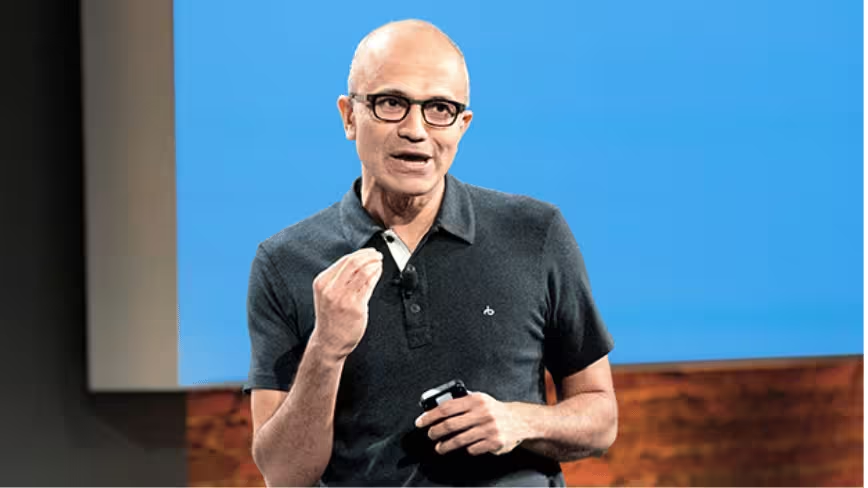
Meta has announced the elimination of about 8,000 positions, roughly 10% of its workforce, beginning May 20. The company is also canceling 6,000 job openings and anticipates more reductions in the latter half of 2026. This large-scale restructure is aimed at focusing resources on artificial intelligence efforts, as Meta allocates $115-135 billion to AI infrastructure. Rather than cutting due to performance issues, the layoffs are part of a strategic realignment into AI-centric teams known as 'pods.' Notably, remaining employees will be tasked with training those who replace departing colleagues.


Tesla has decided to rescind Elon Musk’s $29 billion interim compensation award. This comes after a Delaware court reinstated the larger 2018 pay package, valued at $56 billion. The company is ensuring that Musk does not receive overlapping compensation following his successful appeal to restore the original award.

A significant number of Samsung Electronics employees gathered at the Pyeongtaek facility in South Korea, indicating a readiness to proceed with an 18-day strike scheduled for next month. This labor action underscores growing tensions within the workforce that may further impact the already tight memory chip supply chain.

Sean Plankey has formally requested to have his nomination withdrawn from consideration to lead the U.S. cybersecurity agency CISA. This decision follows a challenging year marked by unstable and chaotic temporary leadership within the agency.


In a recent security breach dubbed "Operation Lunar Peek," attackers exploited two Palo Alto Networks vulnerabilities, CVE-2024-0012 and CVE-2024-9474, affecting over 13,000 devices by chaining a seemingly manageable authentication bypass with a privilege escalation flaw. Despite individual CVSS scores that suggested remediation challenges—one vulnerability scored below common patching thresholds—combined they granted root access to numerous systems. Experts emphasize the failure of scoring systems to account for compound risks and real-world attack strategies, urging a shift beyond traditional CVSS-based prioritization to encompass chained vulnerabilities, rapid exploitation timelines, identity verification gaps, and the growing volume of discovered vulnerabilities due to AI technologies. Key measures include tightening patch deadlines, auditing chains of vulnerabilities, integrating identity-focused controls, and preparing for increased vulnerability discovery rates to prevent overwhelming existing security pipelines.


Experts often discuss persuasion techniques like social proof and trust-building. However, genuine change isn't about just persuasion; it's about shifting the social networks influencing behavior. Successful transformation requires strategies that alter these networks to overcome resistance at its core.
-
Define the grievance and vision: Every change starts with recognizing a key problem (the grievance) and then articulating an aspirational vision. Successful change leaders bridge this gap through a Keystone Change—a clear, tangible goal that includes stakeholders and sets the stage for broader transformation.
-
Conduct a resistance inventory: Every change effort faces pushback that arises because people form attachments to ideas and resist threats to them. Anticipating and understanding categories of resistance helps strategize how to mitigate opposition effectively.
-
Identify targets for action: Not all stakeholders are equal; some are for mobilization, others for influence. Effective strategies differentiate these roles to deploy tactics that leverage strengths against weaknesses.
Ultimately, successful change hinges on applying overwhelming force at decisive points (the principle of Schwerpunkt) and maintaining strategic flexibility. Change requires learning from both successes and failures, continuously adapting, and executing with precision, rather than relying solely on belief or passion.

Elon Musk's AI startup, xAI, is experiencing a significant wave of departures amid organizational shifts, mergers, and new strategic focuses. Since its founding in 2023, all cofounders except Musk have left, including dozens of engineers and program staff. These exits coincide with Musk's evolving vision for xAI, which targets "maximally curious" and pro-human AI to compete with firms like OpenAI and Google. Recent changes include merging with SpaceX and Twitter's parent, X, and pivoting AI product development, especially focusing on Grok, xAI’s flagship chatbot, which has faced public controversies. This period of transformation also includes internal restructuring and a $60 billion option to acquire the coding startup Cursor. Despite the turbulence, Musk remains focused on scaling the company effectively and integrating projects across his ventures, though the talent churn underscores challenges in retaining top AI professionals in a fierce market.


Nike is undergoing a major reorganization of its business, including changes in technology teams and global supply chains, as part of efforts to tackle declining sales.

Discovering the key to retaining top executives may be more straightforward than commonly believed.