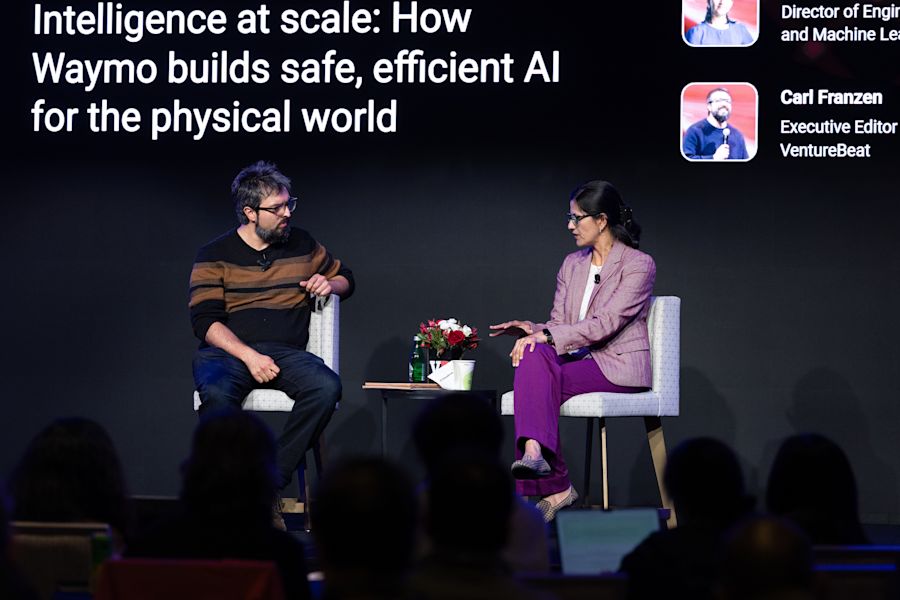
Waymo, Alphabet’s self-driving car division, faces unique challenges where AI performance directly impacts safety on the streets. Their approach to AI development prioritizes continuous and comprehensive evaluation over simply achieving strong model results. Manasi Joshi, Waymo’s director of engineering, shared insights on this at VB Transform 2026, highlighting their strategy of “eval-centric development.”
This means that a project’s readiness is judged by the maturity of its evaluations, not just the model’s output. Waymo conducts ongoing assessments during and after model training, combining real-world driving data with extensive simulations to ensure safety and effectiveness. Evaluations continue post-launch to adapt to evolving conditions and maintain high standards linked directly to key business outcomes.
Safety remains paramount, with detailed attention to rare and hazardous scenarios like construction zones and vulnerable road users. Human oversight remains crucial; automated systems do not make release decisions alone. Efficiency in computing resources is balanced carefully against reliability to meet growing demands without sacrificing quality.
Internally, AI agents assist engineering teams, and these agents themselves undergo rigorous testing to confirm accuracy and trustworthiness. Joshi emphasized that successful deployment of agentic AI depends on clear objectives, representative data, continuous evaluation, scalable infrastructure, and accountable human leadership to build and maintain trust.
Summary:
Waymo sets an industry benchmark by embedding continuous, rigorous evaluation into AI development, focusing on safety and trustworthiness beyond mere model performance. Their approach offers valuable lessons for enterprises deploying AI, emphasizing ongoing testing, human oversight, and linking evaluations to real-world outcomes.
Chinese AI startup Moonshot AI has published the full weights of its largest open AI model to date, Kimi K3, a powerful 2.8 trillion-parameter system with advanced features like a one million-token context window. While the model is openly accessible for download and use, enterprises must carefully review the unique Kimi K3 license, which includes commercial restrictions not found in typical open-source licenses. Specifically, companies generating over $20 million annually and providing “Model as a Service” to third parties must negotiate a commercial agreement with Moonshot AI, while large-scale commercial deployments require prominent attribution of Kimi K3 in their products. The license offers a broad grant of rights for internal and non-commercial uses, making it suitable for many enterprises that want to self-host advanced AI capabilities. Developers have reacted positively to the release, praising the accompanying infrastructure and technical reports, though they note the licensing limits and the operational challenges of running such a large model. This release exemplifies the evolving landscape where “open weights” do not always equate to fully open-source software, ushering in complex legal considerations for commercial use. Enterprises should assess their intended use cases carefully to ensure compliance with commercial terms while leveraging Kimi K3’s state-of-the-art AI performance.

The Model Context Protocol (MCP), an open standard connecting AI agents with global software, has received its biggest update since its launch by Anthropic twenty months ago. Now under the Linux Foundation's Agentic AI Foundation (AAIF), this update revolutionizes MCP into a fully stateless architecture, improves security by enhancing its authentication processes, and introduces a formal 12-month deprecation policy. This transformation enables enterprises to deploy AI agents at scale without the previous challenges of session persistence, allowing seamless operation behind load balancers using modern cloud infrastructure tools like Kubernetes.
Key changes include removing the dependency on persistent sessions, thereby enabling better fault tolerance and scalability, and extending protocol capabilities with new features such as interactive server-rendered interfaces (MCP Apps) and durable long-running asynchronous tasks (MCP Tasks). These improvements allow AI agents to move beyond simple text responses, supporting richer user interfaces and robust handling of complex operations.
Security is fortified by aligning the protocol with OAuth 2.0 and OpenID Connect standards to prevent mix-up attacks, and with enterprise-managed authorization to ensure corporate identity governance. The update is supported by a diverse consortium of technology giants like Microsoft, Google, Amazon, and OpenAI, emphasizing its neutrality and broad industry backing.
Alongside technical enhancements, the introduction of a clear deprecation timeline assures enterprises of protocol stability. MCP is rapidly adopted, evidenced by 250 million weekly SDK downloads, positioning it as a foundational technology for agentic AI workflows in enterprise environments. The new release marks a significant milestone as MCP evolves from an experimental framework into an enterprise-ready standard capable of supporting the next generation of intelligent agents worldwide.

Snowflake has launched Cortex AI Gateway, a centralized platform aimed at regulating how AI agents—including those developed by competitors like Anthropic's Claude Code and Cursor—interact with enterprise data, tools, and models. The gateway features integrations with various identity security providers such as 1Password, Aembit, Linx Security, SailPoint, and Saviynt, creating a collective trust framework for autonomous agents. This move positions Snowflake not just as a data host but as a governance layer controlling AI agent permissions and activities.
The initiative addresses a critical issue: traditional enterprise security models, designed for human actors, are inadequate for AI agents operating at machine speed and across multiple systems. Cortex AI Gateway enforces continuous trust verification for AI agents through dual attribution—logging both agent identity and the human who authorized a task—ensuring task-scoped access and full auditability.
The platform also tackles runaway AI costs by providing IT and finance teams with visibility into AI consumption, attributing spending to specific agents or teams, and enforcing spending limits. This functionality is bolstered by Snowflake’s acquisition of Natoma, which brought advanced identity, policy, and audit features into the ecosystem.
By uniting competing identity vendors under a shared framework, Snowflake aims to prevent new AI silos from forming and foster interoperability. Analyst forecasts predict a trillion-dollar market opportunity in AI agent governance, placing identity verification and control at the heart of enterprise AI strategy. Cortex AI Gateway currently enters public preview, with its partner integrations in private preview, marking a significant step in managing the future of AI agents in business securely and efficiently.

Runway spent weeks tackling a persistent bug where AI-generated avatars drifted off-center in real-time video generation. Instead of fixing it through backend patches, they created a front-end feature to automatically re-center user images, ensuring stable video output. Ryan Phillips, head of enterprise product at Runway ML, shared insights at VB Transform 2026 on how their real-time generative video technology evolved, highlighting the importance of cross-team evaluation processes and innovative development techniques like distillation and adversarial post-training to optimize performance. Runway’s approach emphasizes turning model limitations into user-friendly features, rigorous infrastructure debugging, and embracing “failure hell” to drive breakthroughs. This new mindset allows creatives to shift from designing single assets to creating dynamic worlds generated in real-time by AI models.

Software engineers at General Motors' autonomous driving division now spend only about 15% of their time coding, with AI agents handling much of the other 85%, including data analysis, problem triage, and testing. According to Rashed Haq, GM’s VP of autonomous vehicles, this shift has led to roughly three times as many merged pull requests, faster releases, and fewer defects. GM’s strategy focused on redesigning the entire engineering workflow around AI agents rather than just adding coding assistants. The company connected these agents to internal tools and massive data sets using custom Model Context Protocol servers and gave them instruction sets called "skills" to perform specific tasks. This approach allows agents to access vehicle telemetry data, run experiments in parallel, and automate bottlenecks across simulation, road testing, and post-deployment monitoring. With engineers overseeing critical points and agent permissions matching user access, GM successfully increased development velocity while maintaining quality. This comprehensive integration of AI into workflows substantially improved productivity and reduced errors, far exceeding initial expectations.

Instacart is challenging the conventional approach by asking if much of the engineering work today should actually be handled by machines. At VB Transform 2026, CTO Anirban Kundu explained that development teams often spend time on repetitive, high-volume tasks that AI agents could manage, freeing humans to focus on areas requiring judgment and intent. Remarkably, Instacart’s engineers now rarely read code directly—97% of the time they work through AI systems.
AI handles most code generation and boilerplate tasks, especially for projects updated weekly. This shift means tech debt is no longer a primary concern; inactive code can simply be dropped and rebuilt as needed. However, about 3% of the work, including legacy and compliance tasks, still demands human oversight. Instacart is addressing these by modularizing their systems through their project Atoms, moving from monolithic to RPC-driven architectures.
Evaluation processes are evolving too. Instead of traditional code reviews, the focus is now on an intent-based model where developers query AI with specific goals. Instacart runs thousands of automatic evaluations monthly with near-perfect accuracy.
Additionally, their AI-powered site reliability engineering system, trained on Instacart’s historic incidents, significantly improves detection and resolution of production issues. For example, their internal AI agent Blueberry identified a subtle production hiccup faster than the human team could, showcasing how AI can overcome typical human intuition limits.
Looking forward, engineers’ roles will center on guiding AI systems, designing evaluations, managing experiments, and handling edge cases. Domain expertise is also being democratized across teams through shared code definitions, moving away from siloed ownership of code changes.

A persistent attacker breached the same Langflow server twice, evolving their ransomware to specifically destroy trained AI models. The vulnerability exploited, CVE-2025-3248, allows unauthorized Python execution on the server. The initial attack encrypted configuration items, while the later one deployed ENCFORGE, a ransomware designed for AI assets, targeting specific AI model files like PyTorch, TensorFlow checkpoints, and various AI data formats. Despite its destructive intent, ENCFORGE lacks the ability to exfiltrate data or demand ransom payments effectively, rendering it a wiper.
The impact is severe; restoring AI models is costly and complex, with losses far beyond typical database restorations, making this a critical business risk often underestimated in cybersecurity budgets. The ransomware leveraged built-in shortcuts, such as the Docker socket, to escape containers and execute rapidly, reflecting sophisticated adversary tactics. This threat highlights glaring gaps in patch management, as the exploited vulnerability remained unpatched for over fourteen months.
Experts stress that AI model weights require explicit inclusion in backup and recovery plans. Immediate recommended actions include updating all exposed Langflow instances, securing Docker sockets, naming model artifacts in backups, rotating exposed credentials, and monitoring suspicious file encryptions. This case marks a new frontier where ransomware is purpose-built for AI environments, demanding urgent attention from security and business leaders alike.

Over the weekend, a Reddit user highlighted a troubling discovery: some conversations and AI-generated work products shared via Anthropic's Claude AI chatbot were being indexed by Google Search, making them publicly accessible. These included not only chat conversations but also interactive applications, dashboards, documents, and other collaborative workspaces called Artifacts. VentureBeat verified access to some of these artifacts through Google despite no direct sharing links. By the following day, many of the exposed links had become harder to find, indicating that remedial actions might have been taken. Anthropic clarified that shared links are intentionally public but are not indexed directly by them. This incident raises important questions about user understanding of "shareable" content and the security implications for enterprises using AI platforms for collaborative workspaces. Experts recommend organizations audit shared content, clarify sharing policies, enforce access controls, and regularly review vendor sharing settings to mitigate risks.

In recent years, the way users interact with the web has shifted dramatically due to AI-powered search summaries. Studies reveal that when AI provides summarized answers, users click on traditional search results only 8% of the time, and links within AI citations receive just about 1% of clicks. This trend has caused significant declines in page views for many publishers, with smaller sites especially hard-hit, some shutting down as a result. However, AI platforms are consuming web content more than ever, using it to generate answers and citing deep, specific pages. The issue is that while detailed articles are referenced by AI, users are mostly directed to brand homepages, changing the traffic flow and impacting revenue models based on clicks of individual content pages. The evolving landscape also features conversational advertising inside AI chats, disrupting traditional search ad auctions, with Google both competing in and disrupting its core search business. Publishers must adapt by structuring deep content to be AI-citable, redesigning homepages for pre-informed visitors, and investing in internal site search which is becoming a key navigation tool. This shift signals the end of the traditional click economy and underscores the importance of being recognized by machines while effectively engaging human visitors.