When the One Big Beautiful Bill arrived as a massive, unstructured 900-page document lacking standardized format and official IRS forms, Intuit's TurboTax team faced a pressing challenge: could AI shorten a traditionally months-long tax code implementation into mere hours without losing accuracy?
The solution was a groundbreaking workflow combining commercial AI, a proprietary domain-specific language, and an innovative unit test framework, designed not just for tax but for any team managing complex regulated domains.
Joy Shaw, Intuit's tax director with decades of experience, shared how AI rapidly distilled the law's noisy details into actionable insights, enabling coding to start ahead of official forms. They leveraged large language models to analyze and reconcile House and Senate bill versions, reducing weeks of work to hours.
While general AI tools handled document interpretation, Claude, a specialized AI, translated legal text into Intuit's unique coding language and highlighted only the changes needing developer focus. This selective approach accelerated development.
Two proprietary tools ensured near-perfect accuracy: one auto-generated application screens from law changes, and another provided detailed unit testing that pinpointed errors and allowed in-framework corrections.
Intuit emphasized the importance of verified, deterministic code to meet consumer product accuracy standards, supported by human experts validating AI output.
This workflow’s core elements—using commercial AI for analysis, domain-aware coding AI for implementation, custom evaluation tools, and organization-wide AI fluency—offer a blueprint applicable to sectors like healthcare, finance, legal tech, and government contracting facing similarly complex regulations and tight deadlines.
Sarah Aerni, Intuit's Consumer Group tech VP, remarked on blending AI with human expertise to deliver reliable consumer experiences.

As organizations rapidly adopt AI agents, security gaps are emerging—particularly where agent credentials and untrusted code coexist. Industry leaders at RSAC 2026 highlighted the urgent need to extend zero trust principles to AI systems. The common enterprise pattern bundles AI reasoning, execution, and credential storage in one container, which amplifies risk if compromised. CrowdStrike, Cisco, Microsoft, and Splunk executives all emphasized governance and continuous action verification rather than one-time authentication.
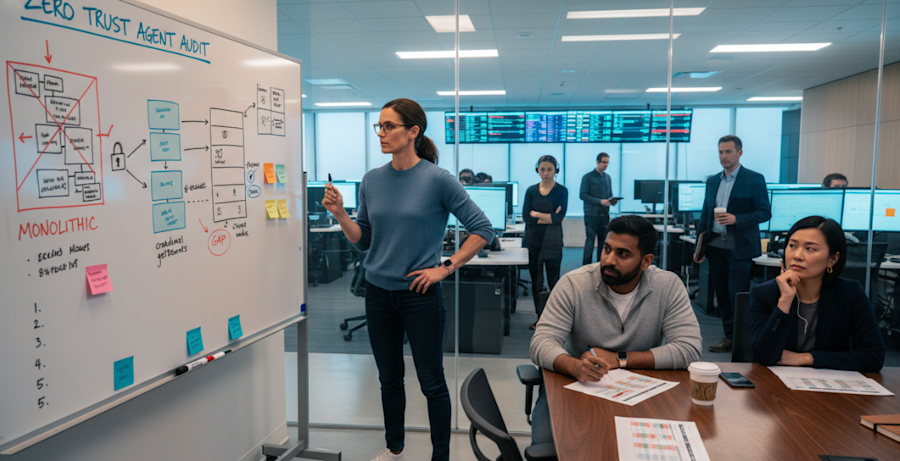
Two pioneering architectures show contrasting approaches: Anthropic’s Managed Agents separate reasoning (the brain) from execution (the hands) and isolate credentials externally, effectively shrinking the attack surface and improving performance. Nvidia’s NemoClaw keeps the agent monolithic but enforces strong layered isolation, intent verification, and real-time monitoring to limit damage and detect misuse quickly. Each design reflects trade-offs between security, complexity, and operational costs.
The key differentiator is credential proximity. Anthropic’s approach structurally removes credentials from risky environments, while Nvidia controls access through enforced policies inside the sandbox. Both address indirect prompt injection—the risk that malicious inputs manipulate agent behavior—only partially, indicating a critical area for future improvement. Comprehensive governance, credential isolation, session durability, observability, and roadmap tracking for injection attacks are emerging as the essential priorities for securing AI agents in enterprise environments.
OpenAI has introduced a $100 monthly ChatGPT Pro subscription aimed at developers and AI programmers, featuring usage limits on Codex that are five times larger than those of the $20 Plus plan. This new tier supplements OpenAI's existing lineup, including free, Go ($8), Plus ($20), and Pro ($200) plans, plus organizational offerings like Business and Enterprise subscriptions. The firm's CEO, Sam Altman, highlighted the growing demand for more robust Codex capabilities as the driving force behind this launch. However, OpenAI is concurrently adjusting ChatGPT Plus limits to encourage more frequent, shorter AI interactions rather than prolonged daily sessions. Detailed limits for local messages and cloud tasks vary by AI model, with tiers including ChatGPT Plus, Pro 5x, and Pro 20x, the latter offering exclusive experimental features for professional users. This strategy arrives amidst rising competition from Anthropic, whose rapid revenue growth and subscription restrictions have reshaped the competitive landscape in autonomous AI coding. OpenAI’s move to increase capacity and onboard key figures from the OpenClaw community aims to solidify its position as the leading platform for AI-assisted software development.

Block has introduced Managerbot, an innovative AI agent integrated into the Square platform designed to proactively oversee small business operations. Unlike previous reactive chatbots, Managerbot anticipates issues such as inventory shortages and scheduling conflicts, offering actionable solutions before the seller is prompted. Key features include inventory forecasting using local data, optimized employee shift scheduling, and automated marketing campaigns targeting top customers. Built on advanced AI models from OpenAI and Anthropic, Managerbot emphasizes user control by requiring seller approval before any changes are made. This launch follows Block's significant workforce reduction attributed to AI integration and highlights the company’s strategic pivot towards intelligence-driven business tools. Early adoption shows sellers consolidating more operations within Square for data-driven decision-making, potentially strengthening Block’s market position. Managerbot aims to improve business decisions and save time for sellers, marking a major step in Block’s AI vision to transform commerce management.

A team of university researchers has introduced Memento-Skills, a pioneering framework that allows AI agents to autonomously update and expand their skills without needing to retrain their core language models. This groundbreaking approach uses an evolving external memory composed of structured markdown skill files, which the AI refines through a cycle of execution, feedback, and self-modification using a mechanism called Read-Write Reflective Learning. Unlike traditional methods that rely on static skill libraries or simple text-based retrieval, Memento-Skills retrieves and upgrades skills based on actual performance and utility, significantly improving task success rates. In benchmarks such as GAIA and Humanity's Last Exam, this system demonstrated substantial gains, including a 13.7-point accuracy improvement and more than doubling performance in complex academic tasks. This technology is especially promising for enterprise applications involving structured workflows, as it reduces operational costs linked to retraining and manual skill updates. To ensure stability and security, automated skill updates undergo rigorous testing before implementation. The researchers have made the code available on GitHub, inviting further exploration and adoption in practical settings.

For over twenty years, digital discovery revolved around a straightforward process: search, scan, click, and decide. This worked well when humans conducted web searches, but AI agents have changed the landscape. These agents consume information differently, leading to a new focus: Answer Engine Optimization (AEO), or Generative Engine Optimization (GEO). Unlike traditional SEO, which values rankings and clicks, AEO prioritizes whether AI comprehends, selects, and cites content. This shift means enterprises must rethink their strategies.
AI agents don't browse like humans; they analyze user intent with persistent context and require concise, structured content. The interaction now includes agents retrieving and summarizing information, shifting emphasis from clicks to citations. Experts highlight that AEO extends SEO by making citation and recognition more important than page rank.
Developers already benefit from AI agents for tasks like research and sales preparation, which these tools simplify and speed up significantly. However, challenges remain with accessibility and reliability due to website restrictions.
For enterprises, competing in an AEO-driven world requires content to be conversational, authoritative, fresh, and well-structured, supported by strong brand presence on platforms influential in AI training datasets. LLM-referred traffic converts at a significantly higher rate (30-40%) compared to traditional SEO or paid channels. Businesses not adapting risk invisibility in AI-mediated searches.
Practical steps include engaging on high-impact forums like Reddit, building YouTube presence, investing in digital PR, and aligning content with AI citation preferences. Quality, expertise, and trustworthiness remain vital, with original long-form content favored. Ultimately, success hinges on focusing on user needs and ensuring content is genuinely helpful rather than trying to game AI systems.

AI-RAN, or artificial intelligence radio area networks, represents a revolutionary approach to wireless infrastructure. It transforms the network from a simple data pipeline into a computational powerhouse—acting as a sensor, computing fabric, and control center all at once. This innovation holds transformative potential for sectors such as manufacturing, logistics, healthcare, and smart infrastructure.
Key insights come from industry leaders Chris Christou of Booz Allen and Shervin Gerami of Cerberus Operations Supply Chain Fund, who emphasize that AI-RAN enables enterprises to shift from mere digital processes to autonomous operations by integrating AI at the network level. Beyond traditional wireless evolution, AI-RAN combines sensing and communications (ISAC) to create intelligent networks capable of real-time environmental awareness, reducing the need for multiple discrete sensors.
AI-RAN also dramatically reduces latency for edge AI computations vital in real-time applications like robotics and quality control, enabling split inference across devices, edge networks, and the cloud. With 5G deployments nearing maturity and 6G standards still in development, now is a pivotal moment for enterprises to influence and adopt this technology. The open software-based architecture lowers barriers to entry, inviting broad innovation and positioning AI-RAN as foundational to future autonomous and AI-driven industrial applications.

For over twenty years, digital discovery has followed a straightforward process: search, scan, click, decide. This worked well when humans were the primary web searchers. However, with AI agents increasingly becoming the main consumers of online information, this approach is evolving. A new paradigm called Answer Engine Optimization (AEO), or Generative Engine Optimization (GEO), is emerging. Unlike traditional SEO, which focuses on rankings and clicks, AEO measures success by how well content is understood, selected, and cited by AI systems.
AI agents analyze user intent with context and memory from past interactions, requiring content to be concise, structured, and clear. The model has shifted from "search, read, decide" to "agent retrieves, agent summarizes, human decides," with agents often handling downstream tasks too. This means traditional SEO methods are no longer sufficient; enterprises must adapt to this new discovery layer.
Developers are already benefiting from AI agents in everyday workflows, using them for faster, more efficient research and synthesis tasks. These tools reduce manual searching and deliver more relevant, actionable outputs. Despite some challenges with data access and reliability, deep mastery of a single AI platform yields the most benefits.
Enterprises must prepare for a world where AI agents decide source citations. Content needs to be conversational, authoritative, regularly updated, and structured with clear headers and FAQ schemas. Building a strong brand presence on key platforms like Reddit, YouTube, and industry forums is essential, as is creating original, expert-backed content that AI models can cite.
Ultimately, success in this AI-driven landscape hinges on producing valuable content that genuinely meets user needs and earning the reputation of being a reliable source for AI-powered search results.

Chinese AI startup Z.ai, renowned for its open-source GLM models, has launched GLM-5.1 under the MIT License, allowing commercial use and customization. This latest model features 754 billion parameters and can autonomously work on tasks for up to eight hours, significantly exceeding prior limits. GLM-5.1 adopts a unique staircase optimization pattern, autonomously refining complex engineering problems with marked breakthroughs, such as optimizing a vector database to achieve 21,500 queries per second, a sixfold improvement over prior models. The model excels in KernelBench, demonstrating sustained gains and competitive performance. Offered through tiered subscriptions and API access, GLM-5.1 balances open source accessibility with proprietary high-speed variants like GLM-5 Turbo. Benchmarks highlight its superiority, outperforming GPT-5.4, Claude Opus 4.6, and others in coding tasks. Users commend its reliability and efficiency, reporting dramatic time savings in complex workflows. This release marks a shift toward AI systems capable of extended, autonomous work, promising to reshape software development and agentic engineering globally.

Anthropic has unveiled Project Glasswing, an ambitious cybersecurity initiative that uses its unreleased AI model, Claude Mythos Preview, to detect vulnerabilities in critical software before malicious actors can exploit them. Partnering with twelve industry giants, including Amazon Web Services, Apple, Google, Microsoft, and the Linux Foundation, Anthropic is committing $100 million in usage credits and $4 million in donations to open-source security. Claude Mythos has autonomously uncovered thousands of serious zero-day vulnerabilities across major operating systems and software, but it will not be publicly released due to its potential risks if misused. Anthropic emphasizes responsible vulnerability disclosure through a careful triage process to avoid overwhelming maintainers and stresses that the cybersecurity landscape is changing rapidly with AI, giving defenders only months to act. In the face of recent operational security mishaps, Anthropic's leadership stresses ongoing improvements to earn and maintain trust while aiming for a public offering around late 2026. Project Glasswing represents a crucial step to strengthen global cybersecurity by providing defenders with early access under strict controls, hoping to stave off threats from less scrupulous actors as AI capabilities evolve rapidly.