


In a joint announcement, Microsoft and OpenAI disclosed updates to their licensing agreement. Microsoft will hold a non-exclusive license to OpenAI’s intellectual property until 2032, continue as OpenAI’s main cloud services provider, and retain its 27% equity in the company. OpenAI will pay Microsoft a capped revenue share through 2030. This news led to a roughly 3% decline in Microsoft’s share price.
OpenAI is working on a groundbreaking smartphone that prioritizes AI agents over traditional apps. This device features a custom processor jointly developed by Qualcomm and MediaTek, with manufacturing handled exclusively by Luxshare Precision Industry. Industry analyst Ming-Chi Kuo highlighted the project's progress based on supply chain insights, suggesting the phone is likely to be released soon.

As AI systems rapidly expand within enterprise settings, a critical challenge emerges: security measures are not advancing at the same speed as AI deployment. Organizations are embedding AI into key workflows, customer platforms, and decision-making systems, yet many still lack strong frameworks to guarantee the security, trustworthiness, and resilience of these AI-driven environments. This gap poses significant risks as AI becomes more integral to business operations.

Stanford's James Zou, known for his FDA-cleared cardiac AI project EchoNet, is now spearheading a new venture named Human Intelligence. The startup is focused on applying AI technology to advance research on the human body. With cutting-edge achievements including a Virtual Lab that designs novel nanobodies and a Virtual Biotech initiative, Zou is reportedly seeking $100 million in funding at a valuation near $1 billion, according to Bloomberg reports.

Oracle has finalized a $16.3 billion financing deal for a single data center campus in Saline Township, Michigan — marking the largest technology debt package ever for a single facility. The bond was primarily anchored by PIMCO, which committed about $10 billion, as U.S. banks stepped back due to concerns over the future demand for AI infrastructure. This deal is part of a broader $72 billion financing effort by Oracle.

China's Ministry of Commerce issued a warning on Friday regarding upcoming US legislation, the MATCH Act, which aims to restrict China's access to semiconductor manufacturing technology. The ministry stated the law would seriously disrupt global trade and stability across the semiconductor supply chain, impacting all parties involved. The MATCH Act, short for Multilateral Alignment of Technology Controls on Hardware, has recently passed through Congress and seeks to tighten controls on hardware exports to China.
Shareholders of Cohere will own about 90% of the newly merged company, with Aleph Alpha's shareholders holding roughly 10%, effectively framing the deal as a Cohere acquisition. The German government is poised to become a key customer following the announcement in Berlin, attended by both countries' digital ministers. Cohere, headquartered in Toronto, and Aleph Alpha, based in Heidelberg, are joining forces to strengthen their presence in the AI industry across the Atlantic.

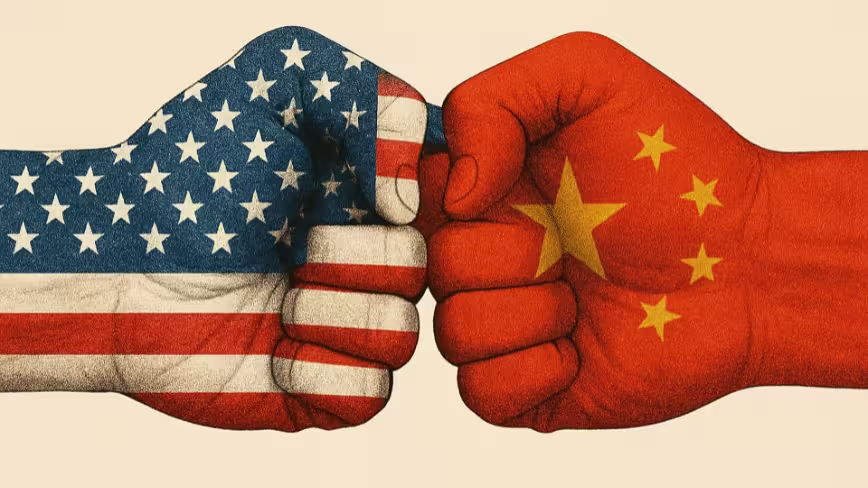
In a move signaling heightened tensions in the US-China technology competition, China is preparing to block US investments in its top AI companies unless government permission is granted. This development, reported by Bloomberg, highlights Beijing's efforts to tighten control over its tech sector amid growing concerns about foreign influence and security. The new restrictions encompass major tech enterprises and emerging AI startups, marking a shift from previous policies focused mainly on chips and exports to now include capital flow and AI model ownership.

Intel reported Q1 revenue of $13.6 billion, exceeding the $12.4 billion forecast by 9.4%. The Data Centre and AI segment saw a 22% increase, reaching $5.1 billion. Non-GAAP EPS came in at $0.29, vastly outperforming the 1-cent estimate. Intel's stock has surged over 80% this year. Additionally, the company is collaborating with Elon Musk on the Terafab chip initiative.

Google is making a substantial investment commitment to Anthropic, pledging up to $40 billion, including $10 billion in cash at a $350 billion valuation and an additional $30 billion contingent on hitting performance benchmarks. The agreement also features a provision for five gigawatts of computing power over five years, totaling around $43 billion in support. This move coincides with Anthropic's impressive growth, as its annual recurring revenue (ARR) surged to $30 billion from just $1 billion in early 2025, reflecting robust market confidence and expansion.
