


While many in the AI space aim for billion-dollar megafunds, Kevin Hartz, co-founder of Eventbrite and founder of the San Francisco-based venture firm A, has chosen a more measured path. A recently closed a $450 million fund, deliberately steering clear of the huge AI megafunds trend now prevalent in venture capital, opting instead for a 'less-is-more' investment approach.

OpenAI has launched Daybreak, a cutting-edge cybersecurity platform that combines GPT-5.5 technology with Codex Security and collaborations from leading enterprise security partners. This initiative focuses on identifying software vulnerabilities, crafting patches, and verifying fixes within enterprise codebases, marking a direct competition with Anthropic’s Mythos, which has been gaining traction in recent months.

General Motors is undergoing a major change by letting go of 500 to 600 of its salaried IT staff, mainly in Austin, Texas, and Warren, Michigan. This move affects over 10% of their IT workforce. Instead of cutting jobs to save costs, GM is reshaping its team to prioritize engineers skilled in developing AI technologies.

Satya Nadella expressed to a federal jury his concern that Microsoft might face the same decline as IBM, especially with OpenAI emerging as a major new force in technology. This admission came from an internal email in April 2022 and highlights the significant anxiety within Microsoft that prompted them to make the largest ever corporate investment in artificial intelligence. The move was a decisive effort to secure Microsoft’s future dominance in the tech industry.

Bristol Myers Squibb has entered into a significant agreement valued at up to $15.2 billion with Jiangsu Hengrui Medicine, the top pharmaceutical firm in China by market value. This partnership includes 13 early-stage drug programs spanning oncology, hematology, and immunology, none of which have yet commenced human clinical trials. The announcement coincided with Bristol Myers Squibb facing critical patent expirations, prompting the strategic collaboration.
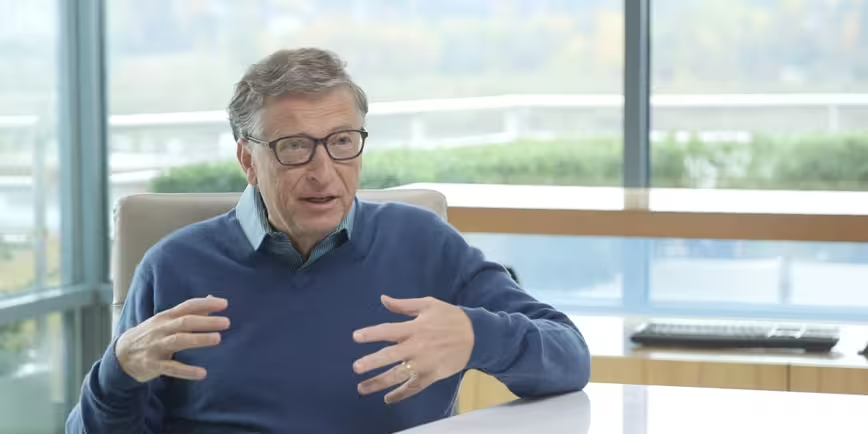
Fervo Energy, a geothermal power developer backed by Bill Gates, has increased its IPO target to $1.82 billion. The company raised its share count by 26% and the top-end price by roughly 8%, as disclosed in a recent SEC filing. This adjustment reflects strong investor interest driven by demand for reliable, clean baseload energy, particularly from AI data center customers.
OpenAI has launched a new venture named OpenAI Deployment Company, backed by over $4 billion in initial funding from a consortium of 19 investors. The funding round is led by TPG, with Advent International, Bain Capital, and Brookfield joining as co-lead founding partners. OpenAI will retain majority ownership and control of this new entity, aiming to accelerate deployment of its technologies.

Alphabet is set to issue yen-denominated bonds for the first time, marking its debut in the Samurai bond market. The deal, led by Mizuho, Bank of America, and Morgan Stanley, is expected to be priced this month. This issuance follows Alphabet’s recent record offerings in Swiss francs, sterling, euros, and a $17 billion euro-Canadian dollar combination, all aimed at supporting its $180-190 billion capital expenditure program.

Novo Nordisk is taking an equity stake in Cellular Intelligence and stands to receive future milestone payments and royalties. Cellular Intelligence intends to apply its AI technology to STEM-PD, a stem-cell-derived Parkinson’s treatment that Novo discontinued in October last year. The transfer marks a strategic move to advance the therapy using AI innovation in biotech.

Santa Clara County has filed a lawsuit against Meta Platforms in California state court, accusing the company of profiting from scam ads on Facebook and Instagram. The complaint, representing California residents, claims Meta generates up to $7 billion annually from these high-risk scam ads and has allowed this activity to continue. The county seeks restitution, civil penalties, and a court order to stop the practices.
