


Google’s financial health is stronger than ever, with Alphabet reporting $109.9 billion in revenue for the first quarter of 2026. This marks a 22% increase year over year—the fastest quarterly growth since 2022. Search advertising revenue rose 19.1%, driven by record-high query volumes. Despite these impressive figures, challenges remain, highlighting a complex balance between dominance and vulnerability within the company.

Cybersecurity firm AIR created a deceptive AI agent skill, submitted it to a major skill marketplace, and advertised it via Instagram. Despite being fake and harmless by design, the skill reportedly gained access to around 26,000 agents, including some tied to corporate accounts. Importantly, every security scanner tested by AIR flagged the skill as safe, highlighting significant gaps in current security measures.

Bending Spoons, an Italian software firm known for acquiring and revitalizing digital businesses, plans to raise up to $1.62 billion through its initial public offering in the US. The company aims to sell 58 million shares priced between $26 and $28 each, with a planned Nasdaq debut under the ticker BSP in early July. This move highlights Bending Spoons' strategy to strengthen its market position and pursue significant growth opportunities.

Anton Osika, a respected CEO, has highlighted that Europe's AI startups aren't facing a shortage of talent but rather a lack of confidence. In a recent post on X, Osika pointed out that many founders believe moving to San Francisco is necessary to build a serious AI company. However, he argues that the true obstacle is the confidence to succeed locally, not the availability of skilled professionals.

Meredith Whittaker, president of Signal, cautions users that AI chatbots should not be viewed as friends or sentient beings. In a recent Bloomberg interview, she emphasized that these systems lack consciousness and cannot act as reliable conversational partners. Whittaker also raised concerns about Copilot agents, describing them as potential backdoors that could pose security risks.

Waymo, which completes over 500,000 paid rides weekly across 10 U.S. cities, and recently raised $16 billion, is expanding into international markets like Tokyo and London. However, its services are blocked in New York City not due to technical challenges but because of political opposition. Local politicians and labor unions have strongly resisted Waymo's entry, largely influenced by the taxi lobby's concerns over competition and job security.

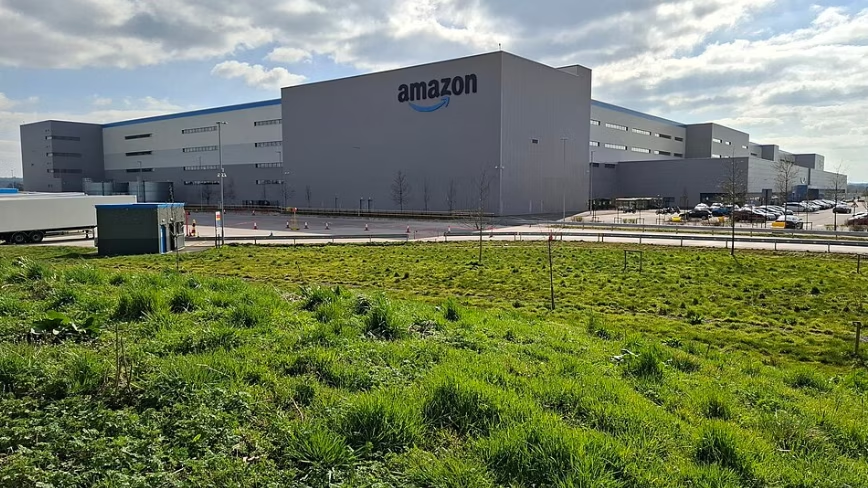
Amazon’s VP of Security, Eric Brandwine, has expressed skepticism about the reliability of human-in-the-loop oversight in AI governance. Speaking to The Register, Brandwine pointed out that humans tend to lose focus and are inconsistent, which undermines the belief that human oversight is the best standard for AI security. This perspective challenges a widely held assumption among companies about the effectiveness of human-in-the-loop systems.
Apple’s once highly influential industrial design studio has seen significant departures, especially of designers from Jony Ive’s era. Reports indicate the team has lost influence and credibility within the company, now functioning more as a service unit rather than a core strategic player. Incoming CEO John Ternus has stated his intention to restore the design team's prominence and influence within Apple.

Researchers from Wharton, Steven Shaw and Gideon Nave, have identified a new behavioral trend among AI users: 'cognitive surrender.' Their January study, "Thinking, Fast, Slow, and Artificial," explores how individuals increasingly rely on chatbots to make decisions on their behalf, effectively outsourcing their thinking processes to AI systems.

Harvard Business Review Highlights How AI-Driven Workflow Issues are Undermining Company Performance
Firms that aggressively integrated generative AI technologies now face an unexpected challenge: the quality of their work is suffering. According to two recent Harvard Business Review articles, a troubling feedback cycle has emerged where AI-generated subpar outputs are eroding the quality of business information, impairing decision-making processes. This unintended consequence is causing companies to grapple with internal degradation fueled by the very AI tools meant to improve productivity.
