


What was once a radical concept has gained widespread support. Nearly 70% of Americans now favor a policy that would require AI companies to allocate half of their stock to a public sovereign wealth fund, according to a June survey of 1,690 U.S. adults by Verasight. This shift highlights growing public interest in shared ownership and oversight of powerful AI companies.

Top executives driving the AI surge remain confident that demand for artificial intelligence technologies is virtually limitless. Pat Gelsinger, formerly of Intel and now at Playground Global, emphasizes that energy supply is the main constraint on growth. Despite this strong belief, the stock market shows uncertainty, reflecting cautious investor sentiment as companies tied to AI experience volatility.
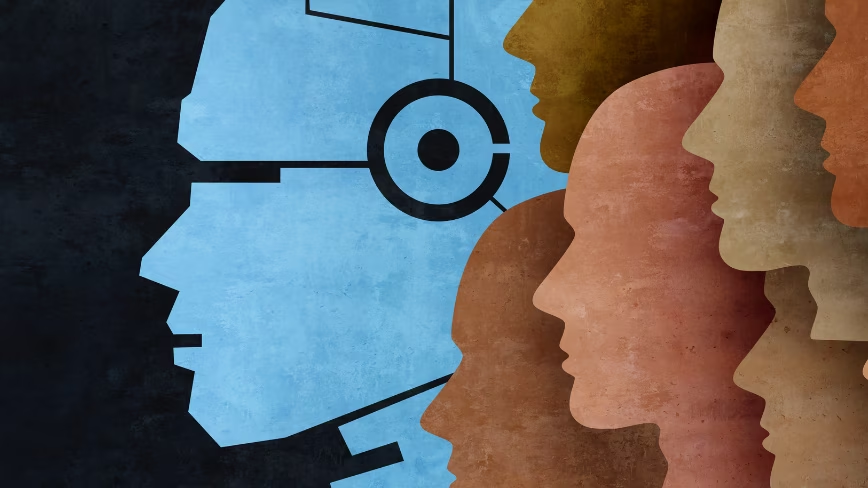
For a long time, the prevailing belief in the AI world was that having the largest model meant winning the race. However, this notion is changing, as reported by CNBC. Companies are now selecting AI models based on specific tasks, cost-effectiveness, and greater control rather than just their benchmark rankings. While cutting-edge advancements remain important, they’re no longer the sole factor in decision-making, especially at an enterprise scale.

Meta’s stock had a tough year, remaining flat while the Nasdaq-100 surged 18%. However, the trend reversed sharply with the stock enjoying its strongest weekly gain since early 2024. Shares increased about 6% on Friday and roughly 15% throughout the week, reports CNBC. This surge was notable as it wasn’t fueled by advertising revenue, which is Meta’s core business. The company shared new plans with investors on how it intends to recover its AI spending, sparking renewed confidence.

Tang Jie, founder of China’s leading AI laboratory Zhipu, advocates for openness in frontier AI development. In an internal memo highlighted by Bloomberg, he argues that the best way to ensure AI safety is through broad accessibility, participation, and shared oversight, opposing the idea of restricting AI advancements to a limited group. This stance contrasts with the more cautious approach favored by his government.

The rise of AI technology has inadvertently triggered the largest surge in construction of natural gas power plants in history, a feat the fossil fuel sector had failed to achieve on its own, according to the Associated Press. Meanwhile, aging coal plants are being kept operational beyond their scheduled retirements. This push to delay plant closures includes efforts by utilities, plant operators, and federal authorities.


Johannes Heidecke is set to leave OpenAI as the company moves to closely align its research and safety divisions, aiming for a more integrated approach.

Meta has quickly withdrawn its Muse Image AI feature from Instagram and the Meta AI app only three days post-launch, citing issues around user privacy. Introduced by Meta Superintelligence Labs under the leadership of chief AI officer Alexandr Wang, the tool launched with a design flaw that caused significant concerns. The swift removal highlights Meta's sensitivity to privacy and regulatory issues that arose shortly after unveiling the technology.


Senator Ed Markey has introduced a new legislative package targeting the negative impacts of artificial intelligence technologies. His proposals address multiple concerns including the excessive energy consumption of data centers, invasive surveillance in the workplace, the perpetuation of bias through automated hiring algorithms, the undermining of worker judgment by AI, and growing economic disparities fueled by disproportionate AI-driven profits.

Starting next week, the Bank of England will have the authority to regulate key technology firms, including Amazon and Google, to mitigate risks that could threaten the UK's financial stability. Alongside the Financial Conduct Authority (FCA), they will monitor critical third-party providers such as Oracle and Microsoft, ensuring these companies maintain strong cyber defenses and reduce the chances of outages or cyber-attacks that could affect millions across the UK.
