


France and Germany have committed to developing a European counterpart to Palantir's military AI software. Following discussions between President Emmanuel Macron and Chancellor Friedrich Merz, the two nations agreed to explore a "European sovereign digital backbone" encompassing data security, artificial intelligence, and cloud technologies. The initiative highlights France’s AI-powered command-and-control system, Arcadia, as a cornerstone of this effort.


Neil Rimer, co-founder of Index Ventures, foresees that the vast wealth generated by AI in Silicon Valley will need to be redistributed, either through voluntary measures or enforced actions. He highlights the historic scale of AI-related wealth creation and the inevitable shift towards its sharing.

Chinese tech firm Moonshot AI has launched an updated version of its Kimi AI model, triggering discussions around the concept of "full AI communism" and the broader implications of advanced AI integration in society.


Apple has surpassed Nvidia to reclaim its position as the world's most valuable company, signaling a shift in investor confidence regarding the future of artificial intelligence. Apple’s market valuation stands at $4.88 trillion, while Nvidia’s valuation fell 3.5% to approximately $4.86 trillion. This change highlights evolving perspectives on AI's market impact and reshuffles the tech giants' hierarchy.

Since 2017, Iason Gabriel has been at Google DeepMind, grappling with the ethical implications and wider impacts of AI development. As the industry faces rising commercial and geopolitical pressures, Gabriel's role centers on anticipating these challenges and pondering the profound questions AI raises about our future. Can ethicists influence the path AI takes amid such intense dynamics? By Robert P Baird, narrated by Simon Darwen. Read the full text version on The Guardian’s website.

More than 4,500 Google employees have signed a petition addressed to CEO Sundar Pichai, urging the company to offer protections against layoffs and introduce buyout options. This action comes as major tech firms reduce staff even while investing heavily in artificial intelligence. Parul Koul, a Google software engineer and leader of the Alphabet Workers Union, highlighted Google's soaring $4 trillion valuation and criticized the layoffs as prioritizing profits over employees. The petition was delivered at Google's California headquarters.


OpenClaw has gained popularity as an agentic framework but struggles at enterprise scale due to the need for real credentials and ineffective traditional guardrails. Brex developed CrabTrap, an open-source HTTP/HTTPS proxy that monitors all network traffic, applies policy rules, and uses a large language model (LLM) as a judge to approve or deny agent requests. By focusing on the network layer, CrabTrap makes nuanced enforcement decisions without needing SDK integrations, enabling framework- and language-agnostic agent governance. Rather than creating policies from scratch, Brex bootstrapped policy rules from actual agent behavior using a policy builder that runs agents in shadow mode. This approach proved more accurate and easier to manage. CrabTrap efficiently handles potential latency issues by activating the LLM judge on only a small fraction of requests and using smaller, faster models. Brex also tackled prompt injection by structuring requests as JSON to avoid manipulation. The system provides extensive audit trails, allows policy refinement through feedback loops, and enhances organizational confidence in deploying autonomous agents. Brex released CrabTrap as open-source to foster community contributions. Future improvements may include advanced authentication, role-based access control, escalation workflows, and automated policy lifecycle management. CrabTrap’s success demonstrates that enterprises can engineer solutions to AI agent governance challenges today, without waiting for the industry to develop perfect tools.

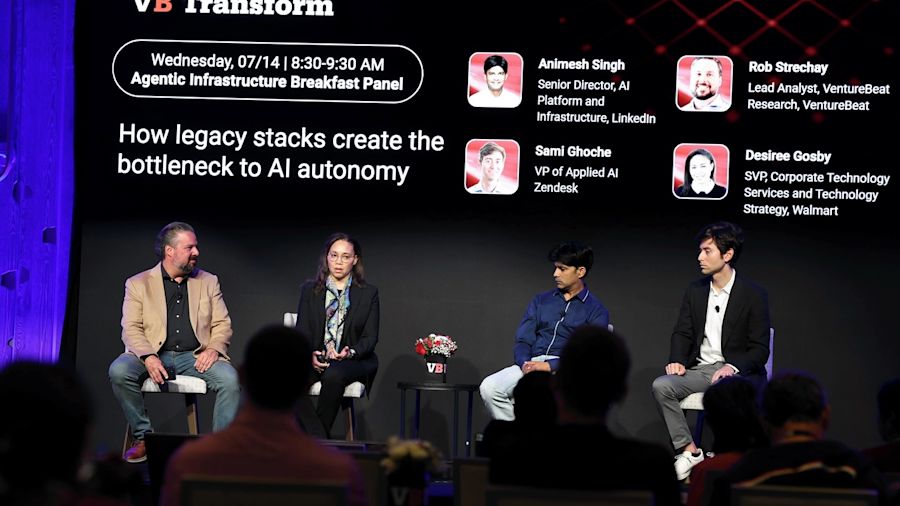
Legacy infrastructure, not AI models, is the real bottleneck slowing down the performance of AI agents. At VB Transform 2026, leaders from LinkedIn, Walmart, and Zendesk shared insights on how their companies tackled this challenge as they moved AI agents from pilot phases to full production. The core issue? Traditional enterprise systems are built for human workflows, which operate on a much slower timescale than AI agents. LinkedIn had to redesign their container provisioning strategy and control flows to reduce lag from seconds to milliseconds. Walmart faced an internal surge of non-engineer "citizen developers" creating overlapping AI agents, prompting them to establish governance and streamline production without slowing innovation. Zendesk wrestled with massive historical customer data, realizing that success required robust data pipelines rather than merely feeding large datasets into language models. All three stressed the importance of owning core infrastructure while selectively integrating frontier AI advancements. Their advice: invest early in evaluation systems, empower employees with AI tools paired with close monitoring, and build infrastructure to remain flexible and model-agnostic for future changes.
Intuit, a pioneer in agentic AI, experienced challenges in its AI agent architecture, leading to two rebuilds within four months. At VB Transform 2026, Nhung Ho, Intuit's VP of AI, explained the shifts from a fleet of specialist agents to a central orchestration layer, and finally to a skills and tools-based system due to complexity issues in the orchestrator. The orchestration layer failed because agents exchanged results via natural language, causing significant loss of context and compounded errors. The rebuild took 60 days with a functional version ready in under 20 days. Gaining support from leadership and engineers involved demos showcasing improved performance and emphasizing scalability benefits. A key feature of the new system is the ability to involve a human agent mid-conversation, enhancing customer support with full context and secure permissions. Feedback mechanisms have evolved, with almost all customers now providing input, enabling systematic improvements through direct, often candid, customer responses.

Capital One has introduced VulnHunter, an innovative open-source AI tool aimed at identifying exploitable vulnerabilities in source code before deployment. The tool performs an attacker-first forward analysis by starting at potential entry points a hacker might use and simulating attack pathways through the application to confirm if vulnerabilities can be exploited. It also includes a falsification engine to minimize false positives by trying to disprove potential vulnerabilities before presenting them to developers, providing detailed explanations and proposed fixes for confirmed issues. VulnHunter runs currently on Anthropic’s Claude Opus 4.8 model and represents Capital One’s commitment to improving cybersecurity through open-source collaboration, especially after the 2019 data breach that impacted millions and reshaped its security strategy. This release aligns with broader financial industry trends toward automated, AI-driven security solutions embedded directly in code development processes, setting a potential new standard for enterprise security tools.
