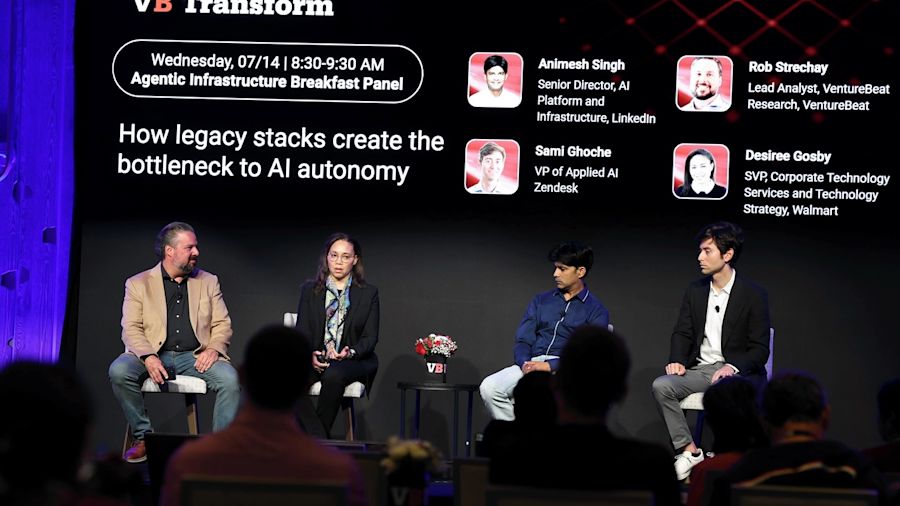
Legacy infrastructure, not AI models, is the real bottleneck slowing down the performance of AI agents. At VB Transform 2026, leaders from LinkedIn, Walmart, and Zendesk shared insights on how their companies tackled this challenge as they moved AI agents from pilot phases to full production. The core issue? Traditional enterprise systems are built for human workflows, which operate on a much slower timescale than AI agents. LinkedIn had to redesign their container provisioning strategy and control flows to reduce lag from seconds to milliseconds. Walmart faced an internal surge of non-engineer "citizen developers" creating overlapping AI agents, prompting them to establish governance and streamline production without slowing innovation. Zendesk wrestled with massive historical customer data, realizing that success required robust data pipelines rather than merely feeding large datasets into language models. All three stressed the importance of owning core infrastructure while selectively integrating frontier AI advancements. Their advice: invest early in evaluation systems, empower employees with AI tools paired with close monitoring, and build infrastructure to remain flexible and model-agnostic for future changes.

Since 1965, Harvard Business Review has surveyed men and women executives on perceptions of women in leadership. Early results showed strong negative views of women in management by many men. Sixty years later, while attitudes improved, a significant gap remains. In 2006, men and women largely agreed on the critical judgment faced by women leaders. Today, 90% of women see higher scrutiny versus 35% of men. Women are more likely to feel they must outperform men to succeed and view promotion criteria as unequal. Men tend to see senior roles as limited by family demands, while women experience pre-emptive assumptions against them. Despite progress, recent political shifts have rolled back diversity initiatives. Studies show women are sponsored and promoted less often, remain underrepresented in leadership, and face higher burnout rates.


Shortly after a firebombing incident at Sam Altman's residence, Anthropic experienced a security breach when an intruder entered their lobby to deliver a warning about a potential threat. This incident underscores the growing security concerns faced by executives in the AI industry, prompting major technology companies to strengthen their protective measures.

AI's rapid expansion is causing a surge in demand for massive amounts of electricity, extensive water usage for cooling, and large physical spaces—pressures that existing global infrastructure struggles to support.

Jamie Dimon, CEO of the largest U.S. bank, downplays fears about AI leading to job losses, highlighting a broader view of AI's role in the workforce.


Anthropic has entered preliminary discussions with Meta to lease computing resources in a deal valued at approximately $10 billion, according to a New York Times report, which CNBC has also confirmed. This negotiation follows Anthropic’s recent $1.25 billion monthly contract with SpaceX to access Nvidia GPUs at the Colossus 1 data center. The collaboration highlights growing demand for extensive computing power in the AI sector.

Apple is currently in preliminary settlement discussions with the U.S. Department of Justice regarding the 2024 antitrust lawsuit that accuses the company of violating competition laws through its iPhone ecosystem. Throughout this year, Apple has proposed multiple offers to resolve the case. While negotiations remain ongoing, there is no certainty that a final agreement will be reached at this stage.


As multinational companies integrate artificial intelligence into their operations worldwide, they face growing challenges from country-specific regulations known as sovereign AI. These rules dictate where data must be stored, whose infrastructure can be used, and how AI decisions are governed, with many nations aiming to reduce reliance on dominant U.S. and Chinese AI models. This regulatory patchwork creates a strategic challenge: global platforms offer consistency but risk geopolitical disruption, while localizing AI infrastructure increases complexity and cost.
Most companies currently treat sovereign AI as a compliance issue under legal or IT departments, yet a recent survey reveals that only 15% of executives consider it a CEO or board priority, even though 60% acknowledge increasing geopolitical risks. Sovereign AI should be seen as a continuum of choices, balancing where accountability lies, the degree of sovereignty required, and which partners to engage.
High-level strategic decisions are critical, exemplified by companies like BNP Paribas partnering closely with European AI providers to keep data under local regulatory control. Sovereignty varies by industry risk, national policy, and specific AI use cases, prompting tailored approaches. For example, AstraZeneca uses different cloud solutions depending on regional regulations and AI application sensitivity.
A hybrid model combining global hyperscalers and trusted local providers is emerging, enabling companies to scale AI while respecting local rules. Strategic partnerships, specialized AI-native infrastructure providers, and federated consortia offer varied solutions to sovereignty challenges.
Ultimately, companies that elevate sovereign AI beyond compliance to a core strategic priority will better manage risks and leverage AI as a competitive advantage in an increasingly complex regulatory landscape.

A recent study involving 101 enterprises reveals that while agent orchestration is rapidly consolidating around leading model-provider platforms—with Anthropic’s Claude taking a significant lead—most deployed agents remain simple chatbot wrappers rather than fully orchestrated multi-step workflows. Enterprises prioritize platforms based on the quality of underlying AI models (“model gravity”) and value reliable, multi-step task execution. Yet, 71% report that only a quarter or fewer of their agents are truly orchestrated, highlighting a gap between ambition and actual deployment.
Looking ahead, enterprises expect a hybrid control plane combining provider-native and external orchestration to avoid vendor lock-in, which is their primary concern. Investments focus on agent workflow tooling and security, though real-time fiscal control over token usage remains limited, with over a quarter lacking mechanisms to prevent cost overruns promptly.
The survey shows that enterprises are moving from experimentation to operational consolidation by standardizing platforms, increasing production deployments, and building in-house controls. Nearly 70% plan to switch or add orchestration platforms within the next year, with many still undecided on their options. This industry is at a crucial crossroads: the orchestration infrastructure is maturing swiftly, but the agents themselves have yet to fully realize their potential beyond chatbot interfaces.

In an analysis of 101 enterprises, the rapid build-out of AI context infrastructure is outpacing the trust enterprises place in it. Retrieval-augmented generation (RAG) has become the predominant method for feeding AI agents business context, with provider-native retrieval tools like OpenAI's file search and Google’s Vertex AI Search surpassing traditional vector databases. Despite this, over half of enterprises report that their AI agents have confidently delivered incorrect answers due to gaps or inconsistencies in the underlying context. While a governed semantic layer is emerging as a vital fix, most organizations are still developing it, pointing to a significant ‘context gap’—where agents sound authoritative but operate on shaky foundations. Enterprises face a strategic tension: adopting provider-native bundles for convenience while preferring best-of-breed, standalone tools for control. Hybrid retrieval architectures combining embeddings with reranking and access controls are widely expected to become the industry standard by 2026. The study highlights that solving this challenge is less about increasing data volume and more about building a consistent, governed, and secure context layer—as AI agents currently outpace the maturity of this essential support infrastructure.