


AI systems tend to be careful when providing answers with significant consequences. The strict standards imposed by regulation are precisely what earn their trust.

The labor force saw its largest one-month decline in prime-age participation since 1976, excluding the impact of the pandemic, with nearly 720,000 individuals stopping work or job seeking during this period.


Brands are evolving the role of creators from merely producing sponsored content to actively participating in the creative process, changing the dynamics of who holds influence over marketing decisions.


Presented by NTT DATA AIVista
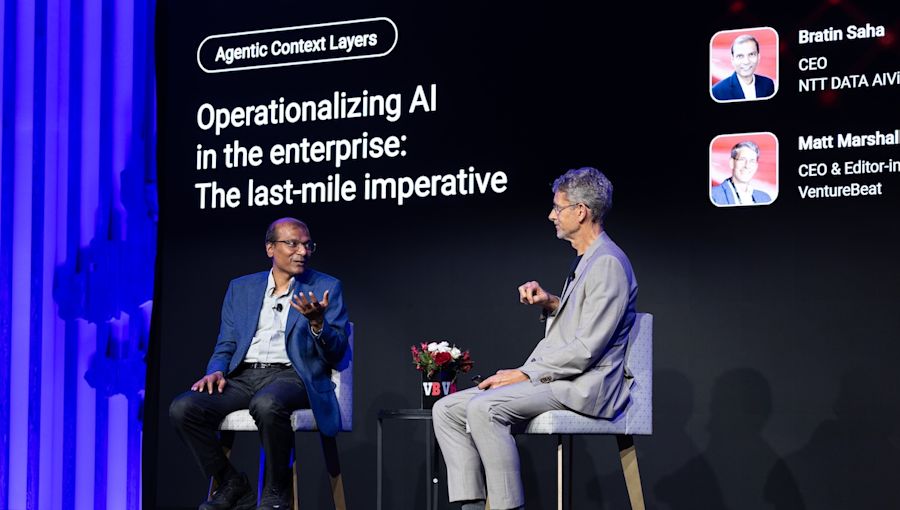
At VB Transform 2026, NTT DATA AIVista CEO Bratin Saha discussed with VentureBeat CEO Matt Marshall the crucial challenge of bringing frontier AI models into regulated enterprise environments. The discussion focused on how enterprises can turn AI investments into actual value by addressing reliability, context, guardrails, and security.
Saha emphasized that success isn’t just about the AI model itself but about building a complete system around it that integrates proprietary data, domain-specific workflows, and strict controls. Many enterprise AI projects fail because they lack proper integration, governance, and clear ownership of results.
Frontier models often struggle out of the box, especially with complex workflows like insurance claims processing. The key to improvement lies in specializing the entire AI system with customer data, workflows, and institutional knowledge that typically isn’t documented. This approach includes capturing enterprise context, running cost-effective ensembles of models, and implementing rigorous guardrails.
Importantly, the last mile of AI doesn’t rely on fine-tuning models but on embedding domain expertise and protecting proprietary workflows. NTT DATA’s advantage comes from combining AI experts with business specialists who understand real-world processes.
Saha also highlighted that AI deployment should be viewed as moving workflows from one point to another, not just deploying technology. Investments should prioritize domain expertise and change management alongside technology to maximize returns.
NTT DATA advocates starting with embedding AI into existing workflows before reimagining them, especially in high-stakes environments where disruptions are risky. Their platform balances bespoke knowledge capture with scalable guardrails and mixed-model ensembles to maintain flexibility and reliability.
NTT DATA’s deep industry expertise, particularly in insurance, provides a durable competitive advantage built over decades of experience and trust.
Sponsored content by NTT DATA AIVista.

Marketing capabilities—comprising the essential skills, processes, and organizational knowledge that drive customer-related initiatives and adaptability—are widely considered crucial for business success. However, the rapid integration of AI technology is reshaping marketing practices, particularly in content creation, customer targeting, and performance measurement, introducing new roles such as managing generative engine optimization (GEO).
For 18 years, The CMO Survey has tracked marketing trends, and its latest 2026 edition, which gathered input from 308 U.S. marketing leaders, reveals troubling insights. Marketing requirements are evolving faster than ever due to AI, yet marketing teams are struggling to build and sustain the necessary capabilities. This disconnect presents a paradox: companies acknowledge the importance of training and hiring to develop marketing skills but are consistently cutting budgets and headcount, undermining their own progress.
Despite recognizing agility as a key success factor, marketing teams excel more at responding to immediate challenges than at investing in the capabilities that would enable smoother, more strategic responses in the future. Seven core obstacles fuel this paradox, including a widening gap between technology adoption and the ability to use it effectively, a strong present-focused mindset that leaves little room for future planning, weak partnerships with CFOs limiting investment, and a persistent preference for building capabilities internally even as resources dwindle.
AI adoption in marketing is rapidly increasing, but organizational readiness lags behind, exacerbating capability deficits. Moreover, marketers often justify capability investments solely by short-term ROI, ignoring their long-term strategic benefits such as competitive differentiation and talent retention. The resulting vicious cycle of underinvestment restricts marketing's ability to prove value, further weakening executive support.
To address these challenges, companies must protect capability investments from short-term budget cuts, reframe them as strategic assets critical to competitive advantage, and reconsider the internal build-only mindset by embracing external partnerships where beneficial.
Ultimately, the marketing capability dilemma reflects a strategic failure to invest in the very strengths that drive lasting business results. In an era defined by AI-driven transformation, overcoming this paradox is essential for maintaining competitive leadership and organizational resilience.


Anthropic has intensified its cloud collaboration efforts recently, culminating in a significant $10 billion agreement with the AI cloud startup Volta. This deal marks a major step in their strategic cloud partnerships.

Waymo has officially removed the waitlist for its robotaxi service in Dallas, marking a significant move toward broader adoption of its self-driving technology. This expansion illustrates Waymo's ongoing efforts to scale its autonomous vehicle operations throughout the United States, as well as in the U.K. and Europe.

Tech companies and developers have been eagerly choosing Texas for new data center projects, attracted by its lenient regulations and abundant power resources. However, recent actions show that Texas is facing limits, as the governor has called for audits, leading to a pause on new data center developments.

Walmart has completed its acquisition of Vibe.co, a TV advertising company, integrating it into Walmart Connect, the retailer's platform for connected TV advertising. The deal, initially announced in June, aims to strengthen Walmart's presence in the connected TV advertising market.

New legislation aims to transform India's instant payment system by revising the current zero-merchant-discount-rate policy. Since 2020, businesses have been exempt from fees when accepting UPI payments, but this move could introduce a new business model for the network.
