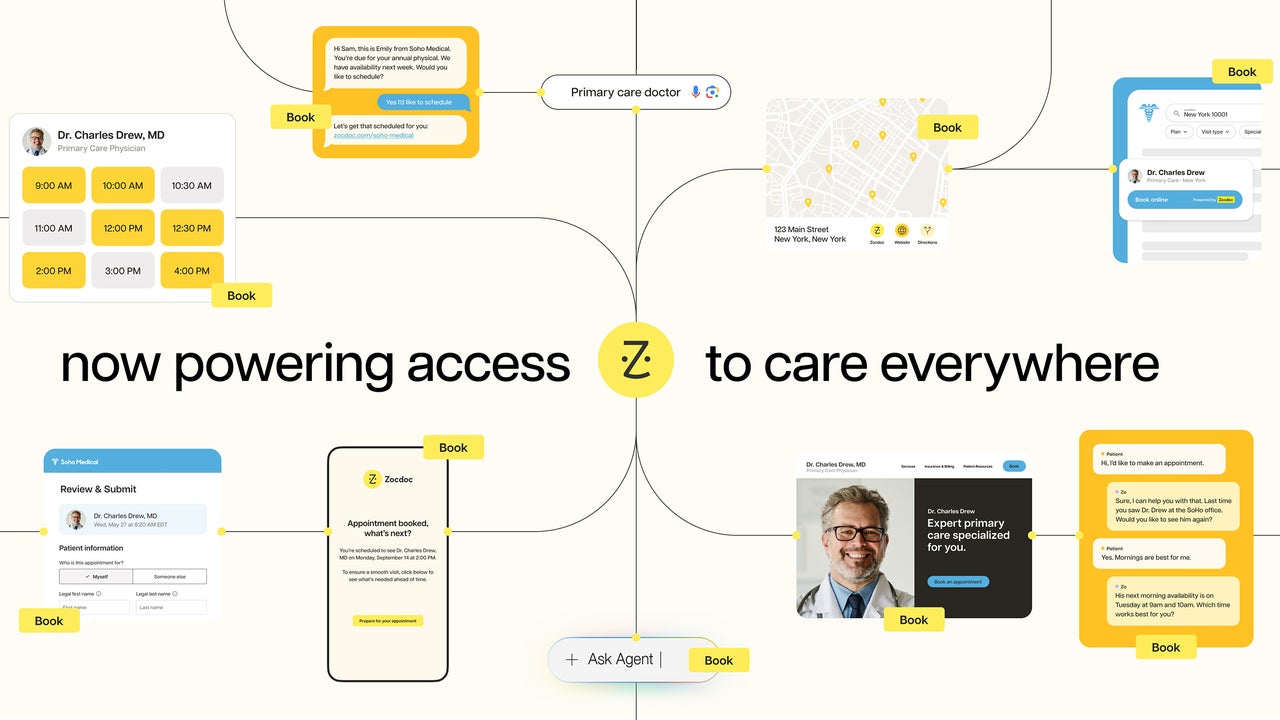
Zocdoc, the online appointment scheduler, is broadening its reach by expanding the Care Access Network. This move enables other platforms—such as Yelp, Healthgrades, and Amazon Health AI—to offer Zocdoc's technology for booking medical appointments nationwide. The tool helps patients find doctors organized by insurance acceptance and available appointment times, addressing the long waits that average 31 days to see a physician. CEO Oliver Kharraz highlights healthcare’s lag in having a universal access layer for bookings, unlike travel or retail. With a network of 200,000 providers and partnerships including the Veterans Health Administration and Blue Shield of California, Zocdoc has improved direct booking options, reduced wait times to six days on average, and drastically decreased no-show rates. As Zocdoc enters a new growth phase, profitability and strategic hires underline its ambition to become a household name and streamline healthcare access for millions.
Stepping into the role of CEO at a historic trillion-dollar company with a beloved predecessor like Warren Buffett is a daunting task. Greg Abel, taking the helm at Berkshire Hathaway, made a bold move to prove his leadership confidence by investing heavily in the company’s future. Early in his tenure, Abel spent significant portions of Berkshire’s cash reserves on expanding stakes in Alphabet, acquiring Taylor Morrison Home, and repurchasing Berkshire’s own shares. By doing so, he not only demonstrated faith in the company's intrinsic value but also signaled his commitment to growth and profitability, reinforcing trust both from shareholders and the market. This strategic confidence inspired analysts to upgrade their stock recommendations and buoyed the company’s share price, despite initial skepticism. Abel’s approach teaches a powerful leadership lesson: backing your own vision with tangible investment builds credibility and fosters confidence in uncertain times.


By SC Moatti
Leading with “we use AI” no longer sets a product apart; AI is now basic infrastructure. According to data from 576 venture-backed AI B2B companies raising over $50 million since 2025, true competitive moats today are those that AI models alone cannot replicate. Using Hamilton Helmer’s 7 Powers framework and insights from Products That Count, two moats stand out:
-
Counter-positioning: Building a business model so distinct that incumbents won’t copy it because doing so would undermine their own business economics. Examples include AI insurers who bypass traditional brokers and AI-native revenue management that competes against consulting revenue. Only 5% of companies employ this, commanding the highest valuation multiples. Key question: Would it cost an incumbent more to copy you than it would cost you to build?
-
Network economies: Value grows as more users or companies join, creating a powerful self-reinforcing cycle. Seen in platforms connecting brands, factories, advertisers, and audiences, where data accumulates and becomes harder to replicate. Also used by 5% of companies, offering strong capital efficiency.
Other assumed moats like proprietary data and switching costs are often weaker than they appear due to model erosion and high capital needs. Scale economies aren’t achievable for most startups outside major players like OpenAI.
Ultimately, the moat is structural—embedded in business model or network design—not just AI tech. Founders must define what aspect of their business would survive a better-funded competitor launching tomorrow. Those who can't answer are merely building products, not enduring powers.
SC Moatti is Founding Managing Partner at Mighty Capital and Chair at Products That Count. She is recognized for pioneering investments and product leadership, with deep experience building award-winning products at Meta and Siebel Systems.


Fidji Simo, previously OpenAI's second-in-command and the executive who guided Instacart through its 2023 IPO, has joined Nscale's board in a strategic move ahead of the company's potential public offering.


Amazon has officially released its Quick desktop assistant for macOS and Windows, targeting enterprise IT users as a secure, governed alternative to shadow AI tools. The service operates within standard European AWS regions, ensuring all data processing remains inside Europe. However, it is currently not listed among services for the AWS sovereign cloud available in Brandenburg.

Pony.ai and Verne have initiated Europe's first fully driverless passenger rides in Zagreb, with no driver present and Uber managing bookings. Their goal is to deploy over 2,000 robotaxis across Europe, although current EU regulations limit annual approvals for fully automated vehicles to 1,500 units. This marks a significant milestone in autonomous transportation on the continent.

ElevenLabs has successfully listed five of its services on the software section of the UK government’s G-Cloud 15 framework, as noted on the Digital Marketplace. These offerings include conversational agents, transcription, dubbing, and text-to-speech capabilities. Interestingly, just three months earlier, the government had entered into an agreement with ElevenLabs which stipulated no purchases. This development marks a notable shift in government-cloud service engagements, as initially reported by TNW in June.
The United Arab Emirates is set to invest €40 billion ($46.4 billion) in Germany, focusing notably on the construction of new data centres with a total capacity of approximately one gigawatt. This investment package was unveiled during a joint announcement on 10 September amid the state visit of UAE President Sheikh Mohamed bin Zayed Al Nahyan to Germany, highlighting the strengthening economic ties between the two nations.


From ghosting candidates to unclear salary details, ineffective hiring communication is driving away the best talent. Learn why building candidate trust is becoming the key competitive edge in recruitment today.


A strong UX concept alone doesn’t guarantee funding. Alex Williams illustrates a practical approach to demonstrate business value by calculating expenses, establishing cause-effect relationships, and constructing a convincing argument for the financial returns of design projects.