


Google's REPLIQA program is supporting academic researchers by funding projects that apply quantum science and artificial intelligence to the life sciences. This initiative aims to accelerate scientific discoveries and push the boundaries of understanding in fields essential to health and biology.


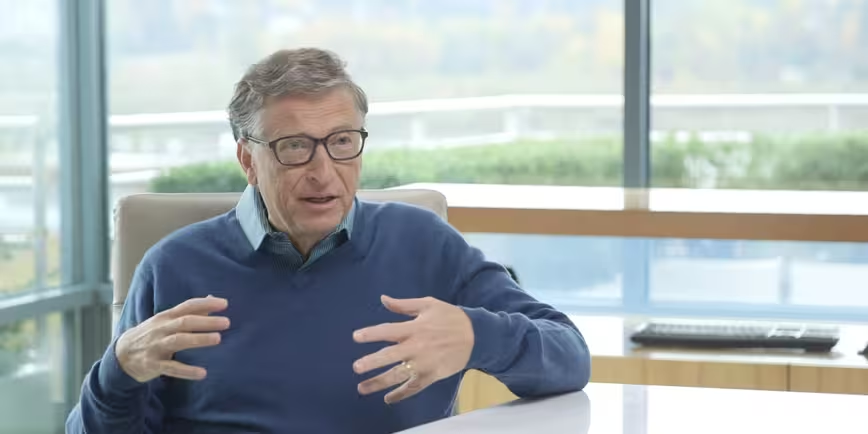
Fervo Energy, a geothermal power developer backed by Bill Gates, has increased its IPO target to $1.82 billion. The company raised its share count by 26% and the top-end price by roughly 8%, as disclosed in a recent SEC filing. This adjustment reflects strong investor interest driven by demand for reliable, clean baseload energy, particularly from AI data center customers.
OpenAI has launched a new venture named OpenAI Deployment Company, backed by over $4 billion in initial funding from a consortium of 19 investors. The funding round is led by TPG, with Advent International, Bain Capital, and Brookfield joining as co-lead founding partners. OpenAI will retain majority ownership and control of this new entity, aiming to accelerate deployment of its technologies.

Novo Nordisk is taking an equity stake in Cellular Intelligence and stands to receive future milestone payments and royalties. Cellular Intelligence intends to apply its AI technology to STEM-PD, a stem-cell-derived Parkinson’s treatment that Novo discontinued in October last year. The transfer marks a strategic move to advance the therapy using AI innovation in biotech.


Helsing, a five-year-old European startup specializing in military drones, is preparing to secure a substantial funding round approaching $1.2 billion, valuing the company at $18 billion. The company has quickly emerged as a notable player in defense technology, attracting significant investor interest.


US President Donald Trump is set to visit China, accompanied by influential tech leaders including outgoing Apple CEO Tim Cook and SpaceX and Tesla CEO Elon Musk. The delegation also features Meta’s new president Dina Powell McCormick, Micron’s CEO Sanjay Mehrotra, Cisco’s CEO Chuck Robbins, and Qualcomm’s CEO Cristiano Amon. The trip aims to focus on technological discussions, particularly artificial intelligence, signaling a shared interest with Chinese President Xi Jinping.


Is AI moving beyond traditional turn-based chats? Today, Thinking Machines, an AI startup founded by ex-OpenAI leaders Mira Murati and John Schulman, previewed 'interaction models' — a new AI system designed for near-real-time multimodal interaction. Unlike current models that wait for users to finish speaking or typing before responding, these models process short chunks of input and output simultaneously in a full-duplex manner. This technology enables AI to listen, speak, and even react visually in real time, creating a more natural conversational experience. The system uses a dual-model approach: an Interaction Model for managing dialogue, and a Background Model for more complex tasks like web browsing or sustained reasoning. Preliminary benchmarks show significant improvements in responsiveness and interactive quality compared to other leading AI models. Though not yet publicly released, these models hold promise for enterprises by enabling real-time monitoring, safety alerts, live translations, and time-aware operations previously not feasible. Founded in 2025, Thinking Machines has quickly established itself with large funding and partnerships with Nvidia and Google Cloud, continuing to attract top talent and innovate on AI interactivity.


Focus on delivering results rather than billing by the hour or effort invested.


Vinod Khosla, head of the venture capital firm Khosla Ventures which oversees assets exceeding $15 billion, shares his insights on the rapid expansion of AI's capabilities. He forecasts that within five years, AI will be capable of performing 80% of jobs currently done by humans. Khosla also emphasizes which skill will become the most important for thriving in this evolving AI-driven landscape.


Within the gene therapy community, frustration mounts as Capsida has yet to disclose which brain receptor was involved when the adverse event occurred, delaying progress in understanding the incident.
