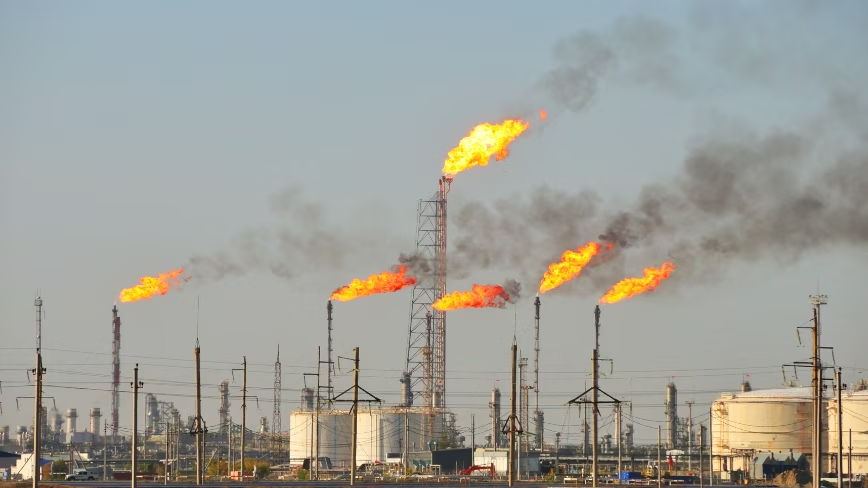
Meta has increased its investments in natural gas over the last year and has consequently decided to leave a major clean energy coalition. This shift reflects a strategic move as the company accelerates its natural gas infrastructure development, stepping back from its previous renewable energy commitments.


As more companies embed artificial intelligence in their operations, the environmental impact of AI remains largely unmeasured, especially since many use closed AI models that do not reveal their energy consumption. Watershed, a startup specializing in emissions tracking, has developed a framework enabling businesses to estimate their AI-related carbon emissions. Their model factors in data center infrastructure and measures emissions per million AI tokens used. By integrating emissions data with existing AI usage tracking, companies can better align sustainability goals with cost management. Investors, auditors, and regulators are increasingly pressing firms to disclose these emissions, which currently fall under Scope 3 indirect emissions, such as business travel. While AI’s share of total corporate emissions might be modest now, it’s expected to grow rapidly, making early adoption of measurement tools crucial. Watershed’s approach not only estimates emissions but links them to actionable choices like AI model selection, query region, and prompt design, all of which affect energy use and carbon output. The challenge remains that precise energy data is scarce, largely due to closed proprietary models and ‘commercially sensitive’ information being withheld. Nevertheless, Watershed hopes companies will share emissions-per-token ratios, improving estimation accuracy over time and potentially highlighting efficiency gains in AI technology.


The water industry has raised serious concerns about the UK’s capacity to support future datacentres, highlighting potential water shortages that could impede AI development plans. Datacentres require substantial water usage to cool their server equipment, utilizing systems like cooling towers and chillers. This demand is compounded by the high electricity consumption that indirectly drives water usage. Industry experts warn that without government intervention to address these cooling water needs, the ambitious plans for AI growth may face critical obstacles.

By 2033, newly established data centers may consume an amount of electricity comparable to the current usage of India, highlighting a significant surge in power requirements.


Kevin O’Leary, known for his role on "Shark Tank," recently argued that AI data centers consume significantly less water than golf courses in the U.S. This statement comes amid controversy over his large Stratos data center project in Utah, which has faced local protests and prompted a gubernatorial executive order. While his comparison is accurate based on current data, the reality of water usage in data centers versus golf courses is complex and involves various factors beyond simple consumption figures.


AI's rapid expansion is causing a surge in demand for massive amounts of electricity, extensive water usage for cooling, and large physical spaces—pressures that existing global infrastructure struggles to support.

In an unprecedented move, New York has become the first state to impose a moratorium on hyperscale data center construction. Governor Kathy Hochul is expected to sign an executive order stopping new permits for data centers that use 50 megawatts or more of power. These hyperscale centers, often associated with tech giants like Amazon, Google, and Meta, have recently expanded rapidly to support AI infrastructure. The moratorium, effective immediately and lasting up to a year, aims to provide time for the development of a Generic Environmental Impact Statement (GEIS) to set uniform environmental standards for future projects. This action reflects concerns about the strain on resources, rising utility costs, and community pushback tied to these large-scale developments. The pause also coincides with recent legislation proposing stricter controls and renewable energy goals for data centers. Political debates continue as Governor Hochul weighs the bill amid an upcoming election, with opposition voices questioning the statewide moratorium’s impact on job growth and investment.

Microsoft’s total carbon emissions surged by 25% in 2025, as revealed in its latest sustainability report, driven largely by expanding AI data centers. Experts warn emissions will continue rising because Microsoft still relies heavily on fossil fuels to power these centers. The increase was mainly attributed to both the growth of AI infrastructure and a temporary pause in using certain renewable energy certificates. Although Microsoft aims to be carbon negative by 2030, its upcoming gas power plant projects—totaling 4.75 gigawatts—are expected to more than double emissions, releasing over 15 million metric tons of CO2 annually. Critics argue the current sustainability report downplays these projected emissions and highlight Microsoft’s new fossil fuel deal with Chevron, which undermines its green goals. Despite acknowledging the challenge that AI infrastructure poses to its climate commitments, Microsoft maintains that AI can aid sustainability efforts and continues to seek ways to increase carbon-free electricity and support clean energy expansion. Other tech giants like Google and Amazon are also facing rising emissions linked to AI infrastructure growth, indicating a broader industry trend.

The Guardian’s global technology team is exploring the tangible impact of the massive datacentres fueling the AI revolution. Their coverage has shifted from digital screens to real-world infrastructures, requiring extensive on-site investigations. In a recent report, they uncovered that an £8.2bn AI complex in rural Scotland falsely claimed it would run entirely on on-site renewable energy. Aisha Down, one of the reporters, highlights the immense physical limitations and real-world challenges behind building these datacentres, showing how these factors critically influence the future of AI development.

The rise of AI technology has inadvertently triggered the largest surge in construction of natural gas power plants in history, a feat the fossil fuel sector had failed to achieve on its own, according to the Associated Press. Meanwhile, aging coal plants are being kept operational beyond their scheduled retirements. This push to delay plant closures includes efforts by utilities, plant operators, and federal authorities.