Would you be ready to trust an AI agent to manage your Amazon store? This possibility might be closer than you think. However, true AI-driven transformation goes beyond simple AI tools that just fill gaps. It demands developing a foundational infrastructure that enables AI agents to design and oversee their own workflows. We gathered perspectives from 7 seasoned e-commerce experts on what still isn’t working and what the industry needs to advance.
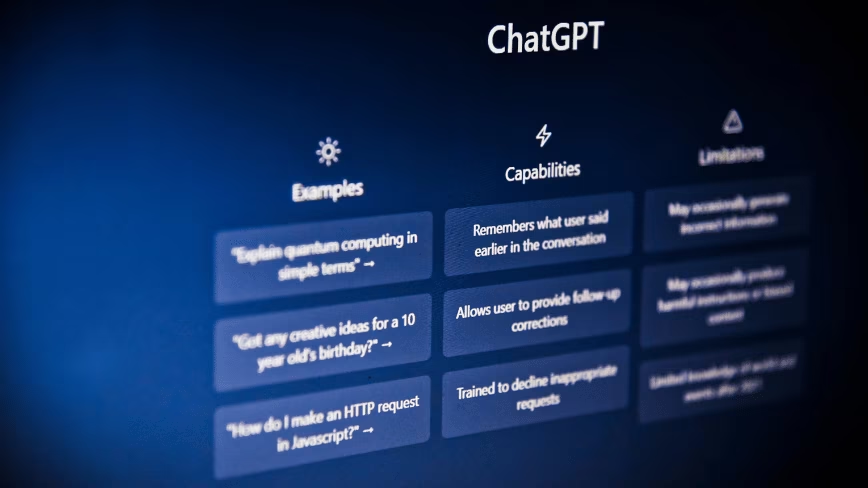
In August, ChatGPT accounted for 95.1% of all AI chatbot referral traffic to websites, marking its highest share this year, BrightEdge reports. The search marketing firm highlighted a 101% increase in ChatGPT's referral traffic from January to August. Gemini followed with 2.4%, while Perplexity and Claude contributed 1.1% and 0.8%, respectively.
New data from NIQ reveals that 51% of US shoppers used an AI application to assist them with their shopping decisions in the past month. This marks the first time the adoption rate has exceeded the 50% threshold, as tracked by NIQ’s Agentic Commerce Tracker. Usage of AI-powered shopping tools has steadily increased over the last two quarters, highlighting a growing reliance on artificial intelligence to enhance consumer experiences.


Google's latest update, Gemini 3.8 Live, allows users to engage in conversations with the AI model while watching a dynamic animated avatar respond in real time. This 'Live Avatar' feature syncs lip movements and facial expressions with speech, enhancing the interaction experience. Currently, it is available exclusively to Gemini Enterprise clients. Remarkably, the Live Avatar can seamlessly switch between the 97 supported languages without losing video quality or causing visual lag. Demonstrations include the avatar speaking English and Japanese with perfectly aligned mouth movements. Additional features include on-screen information display during conversations.


During a Workday-hosted roundtable in Dublin, four industry experts discussed the challenges of AI adoption, the urgency of reskilling, and the persistent underrepresentation of women in high-paying AI leadership positions.


Our recent study with 315 participants revealed a surprising insight: those we assumed would easily spot AI-edited videos—your smartest customers—were actually the most prone to being fooled. This challenges common assumptions about content authenticity and highlights a new vulnerability in customer trust that businesses need to address.


At a glance, New York City's tech sector seems robust, with giants like OpenAI, Anthropic, and Google expanding their presence. From 2008 to 2023, tech jobs surged by 160%, trailing only San Francisco’s rapid growth. Yet, despite this, entry-level tech positions have sharply declined by 49% since the public debut of ChatGPT and the onset of the AI boom. A report from the Center for an Urban Future reveals this reduction as the steepest among all sectors, even amid a steady stream of new graduates in computer science struggling to find openings.
Employers are increasingly favoring candidates with prior experience, shrinking the first rung on the career ladder and causing a ripple effect that limits opportunities for fresh talent. Entry-level roles most vulnerable to generative AI exposure have fallen 29%, while jobs less affected by AI, especially in security and data analysis, remain strong or are growing. Workers skilled in AI see heightened demand, with related job postings up 20%.
This trend mirrors broader national shifts where young workers face a growing employment gap in AI-impacted roles. Surveys show rising skepticism among younger adults about AI’s effect on job prospects. The impact extends beyond highly skilled workers, threatening traditional pathways for those without degrees aiming for white-collar positions.
For New York City, where tech jobs have previously enabled economic mobility, the AI-driven changes signal a pressing need for reinvestment in workforce development to ensure inclusive access to future opportunities. The sector remains poised for growth, but the challenge lies in opening doors for the next generation of tech talent.

Mass layoffs in the tech industry often grab headlines, but beneath the surface lies a far more alarming issue: a sustained decline in labor participation. Take, for example, the story of Dan Coda, a technical program manager from Durham, NC, who after 300+ hours of job searching and dozens of applications, remains unemployed for six months. While his experience highlights individual struggles, aggregated data reveals a deeper crisis. Despite nearly two million Americans facing long-term unemployment—a figure unseen since the Great Recession—the overall unemployment rate remains deceptively low because many are leaving the workforce altogether. This drop in labor participation, especially among prime-age workers, has been ongoing for over two decades in tech, and AI's rise has intensified fears, prompting seasoned workers to exit the industry. The problem is that companies haven't replenished their talent pipelines, which exacerbates this decline. Labor participation must become a key metric for forecasting economic health, as continued drops could ripple through inflation, consumption, and GDP growth. Businesses that leverage AI to enhance employee value rather than replace workers are likely to thrive as the market adjusts.


A major data centre project in Loughton, Essex, which was set to be the UK’s largest AI supercomputer, has been delayed due to power supply challenges. Initially slated to begin operations next year and hailed by the government, the facility’s launch now risks being postponed until the mid-2030s.


Oracle's shares fell approximately 4% on Thursday following investor skepticism about the company's ability to fulfill its ambitious plans for expanding AI data center infrastructure. The recent 'force majeure' notice issued by Oracle has intensified doubts regarding their delivery timeline and capacity for this large-scale AI infrastructure project.