


AI-powered roleplay offers customer-facing teams unprecedented opportunities to practice and refine their skills in realistic, dynamic simulations. Instead of relying solely on scheduled sessions or live coaching, frontline employees—from call center agents to retail staff—can engage in anytime training that evaluates their questioning, empathy, product knowledge, objection handling, and overall customer interaction quality. These roleplays feature scenarios such as handling frustrated customers, cross-selling in banking, managing refund requests, and de-escalating billing disputes, all with instant, personalized AI feedback to help improve tone, listening skills, compliance, and efficiency. By simulating unpredictable customer behaviors and providing consistent coaching, AI roleplay helps frontline teams build the confidence and instincts needed to excel in real customer interactions. This approach scales across onboarding, continuous learning, and performance management, transforming training into an ongoing, adaptive practice rather than a one-time event.

When we imagine robots, we often picture something humanoid, but the real revolution in 2025 is happening behind the scenes—silent, relentless, and indispensable. Over a century after the term 'robot' was coined by Josef & Karel Čapek to mean artificial labor, LLM agents are now redefining business operations. These agents aren’t just interactive chatbots; they handle critical back-office tasks—processing documents, verifying data, updating systems, and flagging issues—without pause or error.
Unlike traditional automation, which relies on fragile scripts prone to failure with user interface changes, LLM agents are adaptable, self-aware systems that understand goals and figure out the methods autonomously. This shift is driving the intelligent automation market toward a $51 billion valuation by 2026, with LLMs leading the way. At Born Digital, we’re replacing bulky, old automation with compact, efficient agents that reduce overhead and increase productivity.
We’ve successfully deployed our first agent managing server support tasks—running diagnostics, restarting services, and escalating problems—saving significant time. Scaling becomes easy; instead of hiring more people, we deploy more agents that consistently follow policies and never lose focus.
This is the future Born Digital is building: intelligent, scalable infrastructure that operates like code. Čapek’s robots are here, working quietly in the background, handling tasks from reading logs to solving problems proactively. The opportunity is now—if your data is ready, your LLM agent can be operational in weeks. The real question is how many opportunities will you miss before then?

This comprehensive guide draws from real-world experience across 150+ enterprise AI projects in industries like banking, healthcare, insurance, telecommunications, retail, and public sector. It offers practical advice on choosing, implementing, and scaling conversational AI tailored to specific business challenges. The guide explains the evolution from simple chatbots to integrated solutions combining AI agents, Voice AI, Digital Humans, and conversational analytics. It emphasizes starting with business problems instead of technology, matching solutions to objectives such as reducing repetitive inquiries, improving self-service, modernizing customer touchpoints, or automating workflows. Guidance on evaluating vendors includes considering business alignment, enterprise readiness, flexibility to adapt over time, and the importance of ongoing support and improvement post-deployment. It also addresses common pitfalls like starting with technology-first, expecting perfection from AI, and underestimating integration, data quality, and cross-team collaboration. Detailed questions for vendors help organizations choose platforms fit for long-term value and enterprise complexity.

As businesses increasingly adopt automation for customer service, training, and self-service, it is crucial to distinguish between digital humans and chatbots to choose the right solution. Digital humans are AI-driven, human-like avatars that engage users through voice, facial expressions, and gestures, creating immersive and natural interactions. Chatbots, on the other hand, are text-based AI tools that handle customer queries, automate tasks, and support communication over websites and messaging platforms.
Digital humans excel in voice interaction, visual engagement, and more personalized customer experiences, often deployed in customer service, onboarding, employee training, and physical kiosks. Chatbots are best suited for high-volume text interactions like FAQ automation, simple website assistance, and self-service support. Both technologies integrate with enterprise systems and knowledge bases, but digital humans add a layer of human touch and brand consistency. Many organizations find value in combining these technologies to meet diverse business and customer needs.

This article explores the distinctions between AI avatars and traditional chatbots in various contexts such as customer support, voice AI, onboarding, enterprise automation, and real-time communication. Traditional chatbots are primarily text-based, focusing on predefined conversation flows and basic customer requests. In contrast, AI avatars offer a more natural and interactive experience, combining voice, chat, visual interaction, and advanced workflow automation. They serve diverse enterprise needs including customer engagement, multilingual support, operational guidance, and internal training. AI avatars enable real-time conversations with low latency and human-like interaction, making them suitable for complex support scenarios, kiosk assistance, and internal enterprise communication. Chatbots remain a cost-effective solution for simple FAQ automation and straightforward website assistance, ideal for organizations beginning their automation journey. The integration capabilities of AI avatars with CRM, analytics, and operational systems further enhance their value in enterprise environments.

The way patients interact with healthcare services is shifting dramatically as AI voice technologies redefine patient support. In 2026, clinics and hospitals are no longer limited by traditional office hours — patient inquiries happen anytime, anywhere, through AI-powered phone and chat systems providing seamless support around the clock. This evolution dramatically reduces missed calls, shortens wait times, and lightens administrative workloads by handling routine tasks such as appointment scheduling, patient registration, insurance verification, and basic triage efficiently and attentively. Beyond inbound interactions, AI voice agents proactively engage patients with follow-ups, reminders, and chronic care check-ins, offering a new level of personalized, continuous care. These advancements pave the way for greater operational efficiency, improved patient satisfaction, and enhanced clinical outcomes, bridging the gap between high-quality medical care and exceptional patient experience.

AI Avatars for Business: Delivering a consistent and interactive brand experience across web, mobile, kiosks, and more, in multiple languages. Many businesses struggle with inconsistent customer experience across platforms and regions, undermining brand trust. AI avatars solve this by providing one cohesive digital persona with a unified voice and appearance, capable of handling complex conversations and transactions in real time. These avatars engage users with 3 times higher interaction rates than text chatbots, resolve 80% of queries autonomously, and support 95+ languages out of the box.
AI avatars are not just videos or prerecorded messages—they are live, responsive digital humans powered by real-time voice AI and integrated knowledge bases, able to seamlessly perform tasks from answering FAQs to processing claims and conducting transactions.
This technology enables a single, scalable brand persona deployed across various channels—website, apps, kiosks, digital signage, and employee tools—ensuring customers worldwide receive a consistent experience regardless of language or location.
Businesses can roll out AI avatars gradually, starting with customer support or sales, then expanding to complex workflows and physical kiosks, benefiting from a modular, scalable platform that avoids typical vendor lock-in. This expanded capability brings greater efficiency, consistency, and customer satisfaction at scale.
Organizations gain a trustworthy and engaging brand face that drives higher customer retention and conversion through personalized and natural conversations. The AI avatar represents a strategic investment into creating a seamless and memorable brand presence across touchpoints, ready for enterprise-grade deployment today.
Ready to explore a customized AI avatar for your brand? Contact us to build a tailored proof of concept that fits your specific channels, languages, and workflows, and see how this technology transforms the way your business communicates.

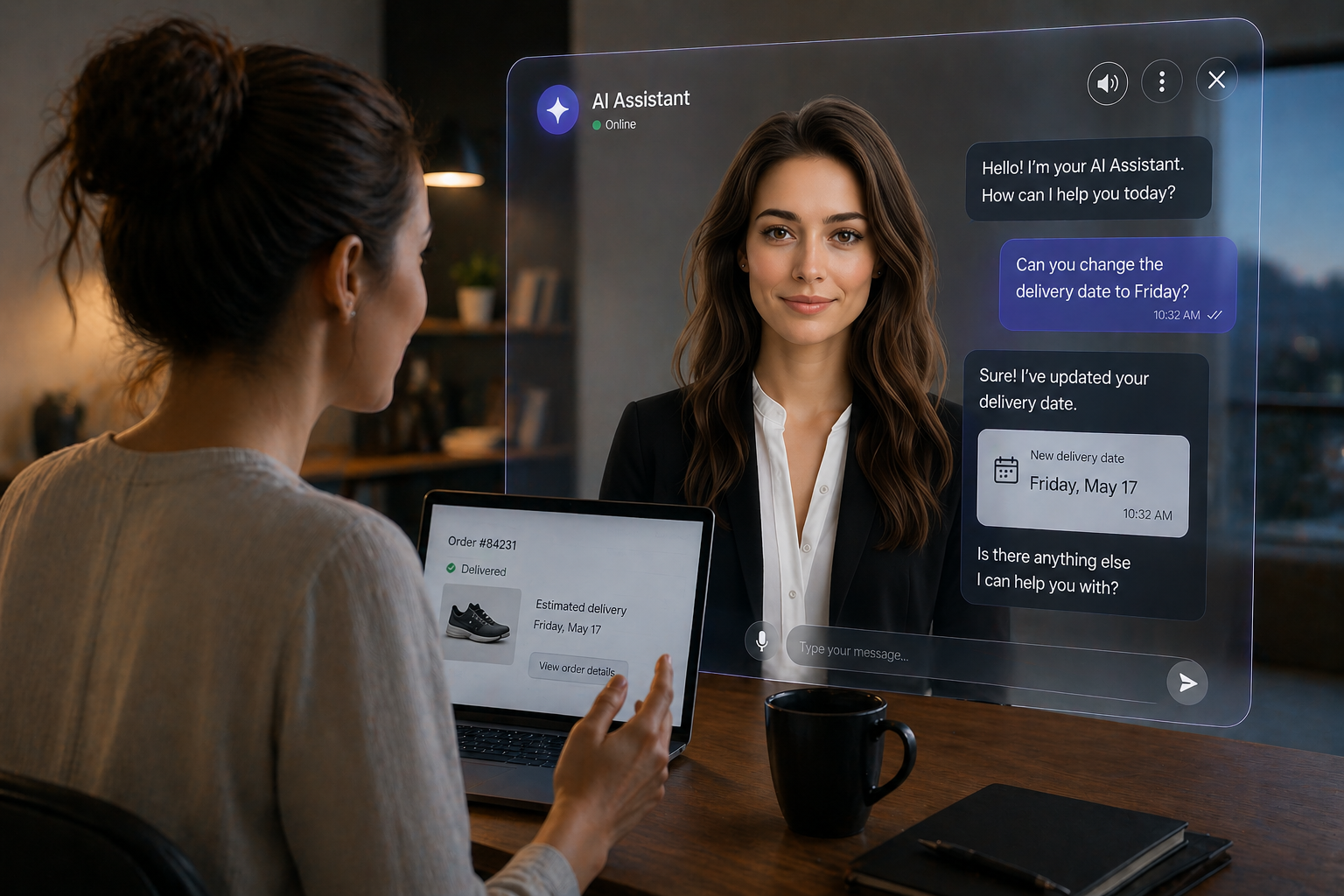
A new generation of agentic AI is reshaping online retail by moving beyond suggestions to taking real-time actions. These intelligent agents independently handle tasks like modifying orders, negotiating deliveries, resolving disputes, and personalizing the shopping experience without human intervention. This shift promises a $47 billion market by 2030 and addresses rising customer expectations for personalized service. Unlike traditional chatbots, agentic AI reasons with intent, integrating with systems like order management, payment gateways, and carrier APIs to proactively engage customers, automate transactions, and manage deliveries seamlessly. Practical successes include increased support efficiency, automated payment issue resolutions, dynamic personalization, and rapid customer feedback handling—all delivered through a unified conversational platform spanning chat, voice, email, and AI avatars. Retailers embracing this integrated agentic model will lead the market in the coming years by providing customers with one intelligent, capable interface that never loses context or responsiveness.
Your front desk often represents the first point of contact for patients, guests, and visitors alike—available 24/7 to handle appointment rescheduling, visitor check-ins, or inquiries. Yet, traditional receptionists face limits in managing simultaneous demands, risking missed calls and lost revenue opportunities.
Enter the AI receptionist: a sophisticated system driven by conversational AI and deep integrations with business platforms. These AI agents handle comprehensive front desk tasks smoothly—from booking and rescheduling appointments to greeting visitors, scanning documents, and even managing access control and services like coffee ordering.
AI receptionists come in two main types: voice-first systems that answer calls and manage scheduling round the clock without hold times, and digital human avatars stationed in lobbies or kiosks that interact face-to-face with in-person visitors.
They significantly reduce costs (by 40–60%), decrease no-show rates by 30%, and speed up visitor check-in processes by up to five times. Healthcare settings, office buildings, and hotels benefit immensely, with AI receptionists managing patient registrations, visitor flows, room bookings, and guest services efficiently.
Integrations with APIs allow these AI systems to control physical access, coordinate with HR directories, trigger security protocols, and even handle catering orders, effectively becoming the nerve center of the front-of-house operations.
Implementation is straightforward and swift, typically completed in weeks, involving discovery, system integration, persona customization, and rigorous testing. Continuous monitoring ensures ongoing improvement.
Businesses investing in AI receptionists today gain enhanced availability, scalability, and operational consistency that human-only front desks can't match.

For years, brands have faced the challenge of maintaining consistency across various platforms: customer service, social media, mobile apps, brick-and-mortar outlets, and call centers. Each channel often operates in isolation, resulting in disjointed experiences that stray from a unified brand identity. This is now evolving thanks to AI avatars — digital personas that present a consistent brand face across all touchpoints.
Instead of a patchwork of separate interactions, AI avatars offer a continuous, familiar presence that can answer questions on social media, guide users on websites, assist in chats or by voice, and appear across mobile apps and digital products. This seamless integration means brand consistency is no longer just planned—it’s actively lived.
Consider airlines, where fragmented interactions are the norm: different voices online, on calls, and in airports. AI avatars create a continuous experience, serving as digital cabin crew across booking, check-in, and in-flight assistance, all in a consistent tone. Beyond digital, these avatars also bridge physical spaces, helping customers at kiosks, retail locations, or bank branches, blending human warmth with operational efficiency.
Moreover, AI influencers—digital personas generating timely content—extend this continuity into marketing, reinforcing a single brand identity across communication and interaction.
The business impact is significant: companies can reduce costs and scale support without sacrificing the quality of customer engagement. Consistent experiences promote clarity, build trust, and increase customer retention, closing the gap between speed, efficiency, and brand coherence.
In a world where customers expect fast, always-on service, AI avatars offer a uniquely consistent and human brand presence, marking a new era in how brands engage and connect.
