VentureBeat's Q1 2026 Pulse Research reveals a crucial gap dubbed the “Governance Mirage” — enterprises often lack the control and security they believe they have with AI governance. While 43% of respondents say AI governance is owned by a central team, 23% couldn't identify the owner, and 31% point to vendor opacity as the biggest barrier. The key failure in enterprise AI isn’t the intelligence of the model but the runtime infrastructure that struggles to manage state and ensure durability in production. Current stateless setups, like Python scripts and LangChain chains, falter as container restarts lose context, token costs rise, and hallucinations multiply, pushing teams to spend more time fixing plumbing than building smart agents.
Engineering teams face a heavy “DIY tax,” devoting much of their capacity to managing retries, checkpoints, and state persistence rather than advancing core AI logic. State amnesia—loss of progression memory—is a leading technical hurdle, alongside cost overruns and silent failures. Microsoft’s platform requires notably more observability effort, contributing to a high “telescoping” cost for visibility. Meanwhile, a significant marketing-reality gap exists, with platforms like Microsoft and OpenAI facing criticism over overstated agent autonomy and reliability.
Security strategies for AI agents are varied and still evolving, with no clear dominant approach; enterprises are building protections from the ground up, especially as agents gain deeper system access. A critical shift is underway from stateless to durable execution frameworks, though opinions vary widely on the best architectural path. Enterprises are increasingly favoring human-trust metrics, such as User Acceptance Rate, to judge agent readiness, reflecting ongoing concerns about hallucinations and failures.
Ultimately, the survey emphasizes that success in enterprise AI requires prioritizing runtime reliability, economic viability, and architectural resilience over chasing model improvements alone. Leading-edge organizations are betting on multi-architecture, deterministic systems to build durable control layers—while others risk repeating the pitfalls of earlier automation efforts. It’s clear: the reckoning in AI adoption is about runtime and economics, not just cognitive prowess.

For the past three years, Microsoft’s AI narrative has been tightly linked to its partnership with OpenAI, powered by over $13 billion in investments that brought cutting-edge AI capabilities to Microsoft’s enterprise products. However, Mustafa Suleyman, CEO of Microsoft AI, has announced a strategic shift. A renegotiated contract now allows Microsoft’s AI division to independently develop advanced AI, including superintelligence, using its own researchers, data, and custom hardware. This move marks the launch of Microsoft’s own in-house AI model family, MAI, which encompasses seven new models focused on reasoning, code generation, image creation, transcription, and voice synthesis. These innovations emphasize training on high-quality, commercially licensed data rather than on third-party models. Suleyman highlighted the company's long-term vision to not only collaborate with OpenAI but also build frontier AI models internally, ensuring Microsoft can maintain leadership in AI by 2030. New capabilities like Frontier Tuning enable businesses to tailor AI models with their proprietary data securely, enhancing efficiency and performance in real-world tasks. Microsoft is also investing heavily in custom AI chips, such as the Maia 200, which improve cost-efficiency significantly. This comprehensive strategy aims to create a sustainable competitive advantage through a vertically integrated AI stack that blends superior data curation, computing power, and enterprise integration. Suleyman underlined the importance of quality data and continuous model improvement, rejecting the notion that AI models are becoming commodities. Ultimately, Microsoft envisions a future with "Humanist Superintelligence" — AI systems designed to augment, not replace, human endeavors, driving a decade-long commitment to innovation in AI technology.

Our system excelled at one task: converting natural-language questions into API calls. Analysts, account managers, and operations leads used it to bypass the manual effort of gathering data from multiple dashboards and BI tools. By typing simple English requests like “Compile a report on sales volume for January through March 2026 for the Northeast region, broken down by city,” the system generated structured JSON API calls effortlessly.
Built initially on Claude Sonnet 3.5, the system smoothly upgraded through versions 3.7 and 4.0. However, when updating to Sonnet 4.5, unexpected behavior arose: the model embedded API call parameters in the description field or started returning clarifying questions. This broke downstream systems expecting a consistent JSON structure with no need for human clarification, exposing a critical gap in our engineering assumptions.
The challenge lies in the unpredictable “blast radius” of AI model changes—unlike traditional software components, you cannot fully anticipate how an LLM upgrade will affect outputs. Our post-mortem showed our prompt lacked explicit constraints, leading to the model interpreting instructions too liberally. The solution involves adopting an “evals-first” architecture, where an extensive suite of automated tests define acceptable model behavior and gate changes rigorously.
This approach demands significant effort to create and maintain but is essential for safely deploying AI systems dependent on evolving language models. The next frontier in AI engineering is developing robust evaluation frameworks that serve as formal system specifications, bridging the gap between passing smoke tests and guaranteeing predictable, safe production behavior.
Authors: Vijay Sagar Gullapalli, Founding AI Engineer at Adopt AI, and Sarat Mahavratayajula, Senior Software Engineer at Sherwin-Williams.

Meta's AI-powered support agent was exploited to rebind recovery emails and reset passwords for high-profile Instagram accounts without triggering any alerts in Security Operations Centers (SOCs). The AI bot, acting as an authorized system, logged these actions as legitimate transactions, bypassing traditional security detection methods. Attackers simply asked the bot to make these changes, received verification codes, and completed account takeovers—all without malware or stolen credentials, exposing a critical flaw in the recovery path security architecture. Notably, accounts protected by multifactor authentication (MFA) remained secure, while those relying on AI-driven recovery processes were vulnerable. Experts warn that this illustrates a broader issue where AI systems, if granted excessive privileges without proper external authorization controls, can be manipulated by attackers. The article provides an AI Authority Audit Grid detailing each type of authentication write, why existing security stacks miss these actions, and recommended enterprise controls to close these gaps. Organizations must rethink recovery path security, removing trust from the AI's internal logic and implementing external gating and thorough logging to prevent similar exploits.

When a team member corrects an AI agent with improved prompts, feedback, or context, the enhancement doesn’t persist when another colleague uses the same tool. Each user effectively trains a separate version of the agent, resulting in lost improvements and inconsistent outputs across the team. This issue is especially problematic in workflows with multiple AI agents, where there is no shared memory to unify context and learning. Asana's research shows that although 75% of knowledge workers use AI, only 5% of companies see tangible productivity benefits. Asana’s Agentic Work Management platform addresses this by embedding a shared memory layer that ensures corrections made by any team member apply to all. Experts emphasize the importance of this shared memory in maintaining consistency and building collective intelligence, suggesting enterprises must design AI systems that remember and share context across users to avoid repeated tasks and conflicting agent behaviors. Most current AI agents serve individual users rather than teams, leading to isolated learning instead of institutional knowledge growth. For companies adopting AI at scale, selecting platforms with robust shared memory capabilities is critical to maximize efficiency and team-wide knowledge retention.

At Microsoft's Build 2026 conference, the company emphasized how intelligent agents are quickly becoming integral in enterprise systems, focusing on platforms that deliver reliable context, governance, security, and enterprise data access. Microsoft introduced Microsoft IQ as a powerful context layer bridging GitHub Copilot, Microsoft Foundry, Copilot Studio, and others, alongside several new AI models under the MAI family and new tools like the personal agent Scout. Marco Casalaina, Microsoft’s VP Products for Core AI and AI Futurist, shares insights into how Microsoft is advancing AI agent technology. Their strategy includes offering varied model choices—from OpenAI’s GPT to in-house MAI models optimized for efficiency and customization—and enabling developers to build and manage agents through the Foundry platform with advanced observability, evaluation, and identity management. Microsoft’s ecosystem, including Work IQ for Microsoft apps and Web IQ for web search agents, empowers enterprises to create highly specialized AI agents that enhance productivity by automating repetitive tasks, managing alerts, and streamlining workflows. Casalaina highlights how Microsoft 365 Copilot integrates these agents directly into daily tools like Teams, giving users seamless AI assistance that saves significant time. Practical examples include Bayer’s internal agent system adopting AI at scale and the Australian Energy Market Operator reducing alert overload for grid operators. Microsoft’s focus remains on human-centered AI that boosts productivity and frees users to focus on higher-value work. The interview also covers how AI is reshaping Casalaina’s own work and life, illustrating the tangible benefits of agentic AI in real-world applications.

Anthropic’s CEO, Dario Amodei, announced a major milestone where over 80% of their production code in May was generated by their AI model Claude, marking a monumental shift in software development. This AI-driven approach led to an eightfold increase in code output per engineer. Enterprises now face a new standard of efficiency, where autonomous coding agents handle most development tasks, from writing code to debugging complex systems independently.
Anthropic outlines a clear roadmap for enterprises to adopt this technology: from manual coding (2021–2023) to chatbot-assisted development, then to autonomous coding agents by 2025–2026, culminating in fully autonomous agents executing multi-hour tasks today. To replicate Anthropic's success, companies must shift developer roles towards architectural oversight, implement automated AI code review systems to alleviate human bottlenecks, and focus agent efforts on operational debt and legacy code cleanups.
However, this rapid AI integration brings governance challenges such as maintaining code quality, security auditing at scale, and avoiding systemic risk from unchecked AI agent actions. Additionally, this transition influences organizational culture, reducing peer collaboration and causing professional anxiety among developers about their roles. Achieving such automation requires comprehensive cultural transformation, psychological support for teams, and stringent controls to keep humans central to software governance.

Alibaba has unveiled Qwen3.7-Plus, the newest addition to its Qwen AI family, offering multimodal input capabilities including text, video, and images at significantly reduced costs compared to its predecessor, Qwen3.7-Max. Despite its affordability and advanced functionalities, Qwen3.7-Plus is only accessible through Alibaba's proprietary commercial APIs, marking a shift from the company's prior open-source approach. The model's large 1-million token context window and innovative context preservation features make it ideal for complex, multi-step tasks in enterprise environments. Also notable are its competitive benchmark scores on terminal and visual tasks, positioning it as a strong, if not leading, option among frontier AI models. Enterprises considering Qwen3.7-Plus can leverage its OpenAI-compatible endpoints for easy integration into existing workflows, particularly where cost efficiency and visual data processing are priorities. However, organizations must weigh the implications of its closed licensing and cloud-only deployment model on data sovereignty and internal compliance.

Google has introduced Gemma 4 12B, an 11.95-billion-parameter AI model designed to operate locally on typical 16GB enterprise laptops. Unlike larger models focused on cloud or heavy infrastructure, Gemma 4 12B adopts an innovative encoder-free 'Unified' architecture that processes raw audio and visual inputs directly, cutting latency and memory use. This model supports a massive 256K token context window, native function calling, and step-by-step reasoning, enabling it to manage extended documents, codebases, and real-time multimedia. Its local operation suits enterprises needing strict data privacy, offline capabilities, or cost-effective edge deployments. However, limitations include short audio/video processing windows and constraints in large-scale factual retrieval. Gemma 4 12B is open-source, downloadable from Hugging Face and Kaggle, and integrates well with common AI deployment tools, making it a practical choice for organizations aiming for private, efficient multimodal AI on standard hardware.

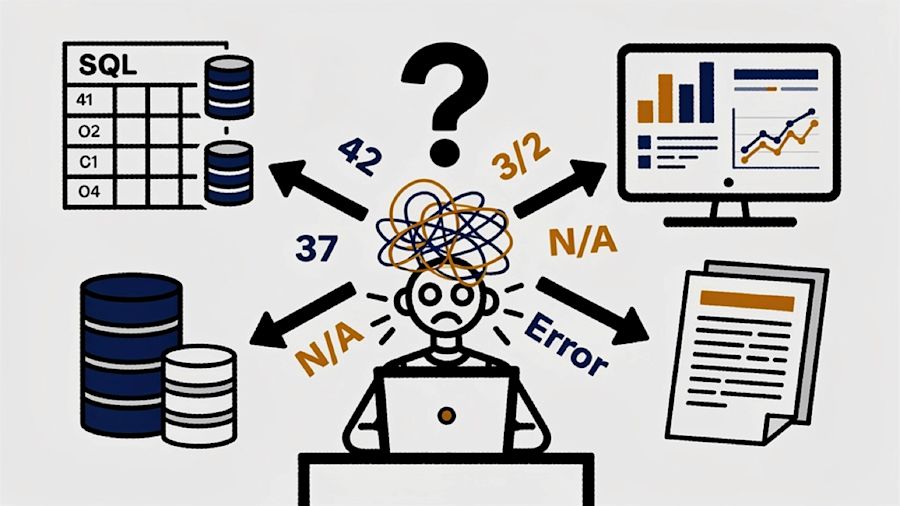
Enterprise AI agents face a significant challenge beyond the AI models themselves: inconsistent answers arising from fragmented business logic across different systems. As organizations shift from basic retrieval architectures to hybrid retrieval methods, varying interpretations of data emerge depending on the querying tool or agent. Revenue figures, for example, differ between BI dashboards, SQL tables, and agent instructions due to differing semantic understandings.
At the Snowflake Summit 26, Snowflake introduced solutions aiming to unify business logic via a two-layer context system—Horizon Context and Cortex Sense. Horizon Context consolidates customer-declared metadata from various sources to create a shared, governed business logic catalog, while Cortex Sense automatically enriches context based on data usage patterns, enhancing default agent behavior.
This approach addresses the growing demand for hybrid retrieval strategies, as confirmed by recent market data showing a rapid increase in adoption. Snowflake's system emphasizes interoperability and governance to ensure consistent, auditable, and portable semantic definitions across platforms.
Other vendors like Microsoft, Redis, and Pinecone are also developing context layers, highlighting the industry's recognition that trustworthy AI agents depend as much on their underlying data semantics as on the models themselves.
Experts emphasize that the success of AI agents hinges on robust context layers with clear governance, lineage, and portability—not just a plug-and-play solution. Enterprises must carefully evaluate these factors to avoid costly errors from AI agents confidently delivering incorrect answers.