


OpenClaw has gained popularity as an agentic framework but struggles at enterprise scale due to the need for real credentials and ineffective traditional guardrails. Brex developed CrabTrap, an open-source HTTP/HTTPS proxy that monitors all network traffic, applies policy rules, and uses a large language model (LLM) as a judge to approve or deny agent requests. By focusing on the network layer, CrabTrap makes nuanced enforcement decisions without needing SDK integrations, enabling framework- and language-agnostic agent governance. Rather than creating policies from scratch, Brex bootstrapped policy rules from actual agent behavior using a policy builder that runs agents in shadow mode. This approach proved more accurate and easier to manage. CrabTrap efficiently handles potential latency issues by activating the LLM judge on only a small fraction of requests and using smaller, faster models. Brex also tackled prompt injection by structuring requests as JSON to avoid manipulation. The system provides extensive audit trails, allows policy refinement through feedback loops, and enhances organizational confidence in deploying autonomous agents. Brex released CrabTrap as open-source to foster community contributions. Future improvements may include advanced authentication, role-based access control, escalation workflows, and automated policy lifecycle management. CrabTrap’s success demonstrates that enterprises can engineer solutions to AI agent governance challenges today, without waiting for the industry to develop perfect tools.

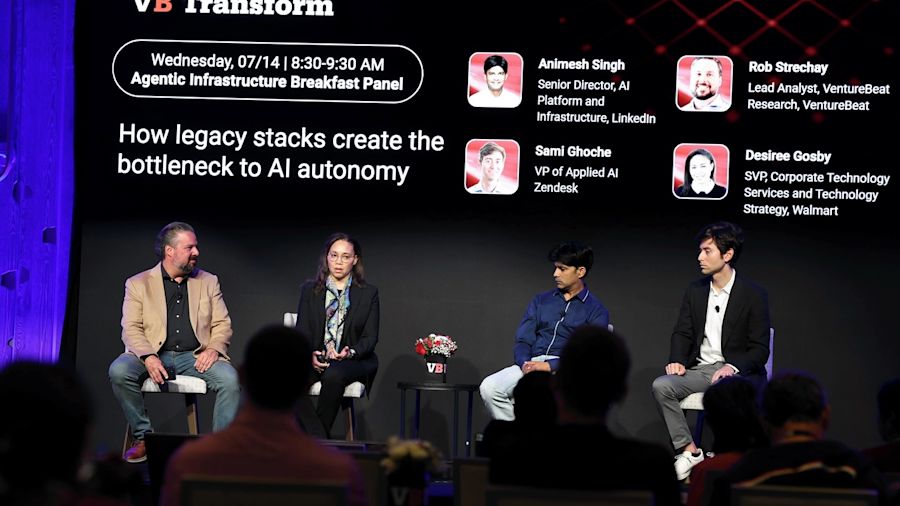
Legacy infrastructure, not AI models, is the real bottleneck slowing down the performance of AI agents. At VB Transform 2026, leaders from LinkedIn, Walmart, and Zendesk shared insights on how their companies tackled this challenge as they moved AI agents from pilot phases to full production. The core issue? Traditional enterprise systems are built for human workflows, which operate on a much slower timescale than AI agents. LinkedIn had to redesign their container provisioning strategy and control flows to reduce lag from seconds to milliseconds. Walmart faced an internal surge of non-engineer "citizen developers" creating overlapping AI agents, prompting them to establish governance and streamline production without slowing innovation. Zendesk wrestled with massive historical customer data, realizing that success required robust data pipelines rather than merely feeding large datasets into language models. All three stressed the importance of owning core infrastructure while selectively integrating frontier AI advancements. Their advice: invest early in evaluation systems, empower employees with AI tools paired with close monitoring, and build infrastructure to remain flexible and model-agnostic for future changes.
Intuit, a pioneer in agentic AI, experienced challenges in its AI agent architecture, leading to two rebuilds within four months. At VB Transform 2026, Nhung Ho, Intuit's VP of AI, explained the shifts from a fleet of specialist agents to a central orchestration layer, and finally to a skills and tools-based system due to complexity issues in the orchestrator. The orchestration layer failed because agents exchanged results via natural language, causing significant loss of context and compounded errors. The rebuild took 60 days with a functional version ready in under 20 days. Gaining support from leadership and engineers involved demos showcasing improved performance and emphasizing scalability benefits. A key feature of the new system is the ability to involve a human agent mid-conversation, enhancing customer support with full context and secure permissions. Feedback mechanisms have evolved, with almost all customers now providing input, enabling systematic improvements through direct, often candid, customer responses.

Capital One has introduced VulnHunter, an innovative open-source AI tool aimed at identifying exploitable vulnerabilities in source code before deployment. The tool performs an attacker-first forward analysis by starting at potential entry points a hacker might use and simulating attack pathways through the application to confirm if vulnerabilities can be exploited. It also includes a falsification engine to minimize false positives by trying to disprove potential vulnerabilities before presenting them to developers, providing detailed explanations and proposed fixes for confirmed issues. VulnHunter runs currently on Anthropic’s Claude Opus 4.8 model and represents Capital One’s commitment to improving cybersecurity through open-source collaboration, especially after the 2019 data breach that impacted millions and reshaped its security strategy. This release aligns with broader financial industry trends toward automated, AI-driven security solutions embedded directly in code development processes, setting a potential new standard for enterprise security tools.

A recent study involving 101 enterprises reveals that while agent orchestration is rapidly consolidating around leading model-provider platforms—with Anthropic’s Claude taking a significant lead—most deployed agents remain simple chatbot wrappers rather than fully orchestrated multi-step workflows. Enterprises prioritize platforms based on the quality of underlying AI models (“model gravity”) and value reliable, multi-step task execution. Yet, 71% report that only a quarter or fewer of their agents are truly orchestrated, highlighting a gap between ambition and actual deployment.
Looking ahead, enterprises expect a hybrid control plane combining provider-native and external orchestration to avoid vendor lock-in, which is their primary concern. Investments focus on agent workflow tooling and security, though real-time fiscal control over token usage remains limited, with over a quarter lacking mechanisms to prevent cost overruns promptly.
The survey shows that enterprises are moving from experimentation to operational consolidation by standardizing platforms, increasing production deployments, and building in-house controls. Nearly 70% plan to switch or add orchestration platforms within the next year, with many still undecided on their options. This industry is at a crucial crossroads: the orchestration infrastructure is maturing swiftly, but the agents themselves have yet to fully realize their potential beyond chatbot interfaces.
Across 157 enterprises surveyed, AI agents are being granted increasing autonomy while confidence in the evaluations that govern this autonomy remains low. Half of the organizations admitted to deploying AI agents that passed internal tests but then failed in real-world customer scenarios. Only 5% fully trust automated evaluations, mainly due to poor alignment with actual outcomes. Yet, two-thirds of enterprises either already allow or are engineering towards fully automated deployments without human oversight for low-risk AI agents. This gap between granted autonomy and trust in evaluations is widening, raising concerns about scaling failures. The evaluation tools landscape is fragmented and mostly provider-driven, with many organizations lacking dedicated evaluation tooling or real-time quality checks on live outputs. Investment priorities show a paradox: companies are reducing human-in-the-loop deployments while increasing spending on human review and production observability. The AI evaluation market is still emerging, with most enterprises planning to adopt new or additional platforms soon. Ultimately, enterprises face a critical challenge where autonomy outpaces assurance, necessitating evaluations that more accurately reflect real-world performance to avoid costly failures.

In an analysis of 101 enterprises, the rapid build-out of AI context infrastructure is outpacing the trust enterprises place in it. Retrieval-augmented generation (RAG) has become the predominant method for feeding AI agents business context, with provider-native retrieval tools like OpenAI's file search and Google’s Vertex AI Search surpassing traditional vector databases. Despite this, over half of enterprises report that their AI agents have confidently delivered incorrect answers due to gaps or inconsistencies in the underlying context. While a governed semantic layer is emerging as a vital fix, most organizations are still developing it, pointing to a significant ‘context gap’—where agents sound authoritative but operate on shaky foundations. Enterprises face a strategic tension: adopting provider-native bundles for convenience while preferring best-of-breed, standalone tools for control. Hybrid retrieval architectures combining embeddings with reranking and access controls are widely expected to become the industry standard by 2026. The study highlights that solving this challenge is less about increasing data volume and more about building a consistent, governed, and secure context layer—as AI agents currently outpace the maturity of this essential support infrastructure.

A survey of 107 enterprises reveals a significant security gap in how AI agents are managed. Over 54% have encountered a security incident or near-miss involving AI agents. Despite this, only about one-third provide each AI agent with a distinct, scoped identity, while most allow credential sharing, increasing risk exposure. Only 30% isolate their highest-risk agents in sandboxes, which limits damage when security fails. Enterprises rely heavily on provider-native security tools from OpenAI, Google, and Microsoft rather than specialized agent security solutions. Satisfaction with current tools is high (4.2/5), yet spending on AI agent security remains a small fraction of overall security budgets. Awareness of AI-enabled attackers is increasing, but only a third believe their defenses are currently ahead. Most organizations plan to adopt new or replacement tooling within the next year, signaling recognition of the urgent need to address these vulnerabilities. The findings highlight an urgent need for better identity management, isolation controls, and purpose-built security solutions to manage autonomous AI agents safely.
Across 107 enterprises, AI infrastructure investment is accelerating faster than their ability to accurately measure and manage its costs. Most organizations rely on familiar hyperscaler clouds and model-provider APIs for AI workloads but plan to increasingly adopt specialized AI compute resources that few currently use. Many intend to change or add providers within the year to optimize integration and total cost of ownership rather than focusing on headline pricing. Yet GPU utilization rates are low—often 50% or less—and fewer than half of enterprises rigorously track the actual costs of AI compute. This disconnect creates a "compute gap": rapid infrastructure spending without the visibility needed for control. The report highlights a shift in infrastructure preferences, widespread intent to switch providers, and challenges in cost transparency and efficiency. Enterprises are still early in AI deployment maturity, with only 21% running AI at scale, but their spending ambitions signal a major re-platforming of AI infrastructure ahead. Notably, as inference shifts from compute power to memory bandwidth constraints, many organizations remain unprepared for this next bottleneck. While satisfaction with current infrastructure is moderate, the gap between spending and cost management raises concerns about value for money and operational efficiency as demand for AI computing power grows.

Moonshot AI, a Beijing-based AI startup supported by Alibaba, has launched Kimi K3, a groundbreaking 2.8-trillion-parameter open-source AI model. This model rivals the top proprietary systems from Anthropic and OpenAI on benchmarks, marking a significant leap in the global AI race. Ahead of the 2026 World Artificial Intelligence Conference in Shanghai, Kimi K3 stands as a testament to China's growing influence in AI technology, featuring innovations like Kimi Delta Attention and Attention Residuals for enhanced performance. The model supports a vast 1-million-token context window and includes native visual understanding and a unique "thinking mode." Developers can access Kimi K3 via an OpenAI-compatible API at competitive pricing.
Benchmarks reveal Kimi K3 competes closely with leading models like GPT-5.6 and Claude Fable 5 Max, reflecting near-parity in real-world task performance and complex knowledge work. A notable demonstration showcased Kimi K3's autonomous capabilities, including designing a nano-scale chip over 48 hours and accelerating advanced astrophysics research.
Moonshot AI's journey highlights the volatility of China's AI sector, recovering from a significant market challenge by DeepSeek with strategic open-source pivots. Open-sourcing Kimi K3’s full weights aims to bolster global developer engagement and counterbalance Western AI dominance. This model empowers enterprises to explore high-performance, self-hosted AI solutions, provided they can support the substantial computational demands.
With a varied model lineup and a strong coding agent ecosystem, Moonshot AI targets enterprise adoption and developer loyalty. Kimi K3 fundamentally shifts the AI landscape, diminishing the gap between open-source and closed-source systems, and heralding a future where AI independently tackles multi-day technical projects. China's state media recognizes this as a landmark in national AI advancement, signaling a transformative wave in the global AI community.
