Anthropic has pledged $10 million CAD to support eight Canadian research institutions dedicated to advancing beneficial and responsible AI technologies. This funding covers collaborations with Canada's top regional AI institutes—including Amii in Edmonton, Mila in Montréal, and the Vector Institute in Toronto—alongside partnerships with healthcare and academic organizations such as CHEO Children's Hospital, the Centre for Addiction and Mental Health, and Université Laval.

For the first time, the European Union and the United Kingdom have jointly imposed sanctions on Russia's cyber apparatus. The EU has sanctioned nine individuals and four entities, focusing on a broad ecosystem that includes intelligence services, rather than targeting just a specific group. Meanwhile, the UK has taken even further steps by sanctioning 24 individuals and entities, according to Politico. Kaja Kallas, the EU's High Representative, emphasized the approach of addressing the entire cyber ecosystem behind these operations.

For the first time ever, bots are responsible for more than half of all internet traffic. In response, Cloudflare has introduced Precursor, a new tool designed to monitor user behavior after entry rather than just verifying identities upfront. This approach marks a shift in how web traffic is managed, as automated requests now outnumber human ones, prompting companies to rethink their defenses against bot activity.

The conversation around AI's effect on employment has largely centered on recent graduates. However, new research highlighted by CNBC reveals an often overlooked group: workers aged 55 and above. Those in jobs heavily influenced by AI are leaving the workforce at higher rates since the advent of ChatGPT. This insight comes from Geoffrey Sanzenbacher at Boston College's Center for Labor Research and highlights a growing concern for older, well-paid employees facing career disruptions due to technological change.

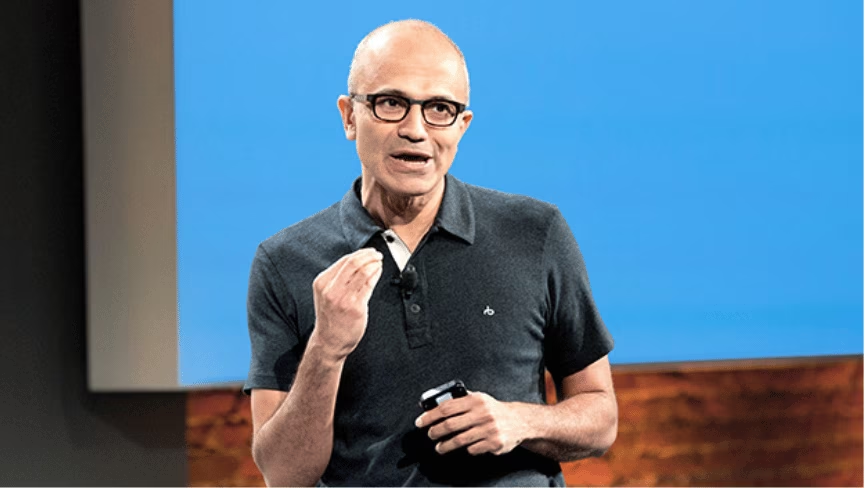
Microsoft CEO Satya Nadella warns that companies using AI face a double cost: the obvious financial expense and the hidden price of sharing valuable data to make AI effective. He terms this dilemma the Reverse Information Paradox, noting that Microsoft itself played a role in creating these challenges.
Intel is investing 5 billion euros (approximately $5.7 billion) to enlarge its Leixlip campus in Ireland. This funding targets the development of advanced data-center processors tailored for artificial intelligence and high-performance computing, as reported by Bloomberg. This allocation constitutes about 30% of Intel's planned $17 billion capital expenditure for 2026, highlighting the company's strong commitment to EUV fabrication on the continent.

What was once a radical concept has gained widespread support. Nearly 70% of Americans now favor a policy that would require AI companies to allocate half of their stock to a public sovereign wealth fund, according to a June survey of 1,690 U.S. adults by Verasight. This shift highlights growing public interest in shared ownership and oversight of powerful AI companies.

Top executives driving the AI surge remain confident that demand for artificial intelligence technologies is virtually limitless. Pat Gelsinger, formerly of Intel and now at Playground Global, emphasizes that energy supply is the main constraint on growth. Despite this strong belief, the stock market shows uncertainty, reflecting cautious investor sentiment as companies tied to AI experience volatility.

Amazon has undergone significant workforce reductions, letting go of over 57,000 corporate employees since 2022, which represents about 16% of its corporate staff, according to CNBC. The rate of layoffs has intensified, with around 16,000 positions cut at the end of January and another 14,000 eliminated just three months prior—the largest job cuts in the company's history. The impact extends beyond those who lost their jobs, as the employees who remain are also facing considerable challenges.

For a long time, the prevailing belief in the AI world was that having the largest model meant winning the race. However, this notion is changing, as reported by CNBC. Companies are now selecting AI models based on specific tasks, cost-effectiveness, and greater control rather than just their benchmark rankings. While cutting-edge advancements remain important, they’re no longer the sole factor in decision-making, especially at an enterprise scale.