Commure is on a bold mission to streamline healthcare administration using AI technology. This inside perspective explores the complex challenges the startup faces as it works to automate the intricate and often chaotic business side of healthcare.


Healthcare has spent the last decade creating multiple entry points, including digital platforms, telehealth, and benefit portals, aiming to simplify initial access. However, the real challenge lies in guiding patients smoothly through the subsequent steps of their care journey. Many consumers face confusion and obstacles when moving from diagnosis to treatment fulfillment, leading to delays, abandoned medications, and erosion of trust in the system.
The healthcare industry must focus on seamless follow-through, much like successful consumer services that manage the entire journey from search to completion. Every stakeholder—providers, pharmacies, payers, and tech platforms—shares responsibility in reducing friction at critical handoffs to improve patient adherence and outcomes.
Innovations like GoodRx Companion illustrate the future by integrating affordable care services and costs into a single subscription, helping patients navigate routine and ongoing healthcare needs more predictably. Ultimately, healthcare's success depends on not just opening doors but ensuring those doors lead to clear, continuous paths forward for patients.


Google has launched AMIE, an advanced medical AI system designed to facilitate real-time clinical video consultations within simulated environments. This breakthrough technology aims to enhance remote medical interactions through AI-driven support, marking a significant milestone in digital healthcare innovation.


Researchers have successfully designed 16 new viruses using artificial intelligence, and these viruses demonstrated the ability to function and replicate effectively.


AI's threat in medicine is not just about experts losing their reasoning skills, but about medical students and trainees who may never develop these critical skills due to early dependence on AI tools. While practicing doctors might become less adept clinically with AI, the greater danger lies with trainees who use AI before building their own judgment. Unlike deskilling, which implies loss of an ability, this scenario risks 'never-skilling'—meaning some doctors might not learn how to reason clinically at all. Tools like OpenEvidence, an AI chatbot used by two-thirds of U.S. doctors for quick, research-based answers, are now also popular among medical trainees. This early reliance could hinder the essential development of independent clinical reasoning during formative education stages.

Former surgeon Frances Mei Hardin argues that AI itself is not to blame; rather, it acts as a reflection of the ongoing reduction in physician judgment and autonomy.


At VB Transform 2026, Stanford's James Zou introduced a revolutionary approach to AI where tens of thousands of specialized AI agents collaborate rather than relying on a single model. His team created a "Virtual Biotech" system that mimics a corporate biotech structure, complete with divisions for target discovery, molecule design, and clinical trials, overseen by a Chief Scientific Officer agent. This multi-agent setup outperformed single-agent models by encouraging debate and rigorous reasoning among agents, resulting in superior scientific outcomes.
The team developed Paperclip, an AI-native system that integrates unstructured data into a unified virtual file system for easy agent access, vastly improving accuracy and efficiency. Virtual Biotech launched 37,000 agents to analyze clinical trial data, identifying predictive single-cell features that increased drug success rates.
Remarkably, these agents autonomously designed an antibody-drug conjugate for lung cancer targeting the CD276 protein, using only pre-2025 data. Merck later independently created and validated the same design, gaining FDA breakthrough designation, confirming the AI system’s real-world effectiveness.
Zou emphasized shifting from fixed workflows to open environments that foster agent collaboration, optimizing the ecosystem rather than individual models. This innovative orchestration paves the way for scalable, robust AI-driven biotech research.


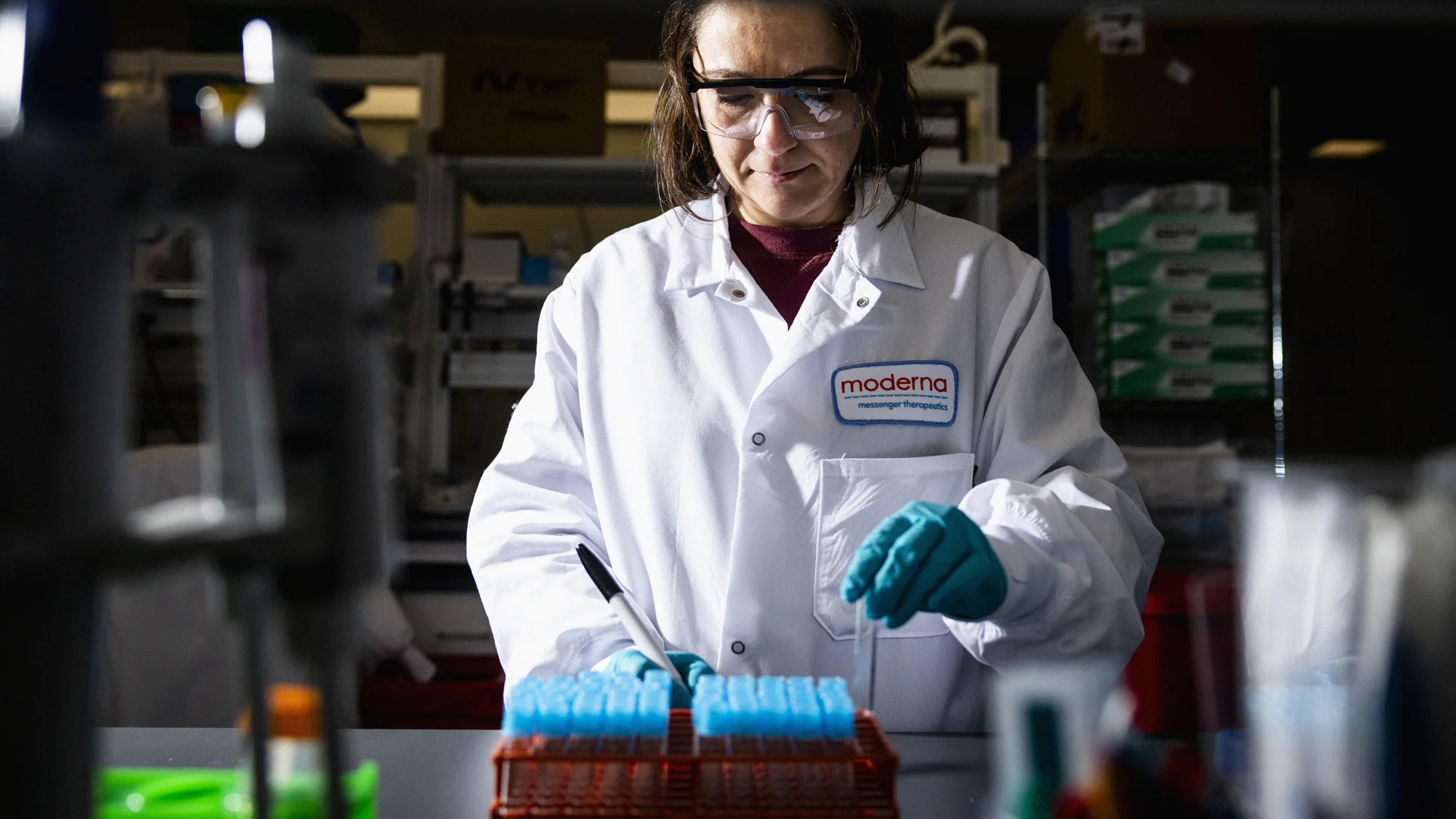
Moderna's newly approved mRNA flu vaccine marks a significant milestone, potentially establishing the company in the seasonal flu market. This advancement also highlights the promise of mRNA technology in tackling rapidly evolving diseases and even cancer.

Most AI imaging companies typically develop individual models tailored to specific diseases. However, a Cambridge-based startup has taken a different approach by raising $20m to create a unified AI model for the entire chest. This foundational model can then be adapted to address various conditions. Qureight specializes in AI imaging tools aimed at clinical trials for lung and heart diseases. Their recent $20m Series B funding round was led by Molten Ventures.
Former VA Secretary David Shulkin highlights the powerful alliance of HHS, the VA, and the DOD as a uniquely American innovation hub that competitors like China find hard to match, emphasizing its potential to drive biotech advancement.