


Legal tech companies like Clio are experiencing significant growth, with Clio recently reaching $500 million in annual recurring revenue. This milestone highlights the increasing adoption of legal technology solutions even as competitors like Anthropic intensify their efforts in the market.


Bill Gross, a respected Silicon Valley investor and founder, has launched ProRata, a platform aimed at ensuring publishers and creators receive fair compensation when their work is used to generate AI-driven content. Drawing inspiration from lawsuits like The New York Times vs. OpenAI, Gross designed a patented attribution method similar to Spotify's revenue-sharing model with artists. Although no AI company has yet adopted this system, Gross believes lawsuits and profitability will eventually compel them to share revenues equitably. ProRata has already partnered with 1,500 publishers and offers a spin-off, Gist, to help clients monetize content better through AI-powered site search and related question features. Gross views his approach as a fair and statistically valid method, comparing it to Nielsen ratings accepted by advertisers. He acknowledges AI doesn't truly understand content but has a useful approximation that provides great value. Gross predicts AI will disrupt society, hoping the benefits reach all levels rather than only enriching the wealthy.


The UK's Competition and Markets Authority (CMA) is examining claims that Microsoft software may not work seamlessly with rival products, potentially limiting users' ability to integrate different technologies smoothly.


Michael Selig, chairman of the Commodity Futures Trading Commission (CFTC), shared insights with WIRED on how the agency leverages artificial intelligence to monitor Polymarket and other prediction markets for signs of insider trading and other illicit activities.

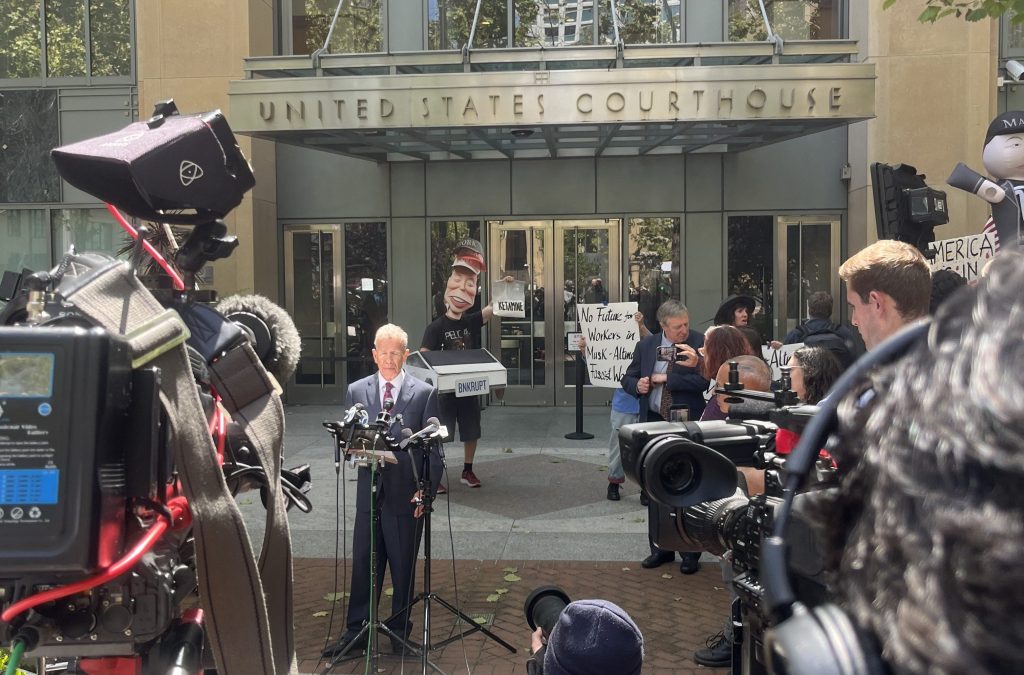
Dive into the heart of this year's most talked-about tech courtroom drama, revealing what's at stake and what the jury will truly decide between Elon Musk and Sam Altman.

This monthly roundup highlights five noteworthy startup funding deals that may have slipped past the spotlight recently. While AI and software continue to dominate venture funding, many notable companies are innovating in tangible, real-world sectors away from traditional tech hubs. These include: Firestorm Labs, which secured $82 million to develop modular manufacturing systems for military fronts; Manifest OS, a legal tech startup raising $60 million to build an AI-driven operating system for outcome-based law firms; ROSI, obtaining $23 million to tackle large-scale solar panel recycling in Europe; Opalia, a cell-based milk producer raising $2.3 million to serve the dairy supply chain; and C-Infinity, with $16 million to automate manufacturing process planning using AI.
These deals represent growing investor interest across physical tech innovations, legal AI applications, sustainability efforts, alternative food production, and manufacturing automation, emphasizing a shift toward integrating technology closely with traditional industries and real-world challenges.


On May 25, Pope Leo XIV will introduce Magnifica Humanitas, the Vatican’s inaugural encyclical dedicated exclusively to artificial intelligence. The presentation, alongside Anthropic co-founder Christopher Olah, marks a rare collaboration between the Vatican and the tech sector. The document emphasizes safeguarding human dignity, cautioning that while AI can simulate reasoning, it cannot replace ethical judgment or authentic human relationships. Released 135 years after Rerum Novarum, this encyclical establishes the Vatican as a moral voice amid rapid AI advancements pushed by governments, corporations, and military interests worldwide.
OpenAI has successfully overcome a legal challenge from Elon Musk, with a jury ruling that Musk's lawsuit was filed beyond the statute of limitations. The judge swiftly confirmed this verdict, ending the case that accused OpenAI of misappropriating assets when it transitioned to a for-profit model. This legal win removes a significant hurdle as OpenAI prepares for a potential public offering, which industry experts anticipate could become one of the largest IPOs in history. Valued at $500 billion after a recent share sale, OpenAI's path to going public is now clearer, bolstered by strong backing from major tech players like Microsoft. Meanwhile, Elon Musk’s SpaceX, a competitor in the AI space after acquiring Musk’s xAI, is expected to launch its own IPO soon. Despite Musk's intention to appeal, the ruling fortifies OpenAI's leadership and diminishes the impact of Musk's previous allegations, allowing the company to concentrate on its market position and future growth.

Joseph Stephens from the NCSC highlights the critical issue of organizations needing to address and fix vulnerabilities as a significant challenge.


The Electoral Commission is urging for stricter regulations on AI-generated misinformation after a Demos study uncovered that AI chatbots provided inaccurate information to voters in 34% of queries during the recent Scottish election. The report highlights instances where AI tools fabricated scandals, invented candidates, or gave incorrect election dates, raising concerns about the need for oversight of AI platforms in the UK.
