For the first time ever, bots are responsible for more than half of all internet traffic. In response, Cloudflare has introduced Precursor, a new tool designed to monitor user behavior after entry rather than just verifying identities upfront. This approach marks a shift in how web traffic is managed, as automated requests now outnumber human ones, prompting companies to rethink their defenses against bot activity.

The conversation around AI's effect on employment has largely centered on recent graduates. However, new research highlighted by CNBC reveals an often overlooked group: workers aged 55 and above. Those in jobs heavily influenced by AI are leaving the workforce at higher rates since the advent of ChatGPT. This insight comes from Geoffrey Sanzenbacher at Boston College's Center for Labor Research and highlights a growing concern for older, well-paid employees facing career disruptions due to technological change.

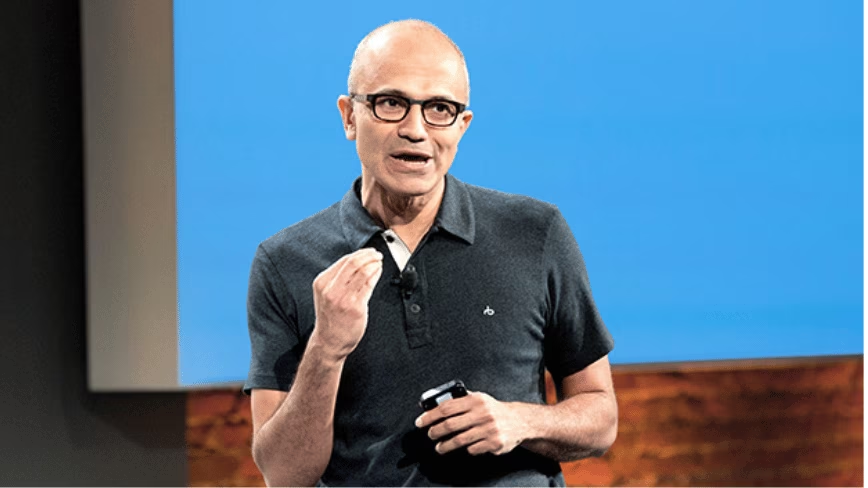
Microsoft CEO Satya Nadella warns that companies using AI face a double cost: the obvious financial expense and the hidden price of sharing valuable data to make AI effective. He terms this dilemma the Reverse Information Paradox, noting that Microsoft itself played a role in creating these challenges.
Intel is investing 5 billion euros (approximately $5.7 billion) to enlarge its Leixlip campus in Ireland. This funding targets the development of advanced data-center processors tailored for artificial intelligence and high-performance computing, as reported by Bloomberg. This allocation constitutes about 30% of Intel's planned $17 billion capital expenditure for 2026, highlighting the company's strong commitment to EUV fabrication on the continent.


Exploring the implications of a world where AI is fully aligned with user intentions raises complex ethical questions. What could such a reality mean for accountability and morality?


The Guardian’s global technology team is exploring the tangible impact of the massive datacentres fueling the AI revolution. Their coverage has shifted from digital screens to real-world infrastructures, requiring extensive on-site investigations. In a recent report, they uncovered that an £8.2bn AI complex in rural Scotland falsely claimed it would run entirely on on-site renewable energy. Aisha Down, one of the reporters, highlights the immense physical limitations and real-world challenges behind building these datacentres, showing how these factors critically influence the future of AI development.


DeepSeek recently cut prices on its V4-Pro model by 75%, a move that initially appeared to be a major win for enterprise AI vendors and developers. However, this price reduction has not guaranteed improved margins because agent workflows consume tokens far faster than the rate at which inference costs are declining. Unlike traditional chatbots that process one user query with one model call, AI agents involve multiple costly operations such as planning, retrieval, tool use, and verification, leading to a significant increase in token consumption — often 100 times more per user query.
This token amplification creates a challenge for the current AI business model, which relies on seat-based SaaS pricing. Heavy users of agentic workflows can incur infrastructure costs that exceed their subscription fees, resulting in negative gross margins. Enterprises adopting these AI agents face mounting expenses, forcing a rethinking of cost structures and product architectures.
To manage this, companies must adopt strategies like cost-aware routing, prompt caching, context trimming, and speculative decoding to control inference expenses. Treating inference cost as a first-class metric, budgeting carefully, and negotiating volume commits are essential steps to sustain margins. The future success of AI-native companies hinges not on the cheapest models but on intelligent agent orchestration that balances capability with cost awareness.
The 100x problem highlights a critical turning point where architecture decisions directly impact financial outcomes, marking a new phase in enterprise AI economics.

What was once a radical concept has gained widespread support. Nearly 70% of Americans now favor a policy that would require AI companies to allocate half of their stock to a public sovereign wealth fund, according to a June survey of 1,690 U.S. adults by Verasight. This shift highlights growing public interest in shared ownership and oversight of powerful AI companies.

Top executives driving the AI surge remain confident that demand for artificial intelligence technologies is virtually limitless. Pat Gelsinger, formerly of Intel and now at Playground Global, emphasizes that energy supply is the main constraint on growth. Despite this strong belief, the stock market shows uncertainty, reflecting cautious investor sentiment as companies tied to AI experience volatility.

For a long time, the prevailing belief in the AI world was that having the largest model meant winning the race. However, this notion is changing, as reported by CNBC. Companies are now selecting AI models based on specific tasks, cost-effectiveness, and greater control rather than just their benchmark rankings. While cutting-edge advancements remain important, they’re no longer the sole factor in decision-making, especially at an enterprise scale.