


A recent data breach at financial technology company Revolut has affected a total of 680 account holders worldwide, including 12 users in Ireland. The leaked information includes sensitive details such as passport and bank data.


In 2026, U.S. venture-backed tech companies have raised nearly $90 billion through public offerings, ranking as one of the highest on record. However, the vast majority of this capital was secured by just two heavyweights: SpaceX, capturing 83% of the funds, and Cerebras Systems, with 6%. The rest of the tech IPO landscape remains modest, with only 21 other sizable offerings including a mix of traditional IPOs and SPACs totaling less than $10 billion. Notably absent this year are enterprise software IPOs—a sector traditionally represented among tech offerings—which may be shifting focus towards AI-driven innovations instead. Meanwhile, sectors like energy, defense, aerospace, medical devices, and consumer products have seen relatively strong activity. This year saw energy startups, especially in geothermal and nuclear technologies, leading the IPO count, quantum computing and defense tech making solid entries, and consumer mobility platforms like Lime debuting despite valuation challenges. The uneven distribution highlights a winner-takes-almost-all dynamic in tech IPOs, with big players dominating returns and smaller companies holding back. Pipeline IPOs similarly are dominated by giants like Anthropic and OpenAI, leaving enterprise software offerings largely absent from the immediate horizon.


Focusing on just a few economic indicators can leave companies blind to important shifts that influence growth and strategy. We consulted 15 leaders from the Fast Company Impact Council to highlight some of the most critical and overlooked economic signals businesses should monitor. These range from regulatory changes and healthcare costs to labor-market shifts, AI-driven innovation timelines, liquidity flows, and trust in institutions. Understanding these diverse data points can provide early warnings and deeper insights that traditional financial reports and common headlines might miss, helping businesses better navigate complexity and plan for the future.

Stepping into the role of CEO at a historic trillion-dollar company with a beloved predecessor like Warren Buffett is a daunting task. Greg Abel, taking the helm at Berkshire Hathaway, made a bold move to prove his leadership confidence by investing heavily in the company’s future. Early in his tenure, Abel spent significant portions of Berkshire’s cash reserves on expanding stakes in Alphabet, acquiring Taylor Morrison Home, and repurchasing Berkshire’s own shares. By doing so, he not only demonstrated faith in the company's intrinsic value but also signaled his commitment to growth and profitability, reinforcing trust both from shareholders and the market. This strategic confidence inspired analysts to upgrade their stock recommendations and buoyed the company’s share price, despite initial skepticism. Abel’s approach teaches a powerful leadership lesson: backing your own vision with tangible investment builds credibility and fosters confidence in uncertain times.


Fidji Simo, previously OpenAI's second-in-command and the executive who guided Instacart through its 2023 IPO, has joined Nscale's board in a strategic move ahead of the company's potential public offering.


The United Arab Emirates is set to invest €40 billion ($46.4 billion) in Germany, focusing notably on the construction of new data centres with a total capacity of approximately one gigawatt. This investment package was unveiled during a joint announcement on 10 September amid the state visit of UAE President Sheikh Mohamed bin Zayed Al Nahyan to Germany, highlighting the strengthening economic ties between the two nations.

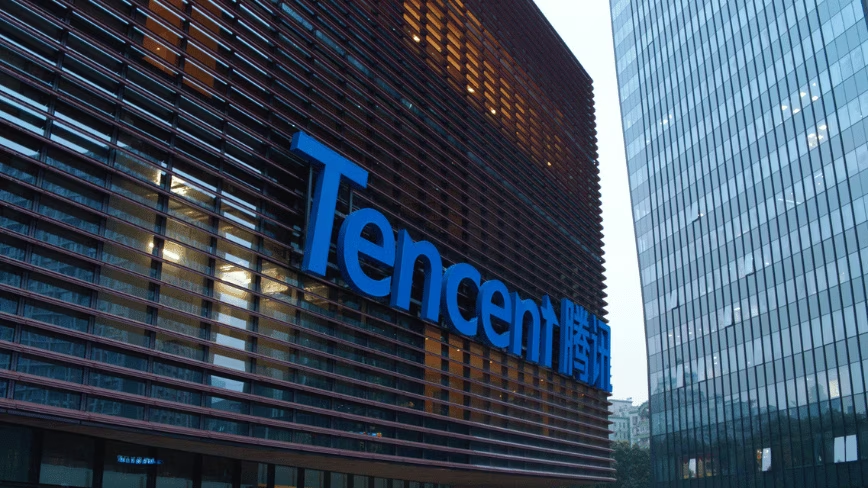
Enflame Technology, an AI chipmaker supported by Tencent, saw its shares close 179% above the IPO price on the first day of trading on Shanghai’s Star Market. The company raised approximately 6.12 billion yuan ($911 million) during its initial public offering. Shares opened at 410 yuan, significantly higher than the initial offering price of 142.18 yuan.
In August, 29 companies joined The Crunchbase Unicorn Board, collectively adding approximately $63 billion in valuation. Remarkably, over a third are startups under three years old, highlighting rapid growth in the tech space. Leading the newcomers are China's XPeng Robotics, valued at $6.3 billion, California's Lumilens at $5.5 billion, and AI platform River AI alongside semiconductor startup Source Foundry, each valued at $5 billion. AI software dominates the new entries across various applications including model training, assistants, and enterprise automation, while semiconductors rank second with five new unicorns. The U.S. contributed the most new unicorns (16), followed by China with four. This surge illustrates a dynamic landscape where sectors like robotics, financial services, data centers, security, and energy are also gaining momentum. Notably, nine companies exited the Unicorn Board through public offerings or acquisitions, reflecting a healthy ecosystem of growth and maturation.

Ant International, Mastercard, and Visa have joined forces to develop a unified Know-Your-Agent framework aimed at verifying the identity of AI agents making purchases on behalf of users. Announced on Thursday in Singapore, this initiative seeks to provide card networks and digital wallets with a standardized approach to ensure security and trust in AI-driven transactions. The collaboration was also covered by Reuters and CNBC.

BNP Paribas predicts that the prolonged upswing in corporate bond markets is nearing its end as major tech firms, known as hyperscalers, prepare to flood the market with approximately $400 billion in bond sales next year. This surge contributes to a record $3.7 trillion in net fixed income supply. The European Central Bank has observed a similar pattern, noting that US tech companies now represent nearly 10% of new euro-denominated bond issuances.
