



The Double-Edged Sword of Using AI at Work: Risking Raises and Promotions
Employees are being urged by managers to use AI in their work, but reliance on AI might harm their career advancement opportunities, such as raises and promotions, because it could overshadow their personal input.


Majority of Companies Using AI Report Disappointing Outcomes Despite Increased Adoption
Despite a significant increase in AI adoption across companies, new data reveals that the majority are struggling to achieve the anticipated benefits. The proliferation of AI tools has not resolved underlying issues, leaving many organizations facing the same problems.


Jamie Dimon Reveals JPMorgan Has Reduced Up to 40% of Jobs in Some Areas Due to AI
JPMorgan CEO Jamie Dimon disclosed significant job cuts—between 30% and 40%—in some departments driven by AI productivity gains. Most displaced employees have been offered new roles within the company, alongside efforts to retrain staff. The move marks a subtle shift in Dimon's earlier views on AI's impact, aligning with a broader debate about AI's actual effect on employment in tech and finance sectors.

Microsoft's Emissions Spike 25% in 2025, Expected to Climb Further with AI Expansion
Microsoft's emissions grew 25% in 2025 due to increased AI data center activity and reliance on fossil fuels. Despite aiming for carbon negativity by 2030, upcoming gas power projects may double its emissions. Critics highlight contradictions in the company’s sustainability efforts, including a new fossil fuel deal. Rising emissions are a broader tech industry issue, with companies like Google and Amazon also reporting increases linked to AI infrastructure expansion.

PepsiCo's Digital Twin Innovation: Revolutionizing Factory Efficiency
PepsiCo is transforming factory operations with digital twins—precise 3D models powered by AI—that simulate and optimize manufacturing processes. This approach boosts productivity, anticipates bottlenecks, and enhances agility, enabling global scaling through partnerships with Siemens and Nvidia. Digital twins also help PepsiCo quickly adapt to changing consumer demands and evolving supply chain challenges, positioning them for future success in a dynamic market.


1Password Introduces AI Spend Management to Tackle Growing Token Cost Challenges in Enterprises
1Password has launched a new AI Spend and Consumption Management tool within its SaaS Manager to help enterprises monitor and control AI token usage and costs from vendors like OpenAI and Anthropic. This addresses the complexity of AI pricing models and aims to prevent budget overruns by providing detailed spending insights and alerts. The tool builds on 1Password's shift from consumer password management to enterprise SaaS governance, recognizing the growing challenge AI token costs pose to traditional budgets. Public preview is available now, with full release planned for fall 2026.


Albanese to Accelerate Datacentre Approvals to Boost AI Investment in Australia
Australian Prime Minister Anthony Albanese promises quicker approvals for AI projects like datacentres, alongside creating a new office to oversee AI's economic, social, security, and environmental impacts, positioning Australia as a global leader in AI governance.

New York Enacts Historic Halt on Hyperscale Data Center Approvals
New York has introduced a groundbreaking one-year pause on permits for hyperscale data centers to address environmental and resource concerns. Governor Kathy Hochul’s executive order targets large facilities using 50 megawatts or more, commonly built by big tech companies for AI infrastructure. The pause allows time to develop uniform environmental standards amid rising community opposition and political debates ahead of Hochul’s reelection.


IBM Shares Drop Sharply as Q2 Revenue Misses Expectations Despite Strong AI Sales
IBM reported a preliminary Q2 revenue of about $17 billion, slightly up year-over-year but below the expected $18 billion. Despite strong AI-related bookings, the revenue miss caused shares to plunge up to 17%, reversing weeks of positive momentum driven by analyst optimism and a stock rally.


The Ethical Dilemma of AI in User-Aligned Technologies
This piece examines the potential consequences of fully user-aligned AI technologies, focusing on the ethical challenges and societal impact of such powerful systems operating without oversight.

Intel Invests €5 Billion to Expand AI and HPC Chip Production in Ireland
Intel is committing a significant investment of 5 billion euros to expand its semiconductor manufacturing capabilities in Ireland, focusing on AI and high-performance computing processors. This strategic move represents a major part of Intel's 2026 budget and brings one of the few EUV fabs to Europe, underlining the continent's growing role in advanced chip production.
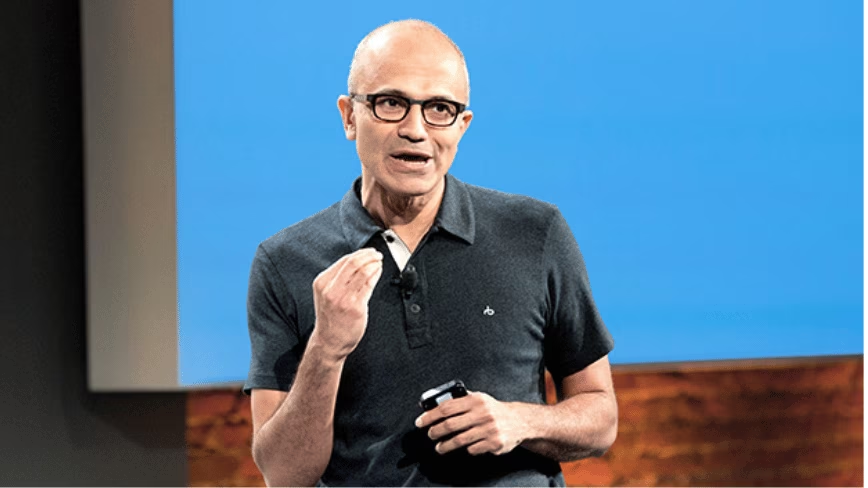
Satya Nadella Highlights the Hidden Costs of AI Adoption
Satya Nadella, Microsoft’s CEO, cautions businesses that adopting AI involves paying twice: not just financially but also by surrendering critical data, a concept he calls the Reverse Information Paradox. Microsoft’s involvement in developing AI technologies means it helped shape this complex landscape.

AI's Impact on Older Workers: Well-Paid Employees Feeling the Pressure First
AI is not only affecting new graduates but also significantly impacting older workers, particularly those over 55 in AI-driven roles. Research indicates a rise in early workforce exits among these employees since the introduction of tools like ChatGPT, signaling a shift in job security for seasoned professionals in well-paid positions.

Bots Now Dominate the Web: How Cloudflare is Enhancing Cybersecurity
Bots now account for the majority of internet traffic, surpassing human users. Cloudflare’s new tool, Precursor, improves security by observing how visitors act after they enter a site, rather than only checking their credentials beforehand. This strategy aims to better handle the surge in automated web requests.

ACRouter Revolutionizes AI Model Selection, Cutting Costs by Over 2.6x Compared to Opus-Only Approaches
ACRouter introduces a dynamic AI model routing system that learns from real-time feedback to optimize task assignment, outperforming static methods and reducing costs by 2.6 times compared to Opus-only models. This open-source framework adapts to changing tasks and models, making it ideal for verifiable AI workflows like coding while improving enterprise AI efficiency and cost-effectiveness.

Slopsquatting: The New AI-Driven Software Supply Chain Threat
Slopsquatting is a rising supply chain threat caused by AI hallucinations in coding tools, where fake software packages masquerade as legitimate ones, enabling malware injection. As AI-assisted development grows, verifying packages and enhancing security checks is crucial to protect codebases.


The Role of Generative AI in Enhancing Customer Insights Management: Opportunities and Limitations
Generative AI is transforming how companies manage and analyze customer insights by combining internal data with large language models for better accessibility and understanding. Leading firms like Procter & Gamble and Novartis showcase AI’s role in streamlining insight retrieval and qualitative analysis, yet AI alone cannot overcome challenges such as cultural resistance, inconsistent data standards, and strategic integration. Success requires blending AI with human expertise and a strong organizational commitment to leveraging customer knowledge effectively.


Third-Party Generative AI Tools Outpace Brand Chatbots in Customer Service
The past year has seen a doubling in the use of third-party generative AI tools for customer service, while brand-specific chatbots provided by companies have not shown measurable increase since 2022, highlighting a shift towards more effective AI solutions in customer interactions.

Inside China’s Bold AI Revolution: From AI Doctors to Drone Deliveries
Amy Hawkins discusses China's extensive adoption of AI technologies, including medical AI, factory robots, delivery drones, and the use of AI for increased state surveillance, highlighting a strong contrast to Western scepticism.

Zhipu founder champions open access to frontier AI despite government reservations
Tang Jie, founder of Zhipu, argues for open access to frontier AI to promote safety via widespread participation and oversight, challenging his government’s more restrictive stance. His call for transparency in AI aims to prevent control by a select few and encourages collective innovation.