


Tencent-Backed AI Chipmaker Enflame Surges Nearly 180% in Shanghai Market Debut
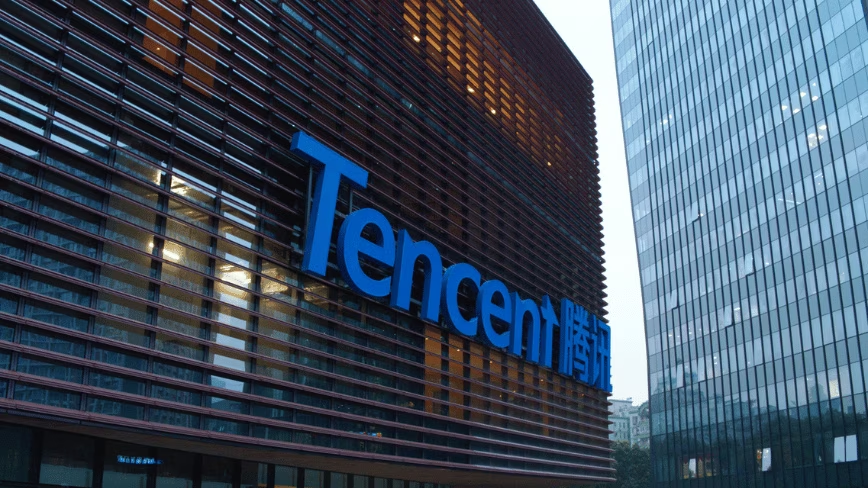
Tencent-backed AI chipmaker Enflame Technology experienced a remarkable surge in its Shanghai stock market debut, with shares closing 179% above the IPO price. The company successfully raised around $911 million, reflecting strong investor confidence in its potential within the AI sector.


Research Shows Majority of AI Job Listings Demand Skills Beyond Job Titles
A study by Andela of over 47,000 technical job ads from major companies uncovers that more than half of AI positions require skills not explicitly mentioned in the job titles, highlighting a shift in hiring practices within the AI sector.


Why Most AI Implementations Fail: It's Not About Training
Many AI initiatives stumble not due to technical training issues, but because companies lack the cultural foundation that encourages employee experimentation, adaptability, and risk-taking, which are crucial for AI to drive real performance improvements.


AI is Transforming Work Dynamics, Not Just Replacing Jobs
AI is not merely replacing jobs; it is fundamentally restructuring work by breaking down traditional roles into tasks and capabilities. This shift challenges organizations to find new ways to develop expertise, especially as AI takes over repetitive entry-level tasks. Successful workforce strategies will focus on capability ecosystems, strategic use of workforce data, and intentional work redesign that balances AI efficiency with human creativity and judgment.


Google Finalizes $1.5 Billion Acquisition of AI Startup Mechanize
Google has completed its acquisition of the AI startup Mechanize for more than $1.5 billion, integrating the company's cofounder and over a dozen staff into its DeepMind team to strengthen its AI capabilities.

AI in Supply Chain Security: Battling Cyber Threats with Smart Technology
The cyberattacks experienced by Uber Freight, Ceva Logistics, and Fairlife underscore the dual role of AI in supply chains: it is used both by attackers to launch sophisticated threats and by defenders to protect and secure operations. This dynamic demonstrates how essential AI has become in managing supply chain risks in today's digital age.


29 New Unicorns Join in August, Led by AI Software and Semiconductor Innovations
In August, 29 startups joined the Crunchbase Unicorn Board, adding $63 billion in value. Notable leaders include XPeng Robotics and Lumilens. AI software and semiconductors dominate the sectors, with rapid entry of young companies mainly from the U.S. and China, signaling fast-paced innovation and growth in tech-driven industries.


Bending Spoons Acquires Miro at a Steep Discount, Valued at $1.36 Billion
Bending Spoons is purchasing Miro for $1.36 billion, a drastic decrease from its $17.5 billion valuation in 2021, highlighting a significant market adjustment for the collaboration tools company.

IDScan Reports Major Data Breach Exposing Over 150 Million Driver's Licenses
IDScan, an identity verification firm, suffered a major breach exposing personal information of over 150 million individuals. The leaked data includes full names, driver's licenses, and other government-issued IDs, raising serious privacy and security concerns.

Anthropic Reveals How Claude AI Was Exploited for Surveillance and Weaponization
Anthropic has exposed various attempts to misuse its Claude AI model for malicious activities such as cyberattacks, state surveillance, and weapons-related research. The company successfully detected and stopped these operations, emphasizing the need for robust security measures in AI deployment. Their detailed threat intelligence report sheds light on the risks and counteractions associated with AI misuse.

TAR Secures $120M in Series A at $1 Billion Valuation to Power AI Data Centers Off-Grid
TAR raised $120 million in Series A funding led by Spark Capital, achieving a $1 billion valuation. The Austin-based company focuses on off-grid power systems for AI data centers, with investment from previous backers and connections to AI ventures like Anthropic.

Spain Grants First National Permit for Level 4 Autonomous Vehicles to WeRide and Uber
WeRide, Uber, and AVOMO received Spain's inaugural national permit for Level 4 autonomous vehicles, authorized by the Directorate General of Traffic under the ES-AV framework. This approval allows them to operate self-driving passenger cars on public roads, advancing autonomous vehicle technology in Spain.

Visa, Mastercard, and Ant International Collaborate on AI Agent Identity Verification
Visa, Mastercard, and Ant International collaborate on a Know-Your-Agent framework to verify AI agents making purchases for users, enhancing security for card networks and digital wallets. This new initiative aims to standardize identity checks for AI-driven transactions, announced recently in Singapore and covered by major news outlets.

BNP Paribas Warns AI-Driven Bond Issuances Could Signal End of Credit Market Rally
BNP Paribas forecasts a slowdown in the corporate bond rally due to a substantial increase in bond offerings from major tech firms, potentially signaling a market shift. The European Central Bank backs this view, highlighting the growing influence of US tech in European bond markets.

AI Experts Warn: Businesses Rushing AI Adoption Without Proper Risk Controls
Steven Mills of Boston Consulting Group warns that companies deploying AI agents often overlook proper risk management, which could lead to serious regulatory and operational problems. Rapid AI scaling pressures executives to accelerate without sufficient controls, risking costly failures. Past incidents demonstrate the critical need for governance, human oversight, and accountable leadership in AI projects.


Google Escapes Another Breakup, Faces Crucial Test with Ad Tech Solutions
Google has avoided another breakup following a lengthy antitrust trial. The focus now shifts to the upcoming changes in Google's GAM over the next month, testing the effectiveness of new ad tech remedies.

Sam Altman Proposes OpenAI Cybersecurity Services to Power Utilities Amid Cyberattack Reports
Sam Altman met with top power utilities to discuss securing the electrical grid, proposing OpenAI’s cybersecurity services as a solution amidst reports of OpenAI’s products linked to a large-scale cyberattack.

Meta Reinstates Management Roles for Some Applied AI Employees in Latest Restructuring
Meta is reversing its flattened team approach by asking certain Applied AI employees to return to managerial roles, highlighting a strategic shift in its organizational structure.

Nvidia's Jensen Huang Highlights AI as a Game-Changer for Cybersecurity
Nvidia CEO Jensen Huang envisions AI as a transformative force in cybersecurity, with strategic alliances formed between Nvidia and major players CrowdStrike, Cisco, and Palantir to leverage AI-driven security solutions.

OpenAI Expands ChatGPT with Enhanced Financial Services Features
OpenAI has launched an upgraded version of ChatGPT tailored for the financial industry, featuring expanded data inputs and enhanced accuracy measures, signaling a stronger commitment to financial applications.