


How Companies Keep Repeating Mistakes — And How to Change That
Organizations often struggle not because they fail to learn lessons, but because they do not effectively transfer and apply those lessons. This results in repeating mistakes and unnecessary costs. Successfully sharing and integrating knowledge is crucial for better decision-making and operational efficiency.


CMOs Focus More on Organizational Influence Than Long-Term Brand Success
A Lippincott study highlights that CMOs often prioritize organizational influence over long-term brand growth. Marketers are encouraged to change internal company dynamics to refocus on enduring brand success instead of short-term gains.


Apple’s Design Team Faces Major Turnover, Incoming CEO John Ternus Aims to Revitalize It
Apple’s industrial design studio has experienced heavy staff losses and diminished influence, particularly among Jony Ive-era designers. The team currently lacks executive presence and credibility, becoming more of a supportive unit. Incoming CEO John Ternus plans to rejuvenate the studio and bring back its strategic role within the company.
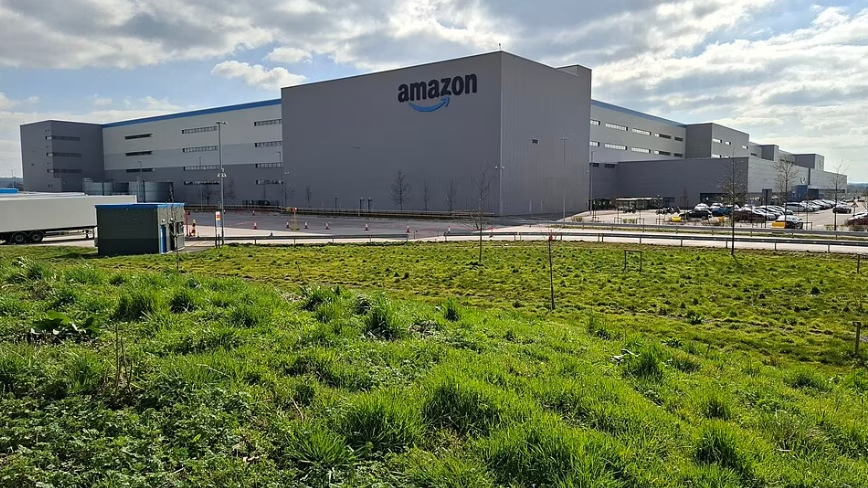
Amazon Challenges the Effectiveness of Human-in-the-Loop AI Oversight
Amazon's security leader Eric Brandwine argues that human-in-the-loop AI oversight is flawed because humans often lose attention and act inconsistently, questioning its status as the gold standard in AI governance.


Why Top Leaders Are Taking Their Time With AI-Driven Decisions
While AI provides rapid data processing, the most effective leaders understand the value of slowing down to make well-considered decisions, balancing speed with thoughtful judgment.


Young Employees as Crucial AI Mentors in the Workplace
Young employees today are essential AI mentors, bringing vital digital and business insights to senior leaders. Organizations thrive by adopting structured reverse mentoring programs that foster knowledge sharing across all levels, enhancing leadership and innovation.

John Jumper, Nobel Prize-Winning Scientist, Departs Google DeepMind for Anthropic
John Jumper, honored with the 2024 Nobel Prize in Chemistry for developing AlphaFold, is moving from Google DeepMind to Anthropic after nearly nine years. He will take some time off before starting his new role at the AI firm behind Claude.

Why New CEOs Must Hit the Ground Running in Today's Fast-Paced World
New CEOs no longer get a grace period to adapt; boards expect decisive leadership from day one. Especially in education and edtech, AI integration demands leaders be deeply prepared before starting. Success hinges on pre-arrival orientation, quick cultural understanding, and immediate action. The modern CEO must hit the ground running with clear goals and full awareness of organizational realities to earn trust and lead effectively.


L’Oréal Boosts AI-Powered Content Creation with New OpenAI Partnership
L’Oréal is advancing its AI content capabilities through a new partnership with OpenAI. Under the leadership of CMO Asmita Dubey, the beauty brand aims to stay competitive by leveraging AI to produce creative content efficiently in an age dominated by zero-click search and fast-paced digital innovation.


Roelof Botha Joins SpaceX's Board Following Company's Historic IPO
Roelof Botha, previously leading Sequoia Capital, has joined SpaceX’s board of directors, filling a vacancy just days after the company achieved the largest IPO ever, marking a significant step in SpaceX's governance and strategic leadership.

World Leaders Fear U.S. Could Cut Off Access to American AI Technology
During the G7 summit, leaders including Macron and Modi voiced worries that the U.S. could abruptly restrict access to American AI, a concern underscored by a recent blackout at Anthropic, demonstrating the vulnerability of reliance on American AI technology.
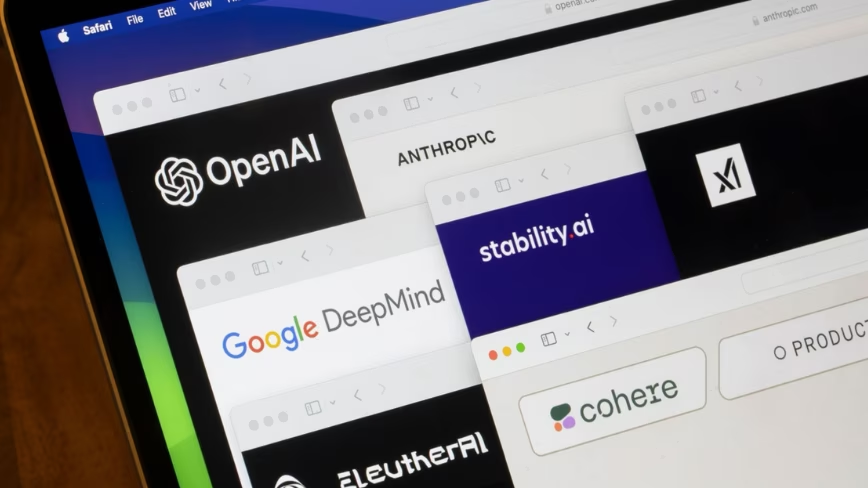
Anthropic and Google DeepMind Propose US-Led AI Alliance at G7; Canada Backs the Initiative
Anthropic and Google DeepMind leaders have called for a US-led coalition at the G7 to set international AI rules and standards, with Canada supporting the initiative. This move aims to foster global cooperation on AI governance.

How AI is Shaping the Future of Leadership: Revealing Strengths and Weaknesses
AI is transforming leadership evaluation by highlighting effective leaders and exposing weaknesses. Companies that succeed are those who embrace AI not just as technology, but as a leadership challenge essential for progress and innovation.

How AI Can Prevent Future Financial Crises Before They Begin
Financial crises often emerge from overlooked warning signs hidden in massive data. AI can integrate and analyze diverse financial data in real time, detecting risks faster than traditional methods. By equipping regulators and institutions with early, actionable insights, AI helps prevent crises before they escalate, making the financial system safer and more resilient without replacing human judgment.

Nvidia CEO Jensen Huang on AI’s Promising Future and Its Societal Impact
Nvidia CEO Jensen Huang outlines AI's transformative potential and stresses society’s need to embrace the technology responsibly. He calls for balanced regulation focused on national security, highlights energy challenges in the U.S., and underscores AI’s role in economic growth and job creation. Despite political scrutiny, Huang remains optimistic about AI’s future and encourages widespread engagement with the technology.

G7 Summit Concludes with AI Talks Featuring OpenAI and Anthropic Leaders
The G7 summit concluded in the French Alps with significant discussions on AI involving OpenAI and Anthropic CEOs alongside world leaders. The meeting also addressed global conflicts and economic growth, highlighting collaboration between major industrial nations and guest countries.

OpenAI Strengthens Team with Key Hires Ahead of IPO
OpenAI is boosting its leadership with strategic hires like Noam Shazeer and Dean Ball as it gears up for its IPO, signaling a strong focus on innovation and policy expertise.


Scaling AI Expertise: Insights from Bank of America's Bernard Hampton
Bernard Hampton of Bank of America reveals how the institution upskills 200,000+ employees for an AI future, balancing technical prowess with critical human skills like empathy and judgment. Through a three-level AI adoption strategy and AI-driven simulations, the Academy enhances workforce agility and client service. The approach emphasizes internal talent growth, measured AI use, and ongoing learning to adapt in a fast-changing environment.

Mark Carney Draws Parallels Between Anthropic Shutdown and 2008 Financial Crisis, Cautions on AI Model Risks
Mark Carney warned that the US export ban causing Anthropic to stop key AI projects exposes the risks of relying heavily on a few dominant AI models, drawing a comparison to the systemic dangers seen in the 2008 financial crisis.

IQM Strengthens Board with Vanguard Director Ahead of Europe's First Quantum Nasdaq Debut
IQM Quantum Computers, a Finnish firm specializing in superconducting quantum systems, has appointed Barbara Venneman from Vanguard to its board. This move comes as IQM prepares to become the first European quantum computing company to list on Nasdaq, marking a significant advancement in the quantum tech industry.